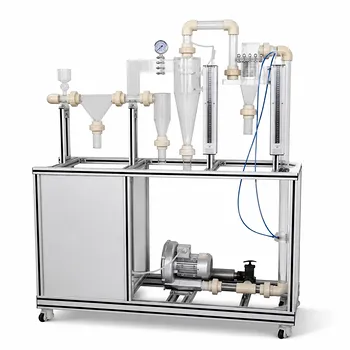
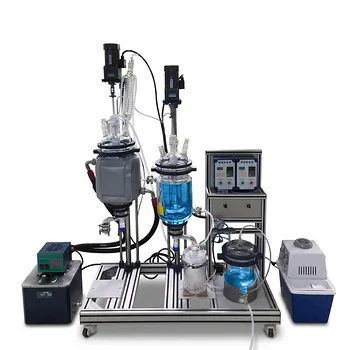
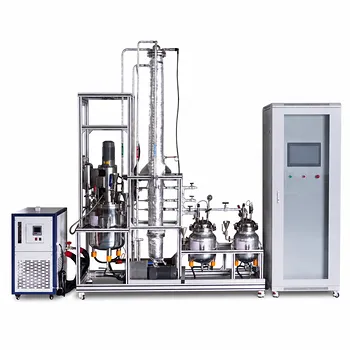
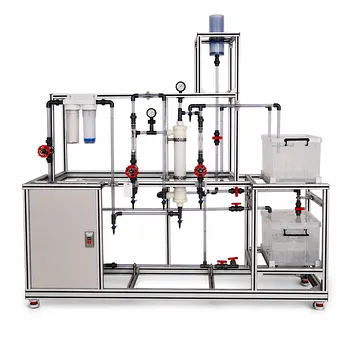
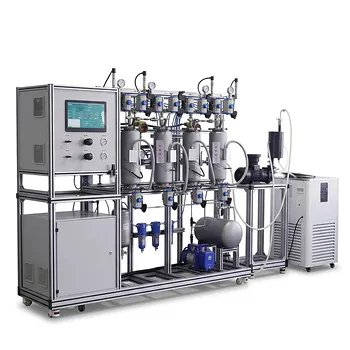
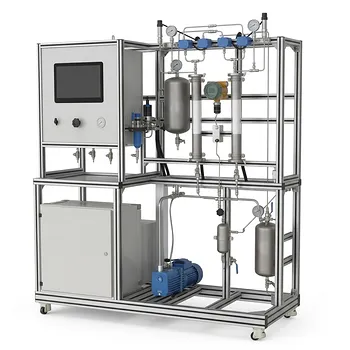
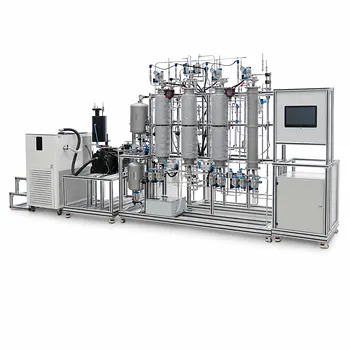
The first simulation run on a pilot plant often fails not because of a bad design, but because of a flawed assumption buried deep in the thermodynamic model. Evaluating multiple thermodynamic correlations, including the Soave-Redlich-Kwong (SRK) equation, is vital because a single equation of state is only a mathematical approximation that performs well in specific regions of temperature and pressure but can introduce catastrophic errors outside that calibrated window. This evaluation is the essential verification step that ensures a process simulator’s mathematical world accurately reflects the physical behavior of your pilot plant’s distillation columns and separators.
Pilot plants exist to de-risk reality. Relying on a single thermodynamic model, like SRK, without testing it against alternatives or empirical data defeats that purpose. The core need is not to find a "perfect" equation, but to expose the regional limitations of each model before those limitations cause operational failure or an invalid design.
The Foundational Question: Can You Trust the Model?
The surface need is selecting an equation. The deep need is understanding why a model that works perfectly for a textbook problem can fail completely in a real-world pilot plant. The answer lies in the mathematical genesis and inherent simplifications of these models.
The Trap of the Regional Approximation
Cubic equations of state like SRK and Peng-Robinson (PR) are widely used for their balance of simplicity and computational speed. However, they are not universal laws. They are crafted to match specific experimental data sets. A correlation that accurately predicts vapor-liquid equilibria (VLE) for a light hydrocarbon mix might drastically overestimate liquid molal volumes near the critical point, as SRK does. If you only use SRK, you accept its mathematical blind spots as physical truth, unknowingly baking a significant density error into your column sizing and pump calculations.
The Compounding Error Problem in Estimation
In a research setting, you often lack perfect experimental data and must use estimation methods like the Group Contribution Method for heat capacity or the Lydersen method for critical properties. These mathematical estimations introduce inherent uncertainties at every calculation stage. If you feed these already-approximate values into a single, unverified equation of state, the errors don't just add up—they multiply. The result is a simulation output suitable only for a rough preliminary design, not for validating a physical pilot plant.
The Azeotrope Litmus Test
Evaluating multiple models becomes non-negotiable when dealing with complex, non-ideal mixtures that exhibit azeotropy. For a system like carbon dioxide and hydrocarbons, the model must predict not just normal VLE but the very existence and predicted disappearance of an azeotrope in the presence of an entrainer. An equation of state that works for a simple binary system has no guarantee of modeling this complex, economically critical behavior. Comparing SRK’s prediction against PR or even more complex models against your column’s actual tray performance data reveals whether the simulator truly "understands" the physics happening inside the glass.
The Inherent Trade-off: Simplicity vs. Accuracy
Choosing a thermodynamic model is a deliberate act of compromise. Understanding what you are sacrificing with a simple model is the essence of technical expertise.
The Practical Appeal of Speed
Cubic equations, requiring only critical properties and an acentric factor, are incredibly practical. For multi-component flowsheeting or real-time modeling in a lab, this speed is essential. The deep risk is allowing this ease-of-use to become intellectual laziness, accepting a fast answer as a correct one without testing the alternative.
The Cost of Simplicity is Precision
A direct comparison between SRK and PR reveals this trade-off clearly. SRK uses a higher critical compressibility factor (0.333 vs. 0.307 for PR). This seemingly minor parameter difference leads to PR offering a 40% improvement in Root Mean Square (RMS) relative error for vapor pressure predictions and a 2 to 4 times improvement in liquid density predictions. For a pilot plant demethanizer, an error in vapor pressure prediction from SRK directly translates to an incorrect reflux ratio and a failed separation in the physical column.
From Equations to Pilot Plant Operations
The consequences of a single-model approach cascade from the simulator screen directly onto the pilot plant floor.
The Unbreakable Link Between VLE and Enthalpy
Accurate phase equilibria calculation is the non-negotiable foundation for a reliable energy balance. In two-phase systems, the vapor-liquid split directly dictates the stream enthalpy. If your chosen EOS inaccurately calculates the phase composition, your calculated condenser duty and reboiler steam requirement will be wrong. You cannot troubleshoot a pilot plant’s thermal performance if your baseline simulation’s energy balance is built on a flawed VLE prediction.
When a Density Error Destroys Hydraulics
SRK’s known weakness in predicting liquid density has a direct mechanical consequence. If the simulation underestimates the liquid density in a packed column, it will also underestimate the pressure drop. You might design a column that floods prematurely in real-world operation. Evaluating a second model, like PR, which corrects this specific SRK deficiency, is the only way to catch this hydraulic design error before you commission the pilot plant and see the differential pressure gauge spike unexpectedly.
Making a Reliable Model Selection for Your Project
Your evaluation should be a systematic process of validation, not a search for a theoretical "best" model.
- If your primary focus is mastering pilot plant operation: Understand that the simulator is a tool with fallible defaults. Your key action should be to deliberately switch between SRK and PR for a single unit operation to see how the tray temperatures and flow rates physically shift.
- If your primary focus is rigorous research or pre-commercial design: You must run a physical experiment to generate empirical data. Use this data as the ultimate arbiter to calibrate the model parameters and definitively identify which correlation has the highest accuracy in your specific operating region.
- If your primary focus is designing a new separation for complex, polar, or azeotropic mixtures: Do not limit your evaluation to just SRK and PR. The failure of these simple cubic models against your pilot plant data will be the justification you need to adopt a more complex activity coefficient model or a modern equation of state.
A pilot plant is your last and best chance to let reality correct your model, not the other way around.
Summary Table:
| Parameter / Feature | Soave-Redlich-Kwong (SRK) | Peng-Robinson (PR) |
|---|---|---|
| Critical Compressibility ($Z_c$) | 0.333 | 0.307 |
| Vapor Pressure Prediction | Higher RMS relative error | ~40% lower RMS relative error |
| Liquid Density Accuracy | Lower accuracy (2-4x higher error) | Higher accuracy |
| Best Application | Light hydrocarbon VLE systems | Near-critical & liquid density systems |
Bridge the Gap Between Simulation and Reality with LABPARK
Don't let thermodynamic simulation errors compromise your physical pilot plant's performance. LABPARK provides high-quality Educational and Vocational Unit Operations Pilot Plants in chemical engineering, bioprocess & biotech, and environmental & water treatment for universities, research institutes, and enterprises.
By matching advanced simulation with our reliable, industry-grade hardware, you can accurately validate your thermodynamic models and de-risk your processes. Contact us today to find the perfect pilot plant for your facility!
Related Products
- Gas-Solid Heterogeneous Separation Demonstration Educational Unit Operations Pilot Plant
- Multi-Functional Membrane Separation Educational Pilot Plant for Unit Operations Lab
- Natural Product Extraction Unit Operations Training Pilot Plant
- Potassium Salt Thermal Dissolution and Crystallization Separation Educational Unit Operations Pilot Plant
- Bench Scale Dual Column Gas Separation and Capture Educational Pilot Plant
People Also Ask
- Why is pressure drop characterization critical in separation pilot plants? Key operational insights.
- What are the key thermodynamic considerations for gas mixture modeling? Expert Guide
- What are the primary operational objectives and physical requirements when running heterogeneous separation pilot plants?
- What are the trade-offs in olefin-paraffin separation? Optimize Pilot Plant Performance
- What are the material limitations of gas separation pilot plants? Key factors to consider.