Simulation software paints a perfect picture—but perfection doesn’t exist inside a real distillation column.
Validation in a physical pilot plant is critical because simulation tools and heuristic rules are built on idealized assumptions that cannot predict the full complexity of real fluid behavior. Only a pilot plant can reveal unexpected azeotropes, heat loss, actual tray efficiency, and thermal degradation risks, providing the empirical data you need to size columns correctly and operate safely.
Pilot plants bridge the gap between theoretical design and operational reality. They expose thermodynamic surprises and physical constraints that heuristics and simulations miss—making them the only way to generate trustworthy data for scaling up a separation sequence without catastrophic consequences.
The Limits of Heuristics and Digital Twins
Heuristics Give You a Starting Point, Not a Guarantee
Shortcut rules like the Fenske-Underwood-Gilliland method quickly estimate minimum reflux, stages, and feed location.
But these correlations assume constant relative volatility and ideal phase behavior—conditions that rarely hold in multicomponent, polar, or close-boiling systems.
Relying on heuristics alone can leave you blind to non-ideal vapor-liquid equilibria that fundamentally change the separation sequence.
Simulations Are Only as Good as Their Assumptions
Commercial software uses mathematical models and thermodynamic property packages to calculate theoretical stages and temperature profiles.
Yet the models behind those calculations are built from correlated data and simplifications that cannot capture every real interaction.
For example, a process simulator may miss the formation of a pressure-sensitive azeotrope that appears only at a specific operating pressure—a quirk that can render your designed column useless.
The Irreplaceable Role of the Pilot Plant
Uncovering Hidden Thermodynamic Behavior
Running a physical distillation column with your actual feed mixture lets you observe real vapor-liquid equilibria directly.
You can analyze stage-by-stage compositions and immediately detect whether the system forms an azeotrope the software did not predict.
This hands-on validation prevents you from scaling up a separation sequence that would never reach target purity in production.
Measuring Actual Efficiency and Heat Loss
A simulation assumes each tray achieves an ideal efficiency of 100% unless you manually input an assumed efficiency value—often a guess.
The pilot plant lets you measure true Murphree tray efficiency, which can drop significantly due to foaming, weeping, or entrainment.
It also reveals heat loss from the column walls and the resulting deviation in temperature profiles, giving you real data to correct your model and size equipment correctly.
Managing Temperature-Sensitive Constraints
Many valuable products—like monomers—can polymerize or degrade if column temperatures exceed a critical limit.
Simulations may not flag the need for vacuum operation if the thermal degradation kinetics aren’t perfectly modeled.
A pilot plant allows you to physically test reduced-pressure distillation and monitor thermal stability, ensuring you can achieve separation without destroying your product.
Understanding the Trade-offs
When a Pilot Plant Just Isn’t Practical
Pilot plants require significant time, capital, and feedstock.
For a mature, thoroughly mapped system like ethanol-water, a full pilot campaign is often overkill—existing industrial data and well-tuned simulations suffice.
But for any process with new chemistry, trace impurities, or tight purity specs, skipping the pilot stage is a gamble that can cost millions in downtime and rework.
The Risk of Over-Relying on Simulations
Overconfidence in digital twins can lead you to accept an unvalidated design as final.
Simulations might converge mathematically but still produce column internals that flood, foul, or fail mechanically under real hydraulics.
The pilot plant catches these mismatches early, converting a theoretical “perfect” design into a physically operable one.
How to Decide if Pilot Testing Is Right for Your Sequence
Which path you take depends on your risk tolerance and what you already know about the system.
- If your primary focus is a novel chemical mixture with unknown VLE: Validate the entire sequence physically. A pilot plant is the only way to map real phase behavior and prevent an undetected azeotrope from blocking your separation.
- If your primary focus is extremely high product purity and safety margins: Use the pilot plant to measure actual tray efficiency, heat loss, and degradation thresholds. These empirical correction factors turn an approximate simulation into a reliable, safe design.
- If your primary focus is a well-characterized, low-risk separation with abundant industrial data: You can lean more heavily on simulation and heuristics, but always cross-check predicted temperature profiles and product specs against a set of small-scale batch distillation experiments to confirm the model’s mid-point.
- If your primary focus is education or building engineering intuition: Running a physical pilot plant alongside a simulation teaches the tangible mismatch between theory and reality—a lesson no simulation can deliver on its own.
Physical validation is what turns a promising simulation into a robust, trustworthy process—and that is the only path to a safe, on-spec, and reliably scalable separation.
Summary Table:
| Feature / Metric | Simulation & Heuristics | Physical Pilot Plants |
|---|---|---|
| Vapor-Liquid Equilibrium (VLE) | Ideal/calculated assumptions | Reveals actual phase behavior & unexpected azeotropes |
| Column Tray Efficiency | Theoretical 100% or manual estimates | Measures true Murphree efficiency & hydraulic limits |
| Heat Loss & Temp Profiles | Assumed adiabatic / simplified models | Captures real column wall heat loss & temperature drops |
| Thermal Stability | Depends on accurate kinetic models | Directly tests vacuum distillation & product degradation |
| Scale-Up Risk | High (potential column flooding/fouling) | Low (physically validated operating window) |
Bridge the Gap Between Process Theory and Operational Reality with LABPARK
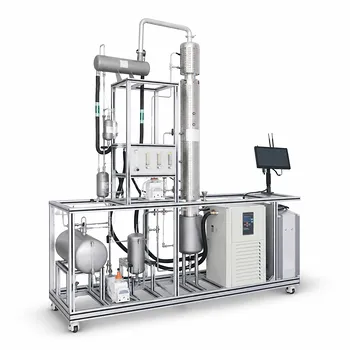
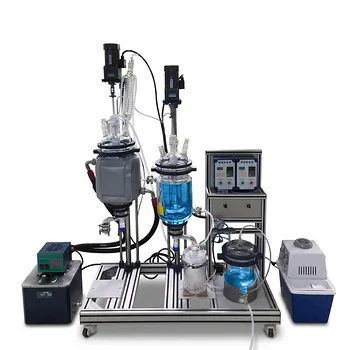
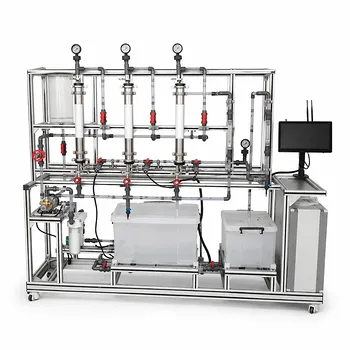
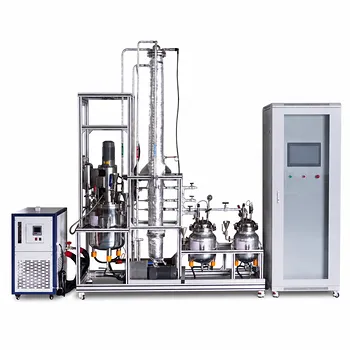
Don't let simulation assumptions compromise your process scale-up. LABPARK provides premium Educational and Vocational Unit Operations Pilot Plants in chemical engineering, bioprocess & biotech, and environmental & water treatment.
Tailored for universities, research institutes, and enterprises, our pilot plants deliver the reliable, hands-on empirical data you need to validate thermodynamic models, evaluate real column hydraulics, and eliminate scale-up risks.
Ready to elevate your engineering research and training capabilities? Contact us today to explore our pilot plant systems!
Related Products
- Continuous Sieve-Plate Distillation Pilot Plant for Unit Operations Laboratory Education
- Multi-Functional Special Distillation Educational Pilot Plant
- Electrolyte Distillation Purification and Formulation Educational Pilot Plant
- Multi-Modal Distillation Unit Operations Training Pilot Plant
- Continuous Batch Extractive Distillation Educational Pilot Plant
People Also Ask
- How can real-time carbon number prediction improve distillation pilot plants? Optimize control.
- How does catalyst water concentration affect distillation pilot plant design? Key separation train choices.
- Why is vacuum operation capability an essential feature for a distillation unit operations pilot plant? Unlock Efficiency
- How to select the right activity coefficient model (Wilson, NRTL, UNIQUAC) for distillation pilot plants?
- What are the primary reflux ratio control strategies? Master Distillation Unit Operations