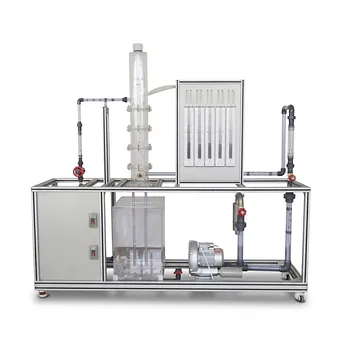
Fixing the reactor-inlet flow rate is critical because it stabilizes both residence time and heat generation inside the PFR. In an exothermic reactor with recycle, a changing inlet flow rate changes the space velocity, reactant loading, residence time, and axial temperature profile at the same time. Those coupled changes can push the system toward a low-conversion steady state, ignition, or thermal runaway, while a fixed inlet flow provides a stable operating basis for temperature control, experimentation, and safe pilot-plant operation.
In a recycle PFR, inlet flow rate is more than a throughput setting: it is a key stability variable. Holding it constant reduces nonlinear interactions between flow, conversion, temperature, and recycle composition, making the reactor’s thermal and kinetic behavior predictable enough to control.
Why Flow Rate Controls Reactor Stability
Flow Rate Sets Space Velocity
Space velocity describes how quickly material passes through the reactor relative to the reactor volume. When the inlet flow rate increases, space velocity rises and residence time generally falls; when flow decreases, residence time increases.
That directly affects conversion. A lower flow rate can give the reactants more time to react, but in an exothermic system it can also allow more heat to accumulate and accelerate the reaction sharply.
Flow Rate Shapes the Axial Temperature Profile
In an adiabatic or weakly cooled PFR, reaction heat accumulates as material moves downstream. For an exothermic reaction, the temperature rises with conversion, and that temperature rise accelerates the reaction rate through the Arrhenius relationship.
The inlet flow rate determines how much reacting material and thermal capacity move through the reactor per unit time. If the flow changes, the balance between heat generation, heat transport, and heat removal changes along the reactor’s axial coordinate.
Flow Rate Influences Residence-Time Distribution
A PFR depends on a controlled progression of composition and temperature along its length. Flow disturbances change the time available for each fluid element to react and can shift where rapid heat release occurs.
In a recycle loop, the disturbance may return to the reactor inlet after circulating through downstream equipment. This can create repeated oscillations rather than a single transient, especially when recycle residence time and reactor residence time interact.
Why Recycle Makes Flow Control More Important
Recycle Couples Outlet Conditions to the Inlet
Recycle returns part of the reactor outlet to the feed. The recycle stream may contain unreacted reactants, products, catalyst, and substantial sensible heat, depending on the process configuration.
A change in total inlet flow therefore changes not only the fresh-feed rate but also the mixture entering the reactor. The reactor inlet temperature, concentration, and composition can all shift together.
Recycle Can Amplify Small Disturbances
Suppose a small flow decrease increases residence time and conversion. The resulting temperature rise can increase reaction rate and alter the outlet composition. When that altered outlet is recycled, it changes the next reactor inlet and can reinforce the original disturbance.
This feedback is analogous to adjusting both the speed and the fuel mixture of an engine at the same time: a small control change can produce a disproportionately large response.
Multiple Steady States Become Possible
Strong thermal feedback can produce multiple steady states for the same nominal operating conditions. One state may have relatively low conversion and modest temperature, while another may have high reaction rates and much higher temperature.
If the inlet flow is allowed to drift, the operating point can move between these states. Fixing the flow removes one major source of movement and makes the remaining thermal behavior easier to analyze and control.
How Fixed Flow Supports Thermal Control
It Establishes a Stable Heat-Capacity Flow
The flowing material carries heat through the reactor. Holding the inlet flow rate constant helps maintain a predictable thermal-capacity rate, which is the system’s ability to transport generated heat downstream.
This gives temperature controllers and operators a more reliable relationship between heat generation, heat removal, and fluid temperature.
It Makes Temperature Feedback More Predictable
A temperature controller performs best when the process gain and response time do not change dramatically. Flow changes alter both of those properties by changing residence time, reaction-zone location, and heat transport.
With fixed inlet flow, temperature feedback can respond to thermal disturbances without simultaneously compensating for a moving hydraulic operating point.
It Improves Conversion and Sizing Analysis
For an exothermic PFR, an isothermal mole balance is insufficient when temperature varies significantly. Mole balances, rate equations, stoichiometry, and energy balances must be solved together.
A fixed flow rate provides a defined space velocity for those calculations. Researchers can then compare measured conversion and temperature profiles with model predictions without confusing flow-induced changes with kinetic or thermal effects.
What Can Happen When Flow Is Not Fixed
Excessive Flow Can Cause Underconversion
If the flow rate increases, residence time decreases and reactants may leave the reactor before reaching the intended conversion. The outlet may then contain more unreacted material, which can change the recycle composition and increase the load on downstream equipment.
For reversible exothermic reactions, the changed temperature and composition can also affect the attainable equilibrium conversion.
Insufficient Flow Can Promote Ignition
A flow reduction increases residence time and can allow more reaction to occur inside the reactor. The resulting heat release may raise the temperature enough to accelerate the reaction further.
This positive feedback can produce a sharp thermal jump, sometimes called ignition, followed by excessive temperatures, reduced selectivity, equipment stress, or thermal runaway.
Conversion May Fall Despite Higher Reaction Rates
Higher temperature increases the kinetic rate constant, but for a reversible exothermic reaction it can reduce the equilibrium conversion. Therefore, a temperature excursion may initially accelerate reaction while ultimately lowering the maximum achievable conversion.
This is why flow stability must be considered together with thermal management rather than treated as an independent throughput objective.
Understanding the Trade-offs
Fixed Flow Does Not Eliminate Thermal Risk
A constant inlet flow rate prevents one important disturbance, but it cannot compensate for inadequate cooling, excessive reactant concentration, catalyst deactivation, or a failed temperature-control loop.
A safe pilot plant still needs independent monitoring and protection for temperature, pressure, recycle flow, and reactor differential pressure.
A Single Fixed Flow May Not Maximize Yield
The best flow rate depends on reaction kinetics, heat-transfer capacity, equilibrium limitations, selectivity, and allowable pressure drop. A flow that is stable may still produce poor conversion or excessive by-products.
The engineering objective is to identify a stable operating window, then hold the selected flow within that window.
Recycle Should Not Be Confused With Fresh Feed
In a recycle system, the total reactor-inlet flow is not necessarily equal to the fresh-feed flow. Control logic must define which quantity is being fixed and measure it at the reactor inlet.
Controlling only the fresh-feed pump may allow recycle fluctuations to change the actual reactor-inlet flow and undermine the intended stabilization.
Flow-Control Actions Must Respect Process Dynamics
A fast controller can overcorrect when the recycle loop and reactor have significant transport delays. Aggressive tuning may create oscillations in flow, temperature, and composition.
The flow loop should be tuned with the recycle-loop delay, reactor residence time, pump limits, and actuator response taken into account.
Making the Right Choice for Your Goal
A fixed reactor-inlet flow should be used as a foundation for coordinated flow, temperature, recycle, and pressure control.
- If your primary focus is thermal safety: Hold total reactor-inlet flow within a defined operating range and use independent high-temperature, high-pressure, and low-flow shutdown protections.
- If your primary focus is conversion: Select a flow rate that provides sufficient residence time while keeping the temperature profile below the onset of runaway and equilibrium limitations.
- If your primary focus is product selectivity: Use flow to control residence time and prevent the reaction from progressing beyond the temperature and conversion region where unwanted side reactions dominate.
- If your primary focus is pilot-plant research or training: Fix and record reactor-inlet flow so that changes in conversion and temperature can be attributed to the experimental variable being studied.
- If your primary focus is recycle-loop stability: Control total inlet flow, not only fresh feed, and account for recycle delay and returned heat or reactants in the control strategy.
Maintaining a fixed reactor-inlet flow rate gives an exothermic recycle PFR a stable hydraulic and thermal reference point, enabling safer operation and more reliable interpretation of reactor behavior.
Summary Table:
| Key factor | Effect of unstable inlet flow | Benefit of fixed flow |
|---|---|---|
| Residence time | Changes conversion and reaction-zone location | Provides a consistent space velocity |
| Heat generation | Alters temperature rise and runaway risk | Stabilizes heat-generation behavior |
| Recycle composition | Changes inlet temperature, reactants, and products | Reduces feedback amplification |
| Process control | Makes controller response unpredictable | Improves temperature and flow control |
| Pilot-plant research | Confounds experimental results | Enables reliable comparison with models |
| Safety | May cause underconversion, ignition, or thermal runaway | Supports defined operating limits and protections |
Stabilize Your PFR Experiments with LABPARK
Need safer, more reliable pilot-plant operation? Contact LABPARK to discuss Educational and Vocational Unit Operations Pilot Plants for chemical engineering, bioprocess and biotech, and environmental and water treatment applications.
LABPARK helps universities, research institutes, and enterprises establish dependable reactor testing and training platforms with coordinated control of reactor-inlet flow, temperature, pressure, recycle loops, and safety limits. Our pilot plants support practical education, process development, model validation, operator training, and repeatable experiments involving exothermic reactions and complex process dynamics.
Related Products
- Tubular Reactor Flow Characteristics Determination Educational Unit Operations Pilot Plant
- Gas Phase Mixing and Residence Time Distribution Determination Educational Unit Operations Pilot Plant
- Residence Time Distribution and Reactor Flow Characteristics Determination Educational Pilot Plant
- 100L Continuous Loop Hydrogenation Educational Unit Operations Pilot Plant
- Fluidized Bed Gas Solid Catalytic Reaction Educational Pilot Plant
People Also Ask
- How to apply Simpson's rule to tracer test data? Reactor Characterization Guide
- When configuring a reactor unit operations pilot plant for highly exothermic reactions, how to prevent thermal runaway?
- How do educational unit operations pilot plants address safety and waste management when scaling up?
- How do educational unit operations pilot plants bridge theory and industrial process development? Hands-On Learning
- How do unit operation requirements differ between traditional chemical processes and bioprocesses? Build Better Pilot Plant Curricula