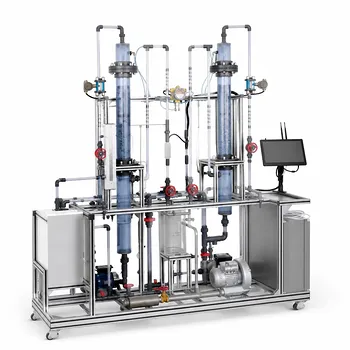
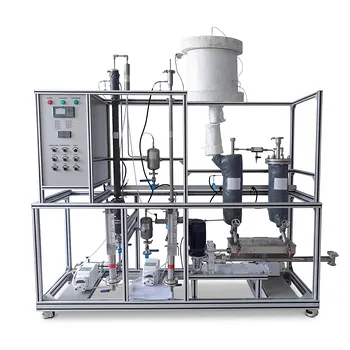
A dynamic mathematical model is not a mere academic exercise—it is the operational brain of a pilot plant control system. Without it, you are flying blind. For chemical engineering pilot plants, this model is the foundational tool that enables robust control design, precise tuning, process optimization, safe simulation training, and intelligent fault diagnosis, effectively translating physical laws into actionable, real-time strategy.
The deep need isn't just to define a model, but to gain predictive power over a complex, often unstable system. A dynamic model transforms a pilot plant from a reactive piece of hardware into a proactive, analyzable, and optimizable asset, making it the single most critical element for safe, efficient, and insightful operation and design.
What the Model Directly Enables in System Design and Operation
The fundamental value of a dynamic model lies in its ability to reveal a system’s inherent behavior over time. This is crucial for answering the core questions of process control.
Informing the Core Architecture of Your Control System
The first step in designing any control loop is deciding what to measure and what to adjust. A dynamic model makes this explicit.
The model mathematically defines the relationships between all key variables. By analyzing it, you can definitively determine the optimal configuration of controlled variables, manipulated variables, and measuring transmitters.
For example, deriving a model for a simple liquid level system using a mass balance, A(dh/dt) = Q1 - Q2, immediately identifies inlet flow rate (Q1) as the primary manipulated variable and liquid level (h) as the controlled variable. The model's structure dictates the control architecture.
Moving from Guesswork to Precision in Controller Tuning
Stable, safe, and robust operation is non-negotiable. Guessing PID parameters puts equipment, product, and people at risk.
A dynamic model provides the system's time constant (T) and static gain (K) . These two parameters mathematically define how fast and how strongly a system responds to changes.
These calculated values allow engineers to use established tuning methods to precisely set PID parameters, ensuring the controller can reject disturbances without causing oscillations or unsafe overshoots. This is the difference between a control loop that fights the process and one that harmonizes with it.
Unlocking Systematic Process Optimization
Running a pilot plant efficiently means maximizing yield while minimizing energy consumption. A validated model turns this into a solvable optimization problem.
The model serves as a high-fidelity digital twin. Operators can formulate and test optimization strategies in silico before committing physical resources.
By simulating the effects of changing setpoints or load conditions, the model helps pinpoint the exact operating window that delivers the best chemical yield at the lowest energy consumption, transforming trial-and-error into a targeted, data-driven effort.
Leveraging the Model as a Predictive Engine
Beyond real-time control, the model’s predictive power provides immense value for planning and diagnostics.
Creating a Safe, Consequence-Free Training Environment
High-risk procedures like startup and emergency shutdown cannot be safely practiced on the physical plant. The model here acts as a surrogate.
The dynamic model forms the core algorithm of a process simulator. It accurately mimics the plant's response to any operator action or system failure.
This allows students and operators to practice rare, critical procedures on computer-based simulation training systems. The dynamic nature of the model ensures that a simulated runaway reaction in a batch reactor, for instance, responds with the correct time-dependent temperature rise. The lesson is visceral, but the risk is zero.
Enabling Intelligent Fault Detection and Diagnosis
A sensor reading that deviates from expectation can be a simple disturbance or a sign of critical equipment degradation. The model provides the baseline for discernment.
By running the model in parallel with the real plant, you create a continuous stream of predictions for each sensor reading. This process is called real-time comparison.
A significant, persistent deviation between the model's prediction and the actual sensor reading is a powerful diagnostic signal. It immediately flags a potential anomaly, such as heat exchanger scaling or catalyst deactivation, long before it would trigger a simple limit alarm. This enables predictive maintenance and prevents process failures.
Understanding the Trade-offs and Hidden Challenges
A dynamic model is indispensable, but its creation and use are not without profound challenges, especially in a pilot-plant setting.
The Modeling Paradox for Complex Processes
The very processes most in need of control—like bioreactors or multi-component distillation units—are often the most difficult to model rigidly.
These systems are inherently highly non-linear, time-varying, and subject to multi-variable coupling. Deriving a precise, first-principles dynamic model for them can be a monumental, and sometimes impractical, task.
In such cases, a pure mathematical approach fails. The solution is a hybrid one: combining a basic dynamic model with an expert control system. This approach uses heuristic IF-THEN rules derived from experienced operators to manage the non-linearity and complexity that the model cannot capture, effectively teaching the system to reason rather than just calculate.
The Inevitable Drift of Process Dynamics
Even a perfect initial model becomes stale over time. A pilot plant is a living system, subject to fouling, catalyst deactivation, and changes in raw material composition.
This means the parameters that underpinned your perfectly tuned PID controller (like the time constant and gain) have changed. The controller’s performance will degrade, leading to instability and inconsistent product quality.
The answer is adaptive control, where the system continuously identifies these dynamic changes in real-time and automatically retunes the controller parameters. This is not just an advanced topic for student demonstration; it is the practical, real-world solution to a fundamental flaw in any static model-based approach.
Making the Right Choice for Your Goal
The essential nature of a dynamic model can take different practical forms. Your primary objective determines where to focus your modeling effort.
- If your primary focus is safe operator training and procedure development: Prioritize developing a high-fidelity, non-linear dynamic model for simulation. Its value lies in reproducing a wide range of realistic operational signatures, from normal startups to dangerous runaway conditions in a batch reactor.
- If your primary focus is robust, hands-off control of a highly complex process: Do not rely solely on a first-principles model. Combine a foundational dynamic model with an expert system’s knowledge base to handle the non-linear and multi-variable behavior that equations alone cannot tame.
- If your primary focus is maintaining peak performance in a dynamic R&D environment: A one-time model for PID tuning is insufficient. You must implement an adaptive control framework where the model's parameters are continuously updated to counteract process drift from fouling, scaling, or deactivation.
A dynamic mathematical model is your best tool for replacing uncertainty with foresight, but its ultimate power is realized only when you choose the right modeling strategy for the specific, evolving nature of your pilot plant process.
Summary Table:
| Key Capability | Core Purpose & Benefit | Key Parameters / Applications |
|---|---|---|
| Control Design | Identifies optimal controlled & manipulated variables | System architecture & sensor placement |
| PID Tuning | Prevents system oscillations and unsafe overshoots | Time constant ($T$) & static gain ($K$) |
| Process Optimization | Maximizes chemical yield & minimizes energy use | Digital twin simulation & testing |
| Simulation Training | Offers safe, consequence-free operator training | Startup, shutdown, & runaway simulation |
| Fault Diagnosis | Enables real-time anomaly detection & maintenance | Sensor drift, scaling, & catalyst decay |
Optimize Your Control Systems with LABPARK Pilot Plants
Implementing precise dynamic control starts with high-quality hardware. LABPARK provides state-of-the-art Educational and Vocational Unit Operations Pilot Plants designed for universities, research institutes, and enterprises. Covering key sectors like chemical engineering, bioprocess & biotech, and environmental & water treatment, our pilot plants are built to help your students, researchers, and engineers master process dynamics, test control models, and scale up operations safely.
Ready to enhance your training and research capabilities? Contact us today to find the perfect pilot plant solution.
Related Products
- Fixed Bed Gas Solid Catalytic Reaction Educational Pilot Plant
- Multi Pump Fluid Transport Process Piping Unit Operations Training Pilot Plant
- Carbon Dioxide Hydrogen Methanol Synthesis Educational Unit Operations Pilot Plant
- Ethyl Acetate Synthesis Unit Operations Pilot Plant for Practical Training
- Natural Product Extraction Unit Operations Training Pilot Plant
People Also Ask
- How do reactor pilot plants safely study gas-solid reactions? Master kinetics with thermal & flow control.
- How does the Mears criterion evaluate transport resistance? Key Guide to Intrinsic Kinetics
- Fluidized vs. Fixed Bed Reactors: Comparing Heat & Complexity in Pilot Plants
- Why is a multibed configuration necessary for exothermic reactions? Optimize your pilot plant trajectory.
- How is the friction factor determined for fixed-bed pilot plants? Select the best pressure drop correlation.