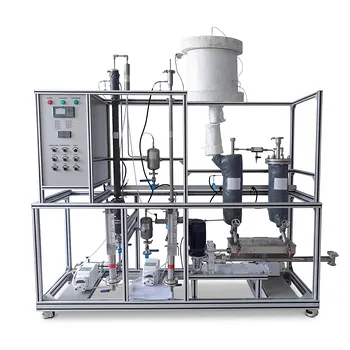
DOF analysis is the non-negotiable first step that tells you whether your experiment can actually yield meaningful data. It’s a simple arithmetic check—Number of Unknowns minus Number of Independent Equations—that determines if your pilot plant setup is solvable, underdefined, or overdefined. Without it, you risk collecting ambiguous measurements, misinterpreting results, or wasting time on an experiment that cannot answer your research question.
Before you turn on a single pump or install a sensor, DOF analysis forces you to confront the mathematical backbone of your experiment. It reveals whether your planned measurements are sufficient to uniquely determine every unknown parameter, preventing the frustration of an unsolvable system.
What a Degree of Freedom Analysis Actually Reveals
The core concept is minimalistic but profoundly diagnostic: DOF = ( N_{\text{unknowns}} - N_{\text{independent equations}} ). The result immediately classifies your experiment into one of three categories, each with a distinct operational consequence.
Zero DOF: The Solvable Sweet Spot
When the calculation yields zero, your experimental configuration is exactly specified. The number of measurements and independent relationships equals the number of unknowns. This is the only condition under which you can uniquely calculate all desired parameters—no more, no less. For a pilot plant, it means the data you collect will lead to a single, unambiguous solution, making the experiment reproducible and interpretable.
Positive DOF: Underdefined and Undetermined
A positive number signals an underdefined system. You have more unknowns than equations, so the data can fit infinite possible solutions. In practice, this is the most common trap: a student installs three thermocouples and expects to fully characterize a heat exchanger, but fails to account for an unknown heat loss coefficient. The experiment will run, numbers will appear on screens, but the conclusions will be statistically meaningless. The fix is always to add more sensors, impose a new process specification, or reduce the number of unknowns through justified assumptions.
Negative DOF: Overdefined and Conflicting
A negative value indicates an overdefined system—more independent relationships than unknowns. This appears to be redundant information, but in a real pilot plant it’s a warning. Physical measurements always contain noise, calibration drift, or tiny inconsistencies. An overdefined system cannot satisfy all measured relations simultaneously, meaning the equations are mathematically incompatible. This often points to a faulty sensor, a violated mass balance, or a thermodynamic constraint that isn’t being met. Until the conflict is resolved, any attempt to reconcile the data will force error into the results.
The Pilot Plant as a Network of Constraints
A chemical engineering pilot plant is not a black box; it’s a physical embodiment of a mathematical model. DOF analysis bridges the two, translating abstract equations into a concrete sensor-and-actuator plan.
Learning from the Distillation Column
Consider a standard binary distillation column in a unit operations lab. A rigorous analysis yields ( 4N_t + 9 ) variables and ( 4N_t + 7 ) independent equations, leaving exactly 2 degrees of freedom. This isn’t a theoretical curiosity—it’s a design directive. It tells the researcher that only two independent variables can be set arbitrarily to control the column. In educational and research settings, those two are typically the reflux flowrate (R) and the vapor boil-up rate (Y). Choose any other pair—or try to control a third variable—and the system becomes overdefined. Understanding this before configuration prevents the common mistake of installing an extra control loop that fights the existing ones, leading to oscillations or a complete loss of steady-state operation.
Avoiding the Catalyst Evaluation Blind Spot
When your research goal is to screen catalysts for activity, selectivity, or deactivation, you are solving for multiple unknown kinetic parameters simultaneously. If the pilot plant DOF is positive, you cannot uniquely attribute changes in conversion to a specific kinetic constant. The experiment becomes a black box that generates data you cannot deconvolve. DOF analysis forces you to ask: Do I have enough independent measurements to decouple mass transfer effects from intrinsic kinetics? Without it, a student might run a suite of catalyst tests, only to realize later that the results could be explained by three entirely different kinetic models—a devastating waste of time and expensive catalyst material.
Why This Matters More at Pilot Scale Than at Lab Scale
Pilot plants introduce complexities that a simple benchtop experiment does not: recycle streams, multi-component interactions, heat integration, and realistic impurities. These add equations and unknowns rapidly.
Economic Sensitivity Hinges on Solvability
Modern pilot plant education integrates economic analysis, such as calculating the impact of raw material cost shifts on a process’s Discounted Cash Flow Rate of Return. To perform a meaningful sensitivity study, you must first establish a solvable base case. If your mass balance is underdefined, you can’t compute a reliable material cost per kilogram of product. If it’s overdefined due to a hidden conflict, your “accurate” profit margin could be an artifact. DOF analysis ensures that the physical process stream data is mathematically coherent before you attach a dollar sign to it, transforming the pilot plant from a mere hardware rig into a valid financial model.
Reproducibility Starts with a Solvable Framework
For research, the ability to reproduce results is paramount. A DOF of zero means that another researcher, given the same equipment and the same set of specified independent variables, will inevitably measure the same dependent variables—within experimental error. A positive DOF, however, means the system’s state can drift across a manifold of equally valid (but physically different) conditions, making replication impossible. For a student, this is the difference between a thesis chapter that stands up to scrutiny and one that collapses during a defense.
Understanding the Trade-offs and Pitfalls
Even a correct DOF analysis can be misapplied if the underlying assumptions are not scrutinized.
The Seduction of the Overdefined System
Some argue that a slightly negative DOF is desirable because it provides redundant data for gross error detection. While data reconciliation algorithms do thrive on overdefined systems, this is an advanced practice. For student and researcher experiment configuration, an overdefined system that hasn’t been deliberately designed for reconciliation will almost certainly hide a sensor fault or a violated physical law (like a leak that breaks the mass balance). The crucial lesson is that an overdefined result should trigger an immediate search for the conflicting measurement, not be accepted as a safety net.
The Act of Simplification Can Destroy Your DOF
The biggest pitfall is assuming a relationship is independent when it’s actually derived. For example, a student might count an overall material balance and three component balances as four equations, forgetting that one is a linear combination. This falsely lowers the DOF and leads to a dangerous belief that the system is well-defined when it’s not. Rigorous equation counting—not wishful thinking—is the only cure.
How to Apply This to Your Pilot Plant Experiment
The goal is to turn DOF analysis into a practical, pre-experiment audit that shapes your hardware decisions.
- If your primary focus is mechanistic understanding: Begin by listing every unknown parameter you intend to calculate (rate constants, heat transfer coefficients, etc.). Then list every independent sensor and every fundamental balance. If the DOF isn’t zero, physically add a sensor to close the gap—do not add a hypothetical equation.
- If your primary focus is process control and dynamics: First determine the steady-state DOF to identify which variables you can freely manipulate. Select your control pairs (e.g., reflux and boil-up) accordingly, and ensure all other measured variables are true dependents. This prevents actuator conflicts that destabilize the pilot plant.
- If your primary focus is economic evaluation: Perform a double DOF check: one for the mass/energy balance and one for the economic model. The cost calculation itself becomes an extra “equation” that must be consistent with the physical data. An underdefined mass balance will cascade into an undefined economic output.
Ultimately, DOF analysis transforms the intimidating complexity of a pilot plant into a manageable intellectual framework. It replaces guesswork with mathematical clarity, ensuring that every hour of experimentation brings you one step closer to a defensible, solvable conclusion—not a dead end.
Summary Table:
| DOF Value | System Classification | Operational Consequence | Action Required |
|---|---|---|---|
| DOF = 0 | Solvable | Unique, reproducible solution; exact specification. | Proceed with experimental run. |
| DOF > 0 | Underdefined | Infinite solutions; statistically meaningless data. | Add sensors or impose process specs. |
| DOF < 0 | Overdefined | Conflicting mathematical relations; sensor drift or leaks. | Inspect sensors and verify mass balances. |
Build a Reliable Foundation for Unit Operations with LABPARK
Successful pilot plant experiments depend on both rigorous DOF analysis and robust equipment. LABPARK provides state-of-the-art Educational and Vocational Unit Operations Pilot Plants in chemical engineering, bioprocess & biotech, and environmental & water treatment for universities, research institutes, and enterprises.
Our pilot plants are engineered to deliver precise, reproducible data, helping your students and researchers avoid configuration errors and build solid mathematical models.
- Academic Excellence: Equip your labs with industry-standard control and measurement systems.
- Research Precision: Prevent underdefined or conflicting experimental setups.
Ready to elevate your engineering lab? Contact us today to discuss your custom pilot plant needs!
Related Products
- Fixed Bed Gas Solid Catalytic Reaction Educational Pilot Plant
- Multi Pump Fluid Transport Process Piping Unit Operations Training Pilot Plant
- Carbon Dioxide Hydrogen Methanol Synthesis Educational Unit Operations Pilot Plant
- Ethyl Acetate Synthesis Unit Operations Pilot Plant for Practical Training
- Natural Product Extraction Unit Operations Training Pilot Plant
People Also Ask
- How do reactor pilot plants safely study gas-solid reactions? Master kinetics with thermal & flow control.
- How does the Mears criterion evaluate transport resistance? Key Guide to Intrinsic Kinetics
- Fluidized vs. Fixed Bed Reactors: Comparing Heat & Complexity in Pilot Plants
- Why is a multibed configuration necessary for exothermic reactions? Optimize your pilot plant trajectory.
- How is the friction factor determined for fixed-bed pilot plants? Select the best pressure drop correlation.