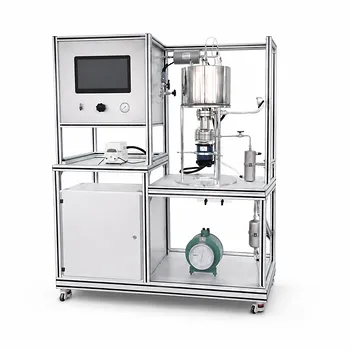
Because without it, you are flying blind. The core reason understanding reactor multiplicity—especially isola patterns—is critical is that certain stable, high-performance operating states are physically impossible to reach simply by adjusting the inlet flow rate. To safely land on these isolated steady states, operators must deliberately manipulate other parameters like feed temperature or concentration. Reactor training pilot plants exist precisely to let students and professionals practice these hazardous, counterintuitive startup sequences in a controlled environment, making the difference between a theoretical concept in a textbook and a skill that prevents industrial disasters.
Reactor multiplicity isn’t a theoretical curiosity; it’s a minefield. An ‘isola’ is a stable operating island that standard flow-rate adjustments will never reach, rendering conventional startup procedures useless. Pilot plant training transforms this abstract hazard into an actionable lesson, teaching engineers the deliberate, multi-parameter maneuvers required to safely capture high-conversion states and avoid thermal runaway.
The Deceptive Geography of Reactor States
On paper, a reactor’s steady-state map looks like a smooth curve. In reality, multiplicity shatters that simplicity, creating a landscape of accessible and inaccessible regions. The most treacherous of these is the isola—a closed loop of stable operating points entirely disconnected from the standard ignition curve. This is the deep need behind the question: to understand why forgetting these patterns in procedure design leads not to suboptimal performance, but to complete failure in achieving the target state.
The Ignition Curve You Can Rely On
Most of a reactor’s familiar multiplicity involves an S-shaped curve on a conversion-vs.-residence-time plot. By gradually changing flow rate, you can follow the lower (low-conversion) branch, then “ignite” to the upper (high-conversion) branch when you cross a bifurcation point. This is the terrain of standard hysteresis loops.
The Isola: An Unreachable Island
An isola is fundamentally different. It floats in the parameter space, disconnected from the main solution branch. There is no continuous path of steady states leading from the low-conversion startup condition to the isola’s stable points by varying flow rate alone. The reactor simply cannot see that island; it remains invisible to standard startups.
This Is Not a Rare Edge Case
For many exothermic reactions, particularly those with complex kinetics or heat-transfer limitations, isola formation is a real possibility. Assuming all stable high-conversion states are reachable via a simple flow ramp is a dangerous oversimplification that pilot plant training is designed to crush.
Why A Standard Startup Procedure Is Doomed to Fail
If you train operators only on simple hysteresis, you send them into a fight they can’t win. The surface need is to design procedures; the deep need is to avoid the catastrophic moment when a procedure silently fails. Failure here doesn’t mean the reactor shuts down gracefully—it can mean thermal runaway or a permanently extinguished reaction while you chase a ghost state.
You Cannot “Flow-Rate” Your Way to an Isola
The basin of attraction for an isola state is divorced from the basin of the standard extinction/ignition curve. If you start from a cold, low-conversion condition and slowly manipulate the feed flow rate, you will slide along the familiar S-curve, never jumping out to the isolated loop.
The Basin of Attraction Is Gated by Other Parameters
To land on an isola, you must temporarily shift the entire bifurcation map. This means deliberately raising the feed temperature or spiking the feed concentration to bring the isola’s basin of attraction into contact with your current state, then locking in the state, and finally slowly relaxing the temporary parameter back to the original setpoint. This is a tightrope walk that no simple PID flow controller can perform.
Startup Sequences Become Scenario-Specific
A single standard operating procedure for startup becomes a liability. Understanding isola behavior forces you to design contingent procedures: if mapping shows an isola, the startup must include a planned, time-limited perturbation of temperature or concentration, with strict safety interlocks to prevent overshoot into runaway during the capture phase.
The Irreplaceable Role of the Pilot Plant
The primary reference holds the key: training on pilot plants allows students to safely practice these complex sequences. But the deep need is to understand why a simulation alone isn’t enough. Pilot plants make the abstract parameter boundaries—the hysteresis and isola varieties—tangible, visceral experiences.
Feeling the Bifurcation Boundary
A pilot plant lets you intentionally push a physical system toward the boundary where the isola collapses (or becomes reachable). You witness the sudden, nonlinear jump in temperature. This teaches a gut-level understanding of bifurcation distances that no software model fully imparts.
Designing Control Loops That See the Unseen
A standard temperature or conversion controller tuned around one steady state can easily destabilize another. Pilot plant experiments reveal how control gains that are perfectly stable on the ignition branch can induce sustained oscillations or runaway when transferred to an isola state. This teaches engineers to design gain-scheduled or model-predictive controllers that account for multiplicity.
Practicing Failure to Prevent Industrial Disaster
The safest place to accidentally trigger a thermal runaway during an isola capture attempt is a small-scale, deeply instrumented pilot plant. Learning the warning signs—a creeping hot spot, a sudden drop in coolant demand just before ignition—builds the human intuition needed to prevent the same scenario in a full-scale production unit.
Understanding the Trade-offs and Pitfalls
No choice comes without a cost. Objectively addressing the downsides builds trust and reflects the reality that engineering is about managed risk. The critical trade-off here is between the promise of higher conversion (or a desired product slate) available on an isola, and the inherent fragility of operating there.
The Reward: Accessing Uniquely Advantageous States
Some isola states offer conversion rates or selectivity profiles that are simply unattainable on the main branch. For complex pharmaceuticals or fine chemicals, ignoring the isola might mean leaving 20% yield on the table. The critical need is to first identify if that isolated state is economically indispensable. If it is, the procedure complexity becomes mandatory, not optional.
The Risk: Extreme Sensitivity to Disturbances
An isola state often sits near its own extinction boundary. A tiny drop in feed temperature or a momentary flow fluctuation can cause an irreversible “fall-off” back to a low-conversion state, or worse, trigger a runaway past the upper branch. This fragility demands a control strategy with predictive alarms and feed-forward compensation, which adds capital cost and operator training burden.
The Training Paradox: Can We Truly Generalize?
A common pitfall is training on a single well-characterized pilot plant and assuming the isola-capture sequence will transfer to a new chemistry. Every reaction has its own bifurcation fingerprint. The real skill pilot plants must teach is not a recipe, but a methodology: how to systematically map parameter space, identify the isola’s sensitivity gradients, and then author a custom capture procedure. Training that fails to teach this methodology only creates a false sense of security.
Making Multiplicity Work for Your Operations Program
The surface question asked for “why,” but the deep need is to turn that understanding into action. You design procedures not for ideals, but for specific objectives under real constraints. Use these goal-driven guidelines to frame your training and procedure design.
- If your primary focus is safe operation above all else: Deliberately avoid isola states entirely. Train operators to map the bifurcation diagram and then define a safe operating window on the stable, reachable main branch, with conservative margins from ignition and extinction points, even if this sacrifices some conversion.
- If your primary focus is maximizing yield from an inherently slow reaction: Invest the pilot-plant time. Dedicate a campaign to mapping the isola’s exact parameter dependencies (temperature, concentration, coolant flow) and develop an automated, model-predictive startup procedure that temporarily pushes the reactor into the island’s basin of attraction while locking out runaway conditions.
- If your primary focus is training operators to handle any eventuality: Make isola analysis a core part of the curriculum. Use induced failures in the pilot plant—deliberately missing the capture window, intentionally recovering from a fall-off—to cement the understanding that startup is a trajectory through a hazardous state-space, not a fixed list of steps.
Mastering isola behavior doesn’t just teach process control; it fundamentally rewires how an engineer sees a reactor—not as a single machine, but as a landscape of hidden possibilities and hidden dangers, where the right startup procedure is the only map to a safe, high-performing destination.
Summary Table:
| Feature | Standard S-Curve Hysteresis | Isola Behavior (Isolated Loop) |
|---|---|---|
| Accessibility | Reachable via continuous flow rate adjustments | Disconnected; requires multi-parameter manipulation |
| Startup Strategy | Gradual flow ramping | Temporary temperature/concentration spikes |
| Runaway Risk | Predictable bifurcation boundaries | High sensitivity near extinction/ignition limits |
| Control Needs | Standard PID control loops | Gain-scheduled or model-predictive control |
Master Complex Reactor Dynamics with LABPARK
Bridge the gap between theoretical chemical kinetics and safe industrial operations. LABPARK provides state-of-the-art Educational and Vocational Unit Operations Pilot Plants in chemical engineering, bioprocess & biotech, and environmental & water treatment designed for universities, research institutes, and enterprises.
Equip your students and engineers with the hands-on experience needed to safely navigate reactor multiplicity, capture isola states, and prevent thermal runaway. Contact us today to customize a pilot plant solution for your lab.
Related Products
- Multi-Reactor Educational Pilot Plant for Reaction Engineering Unit Operations
- Fixed-Bed Chemical Reaction and Gas Dust Tar Removal Unit Operations Pilot Plant
- Fixed Bed Gas Solid Catalytic Reaction Educational Pilot Plant
- 100L Continuous Loop Hydrogenation Educational Unit Operations Pilot Plant
- Fluidized Bed Gas Solid Catalytic Reaction Educational Pilot Plant
People Also Ask
- How do educational unit operations pilot plants address safety and waste management when scaling up?
- How do educational unit operations pilot plants bridge theory and design? Bridge the Engineering Gap
- Why Compare Predicted and Experimental Excess Enthalpy? Key to Accurate Pilot Plant Scale-up
- How to study gasification in pilot plants? Compare exit gas composition & efficiency
- Why Use PTFE & Hastelloy in Chemical Pilot Plants? Prevent Corrosion & Ensure Safety