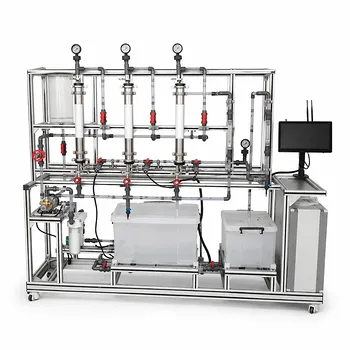
Without a robust pre-treatment system, a polyamide RO pilot plant is a liability waiting to fail. Seawater desalination pilot units rely on the thin, delicate polyamide layer of thin-film composite (TFC) membranes to achieve the exceptional salt rejection needed for research and demonstration. That layer is instantly and irreversibly damaged by even trace amounts of chlorine, and it becomes a magnet for biological growth and scale-forming minerals. A comprehensive pre-treatment train—coagulation, filtration, activated carbon, dechlorination, and pH adjustment—isn't optional; it's the only way to preserve membrane integrity, sustain a salt rejection rate above 99.5%, and get meaningful, reproducible data from the pilot plant.
The core vulnerability of polyamide membranes lies in their sensitivity to oxidative attack and their high fouling potential. Pre-treatment eliminates chlorine, significantly reduces suspended solids and organic matter, and adjusts water chemistry to prevent scaling. This transforms raw seawater from a destructive cocktail into a feed stream the membrane can process reliably, turning a pilot plant from a maintenance nightmare into a productive research tool.
The Inherent Risks of Seawater for Polyamide Membranes
Why Chlorine Is a Silent Membrane Killer
Free chlorine attacks the amide linkages in the polyamide polymer chain. This chemical degradation destroys the selective layer, causing an immediate and irreversible loss of salt rejection. For pilot plants often used for student training or process validation, a single chlorine excursion without proper dechlorination renders the membrane module useless and invalidates any experimental run.
The damage is not always visible. A membrane can appear physically intact while its rejection rate drops from 99.5% to 90% in hours. In a research setting, this produces misleading data and wastes time.
Biofouling: The Persistent Flux Thief
Seawater teems with microorganisms that colonize membrane surfaces. Once a biofilm forms, it creates a low-permeability barrier that drastically reduces permeate flux and increases energy consumption. Polyamide membranes offer an ideal surface for bacterial adhesion, and in the warm, nutrient-rich environment of a pilot plant, biofouling can force a shutdown within days if organic matter and microbes aren't removed upstream.
Beyond flux loss, biofilms also accelerate chemical cleaning frequency. Harsh cleaning cycles further stress the polymeric membrane, shortening its overall lifespan.
Particulate and Colloidal Abrasion and Scaling
Suspended solids and colloidal particles physically abrade the membrane surface and block feed channels. Sharp particulate matter can scratch the polyamide layer, creating permanent defects. Meanwhile, scalants like calcium carbonate and silica precipitate under the high-concentration conditions near the membrane surface, forming hard crusts that are extremely difficult to remove.
Without pre-treatment, this mechanical and chemical assault forces operators to replace expensive membrane modules prematurely and undermines the pilot plant’s cost-effectiveness as a demonstration tool.
The Pre-treatment Shield: Step-by-Step Protection
Coagulation and Sedimentation: Removing the Bulk Offenders
A chemical coagulant destabilizes colloidal particles, allowing them to clump together and settle. This step removes a large portion of the suspended solids and some organic matter before the water ever touches a filter. For a pilot plant, this reduces the load on downstream equipment and directly cuts the risk of abrasive damage and rapid fouling.
Sand Filtration: The Physical Barrier
Sand filtration polishes the water by trapping the smaller particles that escaped sedimentation. This step protects the delicate membrane from fine grit and silt that can embed in feed spacers, creating localized dead zones where fouling accelerates.
Active Carbon Filtration and Dechlorination: The Oxidant Trap
Activated carbon removes free chlorine and other residual oxidants through adsorption and catalytic reduction. For polyamide membranes, this step is non-negotiable. Sodium metabisulfite dosing often supplements carbon beds to guarantee zero chlorine residual, safeguarding the molecular integrity of the membrane.
Without complete dechlorination, every other pre-treatment effort is pointless. The membrane will fail from chemical attack, not fouling.
pH Adjustment: Controlling Scaling Tendency
Lowering the seawater pH (typically to around 6.5–7.0) shifts the carbonate equilibrium, preventing calcium carbonate scaling on the membrane. This simple chemical adjustment dramatically reduces the risk of hard-scale formation, preserving both flux and salt rejection over long pilot runs.
Understanding the Trade-offs and Limitations
The Complexity and Cost Conundrum
A full pre-treatment train adds capital cost, footprint, and operational complexity to a pilot plant. For a university teaching lab, this might seem like an excessive burden. However, skipping pre-treatment shifts those costs directly to frequent membrane replacement and unreliable experimental data. The trade-off is between upfront investment and long-term reliability.
For training purposes, that complexity is itself a learning outcome. Students and researchers learn how real-world plants tackle raw seawater, gaining knowledge that extends far beyond the membrane module itself.
Alternative Membranes Are Not a Simple Escape
Cellulose acetate (CA) membranes tolerate chlorine and resist fouling somewhat better, but they come with their own severe constraints. CA membranes have a narrow pH range (3–7), degrade biologically, and lose performance at elevated temperatures. They cannot achieve the same high salt rejection as TFC polyamide, limiting their use for high-purity demonstrations.
Ceramic or metal membranes solve chemical compatibility issues but are cost-prohibitive and not industrially relevant for seawater RO. For a pilot plant aiming to represent real-world desalination, polyamide TFC membranes remain the standard—and therefore comprehensive pre-treatment is mandatory.
The Risk of Over-Reliance on Cleaning
Some operators might prefer a minimal pre-treatment approach, planning to compensate with aggressive chemical cleaning. This strategy backfires. Frequent exposure to harsh acids, bases, or chelating agents physically degrades the polyamide layer and delaminates the thin-film composite. A properly pre-treated feed extends membrane life far more effectively than any cleaning schedule.
Making the Right Choice for Your Pilot Plant Goal
The design of your pre-treatment system should align directly with your pilot plant’s purpose. Trade-offs exist, but they must be evaluated against what you need the plant to demonstrate or prove.
- If your primary focus is teaching unit operations and water chemistry: Implement the complete pre-treatment train—coagulation, sedimentation, sand filtration, carbon dechlorination, and pH adjustment. Each step becomes a teachable moment, and the membrane failure mode portfolio becomes part of the curriculum.
- If your primary focus is membrane research and materials testing: Use a fully dechlorinated, filtered seawater feed with precise pH control to isolate membrane performance variables. Any shortcut in oxidant removal will produce spurious results, wasting valuable research membrane samples.
- If your primary focus is demonstrating high-recovery multi-stage systems: Invest heavily in scaling prevention (antiscalant dosing or pH control) and organic fouling removal, because concentrate streams magnify scaling risks exponentially. The carbon-dechlorination stage remains absolutely critical to protect every stage in the series.
- If your primary focus is economic feasibility analysis: Model the capital and operational costs of the pre-treatment suite accurately, and include frequent membrane replacement costs in the "no pre-treatment" scenario. The lifetime cost analysis will invariably favor a comprehensive pre-treatment system when TFC membranes are used.
A polyamide RO pilot plant without thorough pre-treatment is an experiment in how quickly a membrane can fail. With it, you gain a reliable platform for insight, education, and real-world process validation.
Summary Table:
| Pre-treatment Step | Primary Target / Function | Core Benefit to Polyamide Membrane |
|---|---|---|
| Coagulation & Sedimentation | Suspended solids & colloids | Prevents physical abrasion and rapid clogging |
| Sand Filtration | Fine grit and silt | Protects against micro-scratching & spacer dead zones |
| Activated Carbon / Dechlorination | Free chlorine & oxidants | Prevents chemical degradation of the polyamide layer |
| pH Adjustment | Carbonate scaling | Inhibits calcium carbonate crust formation & maintains flux |
Optimize Your Water Treatment Research with LABPARK
Building a reliable desalination pilot plant requires precision engineering and robust membrane protection. LABPARK provides advanced Educational and Vocational Unit Operations Pilot Plants in chemical engineering, bioprocess & biotech, and environmental & water treatment designed specifically for universities, research institutes, and enterprises.
Our systems help you achieve reproducible research data, minimize equipment downtime, and provide hands-on training using industry-standard technologies.
Ready to elevate your laboratory capabilities? Contact our experts today to discuss your custom pilot plant configuration!
Related Products
- Dual-Mode Rectification Pilot Plant for Practical Training Unit Operations
- Multi-Modal Distillation Unit Operations Training Pilot Plant
- Electrochemical Water Treatment Educational Unit Operations Pilot Plant
- Multi-Functional Membrane Separation Educational Pilot Plant for Unit Operations Lab
- Green Anhydrous Ethanol Purification Extractive Distillation Unit Operations Training Pilot Plant
People Also Ask
- How does polyphosphate hydrolysis affect scale and corrosion in pilot plants? Essential Monitoring Guide
- How do predictive thermodynamic models integrate into pilot plants? Bridging Theory and Practice
- Which cross-validation strategy should be selected for pilot plant time-series & batch data? Avoid Data Leakage
- Why Use Center Points in Process Analyzer Calibration? Key Benefits Explained
- How can process control schemes be configured to teach basic and advanced control?