High-pressure and recycle loops are not an engineering preference for ammonia synthesis—they are a thermodynamic necessity. The reaction between nitrogen and hydrogen is reversible and exothermic, producing fewer gas molecules. Low-pressure conditions yield negligible ammonia at the high temperatures required for a practical reaction rate. Therefore, high pressure is applied to shift the equilibrium toward the product, and a recycle loop is essential to recover the ~70-85% of unreacted gases that pass through the reactor in each cycle.
Ammonia synthesis faces a fundamental conflict: thermodynamics favor low temperatures and high pressure, but kinetics demand high temperatures for a viable reaction rate. Pilot plants bridge this gap by physically embodying high-pressure reactors, recycle loops, and separation units, allowing operators to observe how pressure manipulates equilibrium and how recycling governs overall efficiency in a real, dynamic system.
The Thermodynamic Impossibility of a Single-Pass, Low-Pressure System
The core challenge starts with the nitrogen molecule. Its triple bond has a dissociation energy of 945 kJ/mol, making it exceptionally inert. Breaking this bond to form ammonia requires overcoming a massive activation energy, which is why a catalyst and high temperatures (~700 K) are mandatory. But this introduces a catch.
The Exothermic, Entropy-Decreasing Trap
The synthesis reaction ($N_2 + 3H_2 \rightleftharpoons 2NH_3$) is exothermic and reduces the number of molecules. From a thermodynamic standpoint, this means equilibrium conversion is boosted by low temperatures and high pressure.
At the high temperatures needed for a practical reaction rate, however, the equilibrium constant plummets. At atmospheric pressure and 700 K, the yield is practically zero. The reaction becomes thermodynamically spontaneous ($\Delta G < 0$) only at lower temperatures—the transition point is around 191°C at standard pressure—where the reaction is glacially slow. We are caught in a classic thermodynamic-kinetic conflict.
Pressure as the Equilibrium Enforcer
According to Le Chatelier's Principle, increasing the pressure of a system with fewer product gas molecules will push the equilibrium toward the product side. This is the primary reason industrial synthesis operates at pressures typically over 100 bar, and often in the range of 20 to 30 MPa.
High pressure physically increases the concentration of reactants, forcing the equilibrium to a point where a meaningful, albeit incomplete, single-pass conversion becomes physically possible.
Why the Recycle Loop is the Industrial Heartbeat
If high pressure solves one part of the problem, it cannot overcome the fundamental limitation of a single pass through the reactor. The conversion per pass is limited by equilibrium.
The Necessity of Incomplete Conversion
Even under optimized conditions, only a fraction of the feed gas is converted to ammonia in one trip through the catalyst bed. The reactor outlet stream is primarily unreacted nitrogen and hydrogen. Simply venting this mixture would be economically and materially wasteful.
A pressurized recycle loop is the system’s circulatory system. It captures the unreacted gases, combines them with fresh feed, and sends them back to the reactor. This elevates the overall conversion of a feedstock molecule to near 100%, even though its single-pass conversion is much lower.
Managing Heat and Inert Poisons
The recycle strategy creates two downstream problems that the loop must also solve. First, the exothermic reaction generates immense heat. A feed-effluent heat exchanger is integrated into the loop to use the hot reactor outlet gas to pre-heat the cold inlet gas, dramatically improving thermal efficiency.
Second, impurities like argon and methane, introduced with the feed or as byproducts, do not react. Without intervention, these inert gases concentrate in the recycle loop, diluting the reactants and lowering their partial pressure, which directly sabotages equilibrium. The system must balance the efficiency benefits of recycling against the efficiency penalty of inert buildup by implementing a controlled purge stream to bleed off a portion of the gas.
Demonstrating These Principles in a Unit Operations Pilot Plant
A pilot plant is not a miniaturized factory; it is a physical model of thermodynamic and kinetic principles. The entire design is centered on making invisible forces visible.
The High-Pressure Reactor: A Study in Materials
The pilot-scale reactor, operating between 10 and 30 MPa, directly demonstrates the consequence of high-pressure design. The primary hazard is hydrogen embrittlement, where small hydrogen molecules diffuse into standard steel, causing catastrophic failure.
This forces the use of specialized, high-strength steel alloys, or unique vessel designs like multi-layer construction. A pilot plant with a multi-layer vessel shows an advanced engineering solution: outer layers are shrink-fit over the inner shell, inducing a compressive residual stress that counteracts the extreme tensile hoop stress from the internal pressure. This prevents fatigue and cracking, a lesson that a simulated computer model delivers poorly compared to a physical unit.
The Separation and Recycle Loop in Action
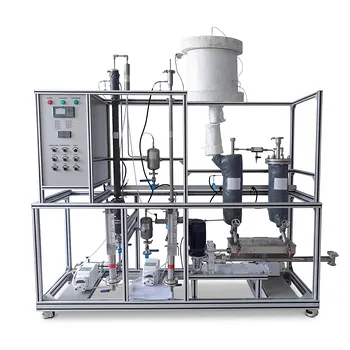
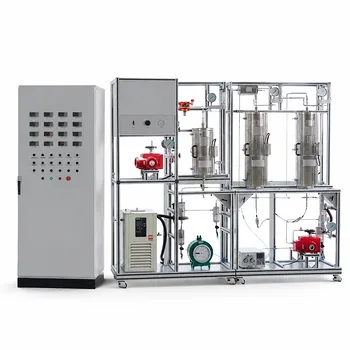
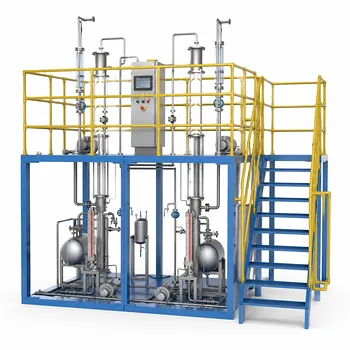
After the reactor, the pilot plant materializes the sequence of ammonia condensation and gas-liquid separation. The gas mixture is cooled, the liquid ammonia is separated in a knockout drum, and the unreacted gases are routed back via a recycle compressor.
Operators can directly manipulate the recycle ratio and observe its immediate effect on the temperature profile and production rate. More importantly, they can study the impact of the inert gas fraction ($x_i$) by adjusting the purge valve. Watching the system respond to an increased purge rate—losing reactant to control inerts—teaches a tangible lesson in process optimization that no textbook equation can fully convey.
Manipulating the Thermodynamic-Kinetic Compromise
The ultimate educational value of the pilot plant is in controlling the conflict. Operators change the reactor inlet temperature in small increments and watch the ammonia concentration at the outlet. They see that dropping the temperature too low (e.g., below 670 K) causes the reaction rate to fall off a cliff, despite more favorable equilibrium.
They can then increase pressure and see the equilibrium shift, boosting the outlet concentration. By running the system across a matrix of pressures (100-250 bar) and temperatures (~675 K), the operator generates a dynamic temperature-concentration profile that proves the balance between thermodynamic driving forces and kinetic reality is the singular challenge of reactor design.
Understanding the Trade-offs
Operational decisions in a pilot plant are never purely chemical; they are economic and mechanical compromises.
Pressure vs. Equipment Cost
Higher pressure directly improves equilibrium conversion. The trade-off is that vessel wall thickness and cost increase exponentially. A study pilot operating at 30 MPa requires a fundamentally different and more expensive construction standard than one at 10 MPa. The pilot plant itself becomes a lesson in capital costs versus yield, having to balance performance against the practical limits of single-wall vessel fabrication and the need for specialized multi-layered designs at extreme pressures.
The Kinetic Limit of Low Temperatures
While the Gibbs-Helmholtz equation proves ammonia synthesis is thermodynamically favorable at low temperatures, the pilot plant shows that this is a pyrrhic victory. Below a threshold, catalyst activity drops so low that the required reactor size and residence time become infinite for all practical purposes. The pilot plant shows that a catalyst is not magic; it is a surface that still requires sufficient thermal energy to do its work.
The Purge Problem
The recycle loop creates an inherent operator dilemma. A larger recycle stream boosts conversion but causes a faster buildup of inerts like argon. The operator must find the optimal purge flow rate—a small side-stream of waste gas—that balances the efficiency of reactant recovery against the penalty of inert dilution. This trade-off, where maximizing catalyst life and conversion opposes the cost of lost feedstock in the purge, is a masterclass in process integration.
Applying These Principles to Your Pilot Plant Study
The pilot plant is a tool for discovering a process sweet spot that satisfies conflicting demands. Your strategy should change based on what you are trying to learn.
- If your primary focus is maximizing ammonia yield: Prioritize operating at the highest safe system pressure and a precise stoichiometric $H_2/N_2$ ratio of 3:1. Focus your measurements on tracking the inert gas concentration and finding the minimum viable purge rate.
- If your primary focus is demonstrating reaction kinetics: Vary the pre-heat temperature and monitor the temperature rise across the catalyst bed. Keep the space velocity constant to isolate the effect of temperature on the rate of reaction, documenting the fall-off point where low temperature kills the reaction.
- If your primary focus is studying material science or process safety: Operate at the higher end of the pressure limit and focus on the mechanical design of the vessel and piping. Your key study becomes the metallurgical selection and the operational protocols to prevent hydrogen embrittlement, not just the ammonia production rate.
- If your primary focus is integrated process control: Introduce disturbances, such as a spike in feed methane (simulating an inert). Observe the time-lag response of the ammonia concentration in the separator and practice tuning the purge and fresh-feed valves to restore steady state without running the system into an unrecoverable equilibrium condition.
The pilot-scale ammonia synthesis loop is more than a production machine; it is a physical proof of the laws of thermodynamics and chemical kinetics. Mastering it requires not just monitoring the pressure gauge, but understanding it as a direct dial for manipulating the very equilibrium of matter.
Summary Table:
| Process Component | Thermodynamic/Kinetic Challenge | Engineering Solution | Pilot Plant Demonstration |
|---|---|---|---|
| High Pressure | Low equilibrium yield at high reaction temperatures (Le Chatelier's Principle). | Operating at 100–300 bar using high-strength/multi-layer steel alloys. | Demonstrates equilibrium shift via pressure control and highlights hydrogen embrittlement safety. |
| Recycle Loop | Low single-pass conversion rates (only ~15–25% feed converted per pass). | Recirculating unreacted $N_2$ and $H_2$ gas after condensing ammonia. | Allows students/operators to adjust recycle ratios and visualize overall mass balance. |
| Controlled Purge | Accumulation of inert gases (Argon, Methane) dilutes reactant concentration. | Implementing a bleed stream to purge inerts from the system. | Direct manipulation of purge rates to balance feedstock loss against system efficiency. |
Bring complex chemical engineering and thermodynamic principles to life in your laboratory. LABPARK designs and manufactures premium Educational and Vocational Unit Operations Pilot Plants specializing in chemical engineering, bioprocess & biotech, and environmental & water treatment. We empower universities, research institutes, and enterprises to provide students and researchers with invaluable hands-on experience in process control, safety, and optimization.
Ready to upgrade your laboratory capabilities? Contact LABPARK today to discuss your customized pilot plant solution!
Related Products
- Methanol Synthesis and Catalyst Performance Evaluation Educational Unit Operations Pilot Plant
- Ethyl Acetate Synthesis Unit Operations Pilot Plant for Practical Training
- Aspirin API Synthesis Unit Operations Training Pilot Plant
- Natural Product Extraction Unit Operations Training Pilot Plant
- Bio-fermentation Ethanol Production Practical Training Unit Operations Pilot Plant
People Also Ask
- Why is a purge system necessary when operating a gas recirculation loop in a methanol synthesis pilot plant? (Guide)
- How do temp & pressure affect methanol synthesis pilot plants? Optimize equilibrium and catalyst performance.
- Why do modern methanol pilot plants operate at lower pressures? Catalyst & Feed Requirements Explained
- What are the operational requirements for catalyst activation? Safe Methanol Pilot Plant Operation
- Why Compare Predicted and Experimental Excess Enthalpy? Key to Accurate Pilot Plant Scale-up