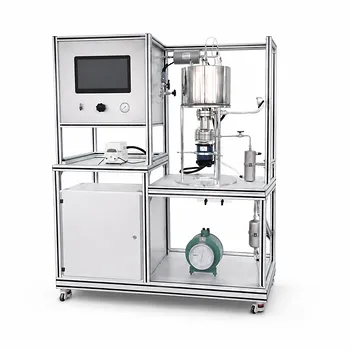
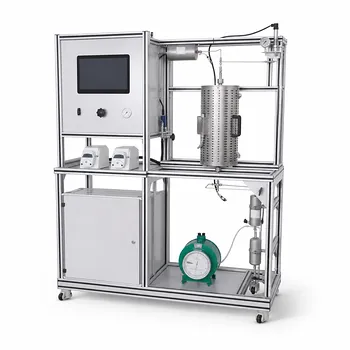
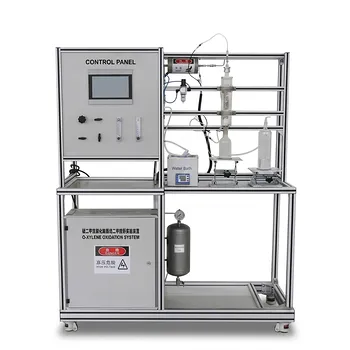
Polymerization pilot plants are not a luxury—they are a pedagogical necessity. A standard monomeric reaction unit, designed to optimize the conversion of a simple, known molecule like ammonia, cannot replicate the intricate relationship between reactor conditions and a polymer's final physical properties. Specialized polymerization pilot plants are required because they are the only way to study how chain-length distribution, branching, and heat transfer history dictate everything from a plastic's tensile strength to its clarity, phenomena that simple synthesis units simply cannot capture.
While a monomeric reactor's goal is to maximize yield of a single molecule, a polymer's identity is a distribution—its molecular weight, branching, and composition. University labs require specialized pilot plants to transform abstract kinetic models into tangible engineering judgment, teaching students that how you make a polymer is the polymer.
The Fundamental Inadequacy of Monomeric Reaction Units
A standard pilot plant for monomeric synthesis, such as an ammonia converter, is fundamentally designed around a single, well-defined target molecule. The engineering challenge is a narrow one: achieve the highest possible conversion and selectivity for that one species.
The Goal is a Molecule, Not a Material
In these systems, the product's identity is fixed. Ammonia is ammonia, regardless of the reactor's temperature profile. You either make it efficiently, or you don't. The end-use properties are inherent to the molecule itself.
Process Optimization is Linear
Scale-up calculations for such units focus on replicating a simple set of outputs: reaction rate, heat release, and yield. You are essentially solving a problem of maximizing throughput for a known chemical transformation.
Why Polymerization Demands a New Engineering Paradigm
The moment you move to polymerization, the product ceases to be a single molecule. It becomes a population of macromolecules, and the distribution of that population is what defines the material's utility. A generic name like "polyethylene" is a family, not a specification.
The Product is a Statistical Distribution
Physical performance—mechanical strength, melt flow, impact resistance—depends entirely on the molecular weight distribution (MWD) and chain architecture. A polymer batch with the same average molecular weight but a different distribution can be a complete failure for an injection-molding application. This "selectivity challenge" is a parallel, complex reaction network, not a single-pathway conversion.
Heat and Mass Transfer Dictate Structure
Polymerization reactions are often highly exothermic and can undergo the Trommsdorff-Norrish effect (autoacceleration), where viscosity spikes and heat removal collapses, leading to a runaway reaction or a broad, unusable MWD. This coupling between reaction kinetics and transport phenomena—where the viscosity of the forming polymer alters mixing and heat transfer in real-time—is a dynamic that a water-jacketed stirred tank for a simple liquid reaction can never replicate.
The "How" Defines the "What"
Because the reaction pathway (parallel, sequential, or network) is sensitive to local conditions, the reactor's mixing configuration, heat transfer surface geometry, and residence time distribution become direct design parameters for the final material's end-use mechanical properties. A specialized pilot plant makes this invisible link visible.
Bridging Theory and Industrial Reality
Laboratory glassware can provide kinetic rate constants, but it cannot teach scale-up. A specialized pilot plant is the essential bridge that reveals the non-linear complexities that render purely theoretical models useless at an industrial level.
Unmasking the Tyranny of Impurities
Kinetic models derived from pure lab-grade monomers fail on contact with reality. Pilot plants allow students to investigate how parts-per-million levels of feedstock impurities dynamically poison catalyst activity and alter comonomer incorporation rates—a make-or-break factor in continuous processes that a simulation cannot predict with certainty.
Validating Catalyst and System Integrity
Students must see first-hand how a supported catalyst particle mechanically attrits under operational fluid dynamics in a slurry bubble column, or how fouling builds on a heat exchanger in a solution process. A standard monomeric unit provides no platform for evaluating these long-term catalyst stability and separation challenges, which are critical for homogeneously catalyzed systems.
Understanding the Trade-offs in Polymerization Pilot Plant Design
Designing these specialized units involves confronting real physical contradictions. There is no universal pilot plant, and choosing the wrong configuration teaches the wrong lesson. This forces students to confront the core transport-separation trade-offs central to chemical engineering.
Slurry Reactor Pilot Plants: Isothermal Control vs. Separation Burden
For systems using fine catalyst particles (<100 µm) or requiring precise, isothermal conditions, a slurry reactor is often ideal. It excels at managing heat and can handle feeds that cause severe catalyst fouling. However, it inherently demands a secondary, often complex, separation step to remove catalyst residues from the highly viscous polymer product. The lesson: thermal elegance comes at the cost of downstream complexity.
Fixed-Bed Reactor Pilot Plants: Plug-Flow Simplicity vs. Pressure Constraints
A fixed-bed setup is suited for coarser catalysts and providing a well-defined residence time distribution. It avoids the catalyst separation problem entirely. Yet, it can suffer from crippling pressure drops if the feed has solids or if the reaction demands a long bed length, and it is susceptible to hot spots that degrade polymer quality. The lesson: mechanical simplicity can mask thermal instability.
Making the Right Choice for Your Educational Goal
The configuration of a university pilot plant should map directly to the core engineering principles you aim to teach. A one-size-fits-all approach undermines the very purpose of the investment.
- If your primary focus is teaching the link between reaction kinetics and product architecture: Choose a highly instrumented continuous stirred-tank reactor (CSTR) or a tubular reactor with multiple dosing ports for comonomers. The goal is to demonstrate how residence time distribution shapes MWD.
- If your primary focus is on industrial process troubleshooting and scale-up: Prioritize a pilot plant that mirrors an industrial configuration (e.g., a gas-phase fluidized bed or a loop reactor) with realistic monomer recovery and extruder-pelletizer systems. The goal is to let students manage the full
reaction → devolatilization → finishingsequence. - If your primary focus is on fundamental heat and mass transfer limitations: A reactor with a high surface-to-volume ratio and adjustable internal geometries is essential. This allows students to directly measure and mitigate the onset of the Trommsdorff effect under controlled conditions.
The right pilot plant transforms polymer science from a theoretical black box into a mastered engineering discipline.
Summary Table:
| Feature | Monomeric Reaction Units | Polymerization Pilot Plants |
|---|---|---|
| Target Output | Single defined molecule (e.g., ammonia) | Macromolecular population (molecular weight distribution) |
| Process Focus | Maximizing conversion and yield | Controlling physical, thermal, and mechanical properties |
| Transport Challenges | Linear, predictable scale-up | Non-linear viscosity spikes & Trommsdorff autoacceleration |
| Key Educational Value | Basic kinetics and stoichiometry | Real-world scale-up, transport limitations, and processing |
Elevate Your Chemical Engineering Lab with LABPARK
Bridge the gap between theoretical kinetics and industrial reality. LABPARK provides state-of-the-art Educational and Vocational Unit Operations Pilot Plants in chemical engineering, bioprocess & biotech, and environmental & water treatment. Designed specifically for universities, research institutes, and enterprises, our specialized pilot plants empower students and researchers to master complex transport phenomena, polymer distributions, and industrial scale-up.
Ready to upgrade your lab's capabilities? Contact us today to discuss your custom pilot plant requirements!
Related Products
- Polymerization Granulation and Pellet Processing Educational Unit Operations Pilot Plant
- Methanol Synthesis and Catalyst Performance Evaluation Educational Unit Operations Pilot Plant
- Fixed-Bed Chemical Reaction and Gas Dust Tar Removal Unit Operations Pilot Plant
- Fixed Bed Gas Solid Catalytic Reaction Educational Pilot Plant
- Fluidized Bed Gas Solid Catalytic Reaction Educational Pilot Plant
People Also Ask
- How do educational unit operations pilot plants bridge theory and design? Bridge the Engineering Gap
- How do educational unit operations pilot plants address safety and waste management when scaling up?
- What role do educational pilot plants play in scaling green chemistry? Bridging the Lab-to-Industry Gap
- How do educational pilot plants teach scale-up? Bridge the gap to commercial manufacturing.
- Why Compare Predicted and Experimental Excess Enthalpy? Key to Accurate Pilot Plant Scale-up