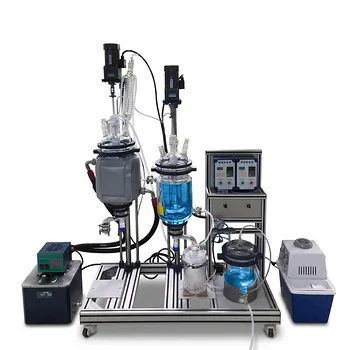
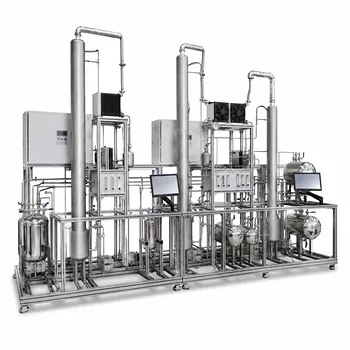
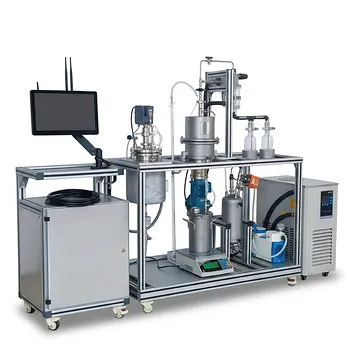
Inverse solubility creates a direct path to catastrophic fouling. In any heat-exchanged crystallizer, these solutes precipitate exactly where you don't want them—on the hottest surfaces. This rapidly chokes heat transfer, destroys process control, and forces frequent, costly shutdowns. The core challenge is that the very act of supplying the energy needed to drive supersaturation also triggers uncontrolled, localized crystal growth on the equipment itself.
Before diving into the mechanics, the central takeaway is this: Solutes with inverse solubility curves turn the thermal driving force of a crystallizer into a liability. Because they must be processed using evaporation (not simple cooling), hot heat-transfer surfaces become an unavoidable nucleation site. Pilot plants address this by turning the heat exchanger into a controlled, self-cleaning environment, using fluid dynamics, mechanical scraping, and precision thermal thresholds.
The Root Cause of the Operational Challenge
The difficulty isn’t just that these solutes behave differently. It’s that their behavior forces you into a process that inherently creates the problem.
Why Inverse Solubility Defies Standard Cooling Methods
For most solutes, solubility drops sharply as temperature falls. Cooling crystallization is the intuitive, energy-efficient solution. You simply cool the solution to create supersaturation.
Inverse solubility is the exact opposite. Solubility decreases as temperature rises. If you try to cool an inverse-solubility solution, the solute actually becomes more soluble, destroying any hope of crystal recovery. To create supersaturation, you must remove solvent.
This demands evaporative crystallization. You must heat the solution to boil off the solvent and concentrate the solute. Heat input is now non-negotiable, and the hot surfaces that deliver that heat become the central challenge.
Scaling on Heat-Transfer Surfaces – The Domino Effect
When you pass a solution with inverse solubility across a hot tube or plate, a steep, localized temperature gradient forms. The fluid layer directly in contact with the metal is the hottest.
In that thin boundary layer, the solute’s solubility plummets. Supersaturation spikes right at the wall, causing crystals to nucleate and grow directly onto the heating surface. This is scaling.
The immediate consequence is a rapid buildup of a low-thermal-conductivity crust. This scaling layer acts as an insulator, dramatically reducing heat transfer efficiency. The process fights itself: more scaling means you must increase the heating medium temperature to maintain evaporation rate, which in turn accelerates scaling. The feedback loop is vicious, leading to unplanned shutdowns, mechanical cleaning, and inconsistent crystal quality.
How Pilot Plants Diagnose and Solve the Scaling Problem
A crystallization pilot plant is not a smaller production unit; it is an engineering testbed. For inverse solubility systems, the goal is to decouple the required heat input from the surface fouling mechanism. Three main strategies are tested and validated at this scale.
Optimizing Flow Velocities to Scour the Boundary Layer
High fluid velocity through the heat exchanger tubes generates powerful shear forces at the wall. This turbulence disrupts the stagnant boundary layer where the worst scaling originates.
By testing different tube-side velocities, pilot plants identify a critical velocity regime. Above this threshold, the scouring action continuously removes incipient crystals before they can anchor and grow into a scale layer. This turns a passive encrustation process into a dynamic, manageable one. The pilot data provides a direct design basis for main pump sizing and tube geometry.
Scraped-Surface Heat Exchangers for Active Mechanical Removal
When flow alone isn't enough, the pilot plant introduces scraped-surface heat exchangers. These units feature rotating blades that continuously wipe the internal heat-transfer surface.
The mechanical action physically removes any crystals the instant they form. This maintains a pristine, scale-free surface, ensuring consistent high heat transfer coefficients. Pilot-scale operation validates the choice of blade materials, rotational speeds, and the impact on crystal size distribution, proving that you can process even the most aggressively scaling solutes continuously.
Precise Temperature Control Below the Scaling Threshold
Not all scaling is instantaneous. There is often a "metastable" zone temperature near the surface where nucleation is very slow. A pilot plant equipped with fine-resolution thermal control can pinpoint this threshold.
The strategy is to operate the heating medium (steam or hot oil) at a temperature just below the point where rapid surface nucleation occurs. A very tight ΔT drives evaporation without creating the extreme local surface supersaturation that causes catastrophic fouling. This requires advanced cascade control loops, which are perfected in the pilot environment to provide a scalable, energy-efficient solution without moving parts.
Understanding the Trade-offs
Mitigating scaling is not about finding a single perfect answer; it's about choosing the right set of compromises for your specific process.
- Scraped-surface units eliminate scaling but add high capital cost, maintenance for seals and blades, and the risk of metal fragments contaminating the product.
- High velocity operation is elegant and uses simpler equipment, but it creates a significant pressure drop, which demands larger pumps and increases energy consumption.
- Precision low-ΔT control is gentle and equipment-friendly, but it slows the evaporation rate. You will need a larger heat exchange area, increasing upfront capital cost and footprint.
Pilot plant data is the only way to objectively weigh these factors. It turns these qualitative trade-offs into quantitative design equations for your specific solute-solvent system.
Making the Right Choice for Your Pilot Plant Goal
Your mitigation strategy should be dictated by what you need to prove at the pilot scale. The equipment configuration is a tool for investigation, not just a production solution.
- If your primary focus is understanding the fundamental scaling kinetics: Configure the pilot plant with a simple tubular heat exchanger and sophisticated temperature mapping to measure the exact relationship between surface temperature and scaling rate.
- If your primary focus is demonstrating a robust, industrially viable treatment process: Test a scraped-surface exchanger or high-velocity loop to generate long-duration, fouling-free operational data that directly derisks a full-scale design.
- If your primary focus is a high-purity, shear-sensitive product: Invest heavily in the precise low-ΔT control strategy, using the pilot plant to log the long-term stability of the heat transfer coefficient as your primary validation metric.
The pilot plant transforms the inevitable fouling tendency of inverse-solubility solutes from a fatal operational flaw into a designed, controlled, and understood parameter ready for commercial success.
Summary Table:
| Strategy | Mechanism | Key Advantage | Trade-off / Cost |
|---|---|---|---|
| High Flow Velocity | Disrupts boundary layer with fluid shear | Simple equipment design | High pressure drop & pumping energy |
| Scraped-Surface HX | Mechanical blades wipe crystals off walls | Eliminates scaling entirely | High capital cost & maintenance |
| Precise Low-ΔT Control | Keeps surface temp below nucleation point | Gentle on crystals, no moving parts | Slower evaporation, larger HX area required |
Master Crystallization Challenges with LABPARK
Are scaling issues or complex crystallization kinetics hindering your research or educational goals? LABPARK provides premium Educational and Vocational Unit Operations Pilot Plants in chemical engineering, bioprocess & biotech, and environmental & water treatment.
Designed specifically for universities, research institutes, and enterprises, our pilot plants help you model real-world challenges, optimize process parameters, and scale up with confidence.
Contact our engineering team today to discover how we can customize a pilot plant solution for your lab!
Related Products
- Multi Functional Membrane Crystallization Educational Unit Operations Pilot Plant
- Potassium Salt Thermal Dissolution and Crystallization Separation Educational Unit Operations Pilot Plant
- Rising and Falling Film Evaporation Educational Unit Operations Pilot Plant
- Multi-Modal Distillation Unit Operations Training Pilot Plant
- Natural Product Extraction Unit Operations Training Pilot Plant
People Also Ask
- Control Crystallization Pilot Plant Secondary Nucleation: 4 Key Adjustments
- Why is precise temperature control critical in crystallization pilot plants? Key to Scale-Up Success
- What key factors should be considered when configuring a crystallization unit operations pilot plant?
- What are the benefits of integrating online PAT tools like ATR-FTIR into crystallization unit operations pilot plants?
- How to use crystallization pilot plant agitation speed to identify diffusion vs reaction growth?