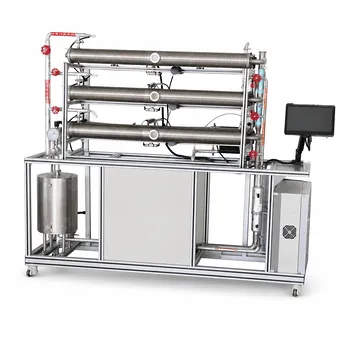
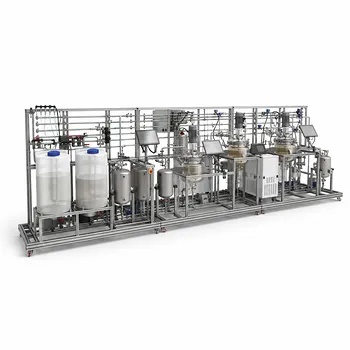
The answer lies in pedagogical isolation. Standalone unit operations pilot plants are the cornerstone of chemical engineering education because they are self-contained, simplified systems that let students master a single fundamental process—like distillation or absorption—without the overwhelming complexity of a fully integrated industrial plant. This deliberate isolation creates a safe, controllable sandbox for learning the core principles of fluid dynamics, heat and mass transfer, and process control. In stark contrast, industrial projects are almost never built as isolated, grass-roots units; over 90% involve integrating new equipment into a complex web of existing utility networks, heat recovery systems, and recycle loops.
The core insight is that educational pilot plants are optimized for learning a single principle in a controlled environment, while industrial projects are constrained by the economic and thermodynamic reality of complete system integration. The educational tool’s greatest strength—its independence—is the exact opposite of real-world engineering practice, which is defined by interconnectedness.
The Pedagogical Power of a Simplified Universe
The primary goal of an educational pilot plant is not to produce a chemical product, but to produce a knowledgeable engineer. This fundamental difference in purpose dictates every aspect of its design. By stripping away the interlocks of a full-scale plant, the system transforms from a black box into a transparent educational tool.
Bridging the Theory-Practice Chasm
Chemistry and physics are taught through abstract formulas predicting reaction directions, heat exchange, and rates. A standalone pilot plant bridges this gap by providing a hands-on, scaled-down industrial environment. Students can physically manipulate parameters like temperature, pressure, and flow rates, directly observing how thermodynamic equilibria and kinetic rates manifest in real time. This immediate feedback loop translates a textbook equation like Fourier’s Law into an observable, tactile reality. The student sees the temperature profile change, not just calculates it.
The “Kilo Lab” Scale of Understanding
This learning happens at a critical scale between the gram-scale of a beaker and the tonnage of a production facility. Bench-top glassware cannot demonstrate fluid dynamics, mixing dead zones, or the challenges of heat removal at scale. A pilot plant, often in the 50–4,000 L range, introduces these real-world physical constraints. A stir bar in a round-bottom flask behaves perfectly; a mechanical agitator in a 200L reactor reveals channeling, vortexing, and the non-ideal mixing behaviors engineers must actually manage.
A Safe Playground for Cause and Effect
A self-contained unit is an unparalleled safety training tool. In an integrated plant, a pressure spike in a reactor could cascade into a disaster in downstream separation columns. In an isolated educational skid, the same error results in a data spike on a screen and a teachable moment. This environment allows students to safely explore process limits, learn the logic of alarms and interlocks, and develop a visceral respect for process safety without creating an industrial hazard.
The Industrial Reality: Thinking in Loops, Not Units
The clean, standalone skid that defines a university lab is an anomaly in professional practice. The industrial world is fundamentally about integration, resource efficiency, and managing complexity. The isolated unit operation is a learning module; the interconnected plant is a profit center.
Integration is the Default, Not the Exception
The primary reference highlights a powerful statistic: less than 10% of industrial projects are completely independent grass-roots systems. The vast majority of engineering work involves retrofitting, expanding, or debottlenecking within an existing infrastructure. A new distillation column is not just a column; it’s a new draw on a steam header, a new duty for a cooling water system, and a new source for a flare network. The design process is dominated by tie-in points, heat and material integration, and the ripple effects that a new unit sends through the established plant.
The Energy Integration Imperative
A standalone educational skid on its own is a thermodynamic nightmare by industrial standards. It likely uses fresh utilities and discards waste heat directly to the environment. An industrial plant cannot survive this way. Heat integration, using a hot product stream to pre-heat a cold feed stream, is a core skill taught by the absence of this feature in a standalone unit. The educational lesson is that real designs are dictated by the Pinch analysis, connecting reactors to separation trains to recovery boilers in a complex web that a standalone unit deliberately omits.
Understanding the Trade-offs: The Limitations of Isolation
While pedagogically powerful, the standalone unit ops model has a critical downside that must be openly acknowledged. The very independence that makes it an excellent teaching tool can create a conceptual gap that educators must actively bridge.
The Lost Lesson of System Dynamics
Students trained exclusively on isolated units often fail to grasp the time-dependent, domino-like behavior of an integrated plant. A change in reflux ratio in a standalone column is a simple test to see a purity change. In a real plant, that same change immediately alters the hydraulic load on the upstream reactor’s overhead condenser, potentially destabilizing the reaction and creating a positive feedback loop. The surging and hunting behavior of an integrated heat recovery network is a whole that is far greater than the sum of its standalone parts.
The Oversimplification of Economics
A standalone pilot plant makes utility consumption an abstract academic exercise. An industrial facility makes it a line item that determines profitability. The deep need to minimize steam, cooling water, and electricity through integration is the primary driver of a process design, yet it is the most difficult concept to demonstrate in a single-unit skid. The risk is that a student learns how a pump works perfectly but never internalizes that running it unnecessarily is a direct loss of corporate revenue.
Making the Right Choice for Your Training Goal
The decision between a standalone and an integrated pilot plant depends entirely on your educational objective. The tool must match the lesson. Based on this analysis, the path forward is clear for different priorities.
- If your primary focus is mastering fundamental unit operations: A standalone pilot plant is the definitive choice. It provides the uncluttered, safe, and controllable environment needed to isolate and deeply understand principles like mass transfer and heat exchange without distraction.
- If your primary focus is teaching process integration and plant-wide dynamics: A single standalone unit is insufficient. You need a multi-unit system with recycle loops and heat recovery to demonstrate the critical stability, control, and optimization challenges of a real industrial ecosystem.
- If your primary focus is training for an industrial commissioning or debottlenecking project: Begin with a standalone unit to teach the fundamentals of a specific piece of equipment, but then immediately overlay a simulation or case study that places that unit within a complex, pre-existing network with strict tie-in constraints.
The ultimate goal is to produce engineers who are masters of the fundamentals, yet fully aware of the complex industrial web that awaits them. The standalone unit is not a replica of a chemical plant; it is a carefully designed gymnasium for building specific, essential mental muscles before the student ever steps onto the real playing field.
Summary Table:
| Feature | Standalone Educational Pilot Plants | Integrated Industrial Projects |
|---|---|---|
| Primary Goal | Pedagogical learning & safety | Economic profit & resource efficiency |
| System Design | Isolated, simplified unit operations | Interconnected networks & recycle loops |
| Energy Focus | Fresh utilities (isolated limits) | Heat integration & pinch analysis |
| Risk Level | Safe sandbox for cause/effect | Cascading risks & system dynamics |
Bring Hands-On Engineering to Life with LABPARK
Are you looking to equip your students or research team with the ultimate learning tools? LABPARK provides premium Educational and Vocational Unit Operations Pilot Plants in chemical engineering, bioprocess & biotech, and environmental & water treatment designed specifically for universities, research institutes, and enterprises.
Bridge the gap between classroom theory and real-world industrial practice. Contact us today to find the ideal pilot plant solution tailored to your educational and training goals!
Related Products
- Solid Waste Pyrolysis and Refining Educational Pilot Plant for Unit Operations
- Multimodal Absorption and Desorption Pilot Plant for Unit Operations Training
- Three-Tube Heat Transfer Educational Pilot Plant for Unit Operations Training
- Educational Unit Operations Pilot Plant for Intraparticle Diffusion Effective Factor Measurement
- Two-Dimensional Fluidization Hydrodynamics Educational Pilot Plant for Unit Operations Training
People Also Ask
- How do educational unit operations pilot plants bridge theory and design? Bridge the Engineering Gap
- How do educational unit operations pilot plants address safety and waste management when scaling up?
- When to transition from PID to adaptive control in pilot plants? Key process indicators.
- Why is the chemical plant startup schedule crucial? De-risk scale-up with pilot plants.
- Why Use PTFE & Hastelloy in Chemical Pilot Plants? Prevent Corrosion & Ensure Safety