Knowledge Chemical Engineering Education Why are unit operations pilot plants essential for model validation? Ensure safe process scale-up.
Author avatar

Tech Team · LABPARK

Updated 1 month ago

Why are unit operations pilot plants essential for model validation? Ensure safe process scale-up.


Here is the definitive reason: physical unit operations pilot plants are essential because they are the only authoritative, empirical arbiter when competing thermodynamic models produce conflicting predictions for phase equilibrium. Without this physical validation, process designers risk scaling up a simulation based on an inaccurate model, which can lead to catastrophic yield loss, safety incidents, or uneconomical operations.

A software simulation is only as trustworthy as the thermodynamic model it relies on. When experimental data is missing, different models can diverge wildly. A physical unit operations pilot plant closes this gap by providing real-world equilibrium data that either confirms a model’s accuracy or provides the hard numbers needed to calibrate it, transforming an educated guess into a fact-based design.

The Gap Between Simulation and Reality

The Inherent Fragility of Thermodynamic Models

Modern process simulators deploy a library of models—NRTL, UNIQUAC, UNIFAC—to calculate phase equilibrium (VLE/LLE).
These models are semi-empirical. They depend on binary interaction parameters that are often estimated when experimental data for a specific mixture is absent.

An estimation method like the Group Contribution approach is convenient, but it introduces compounding uncertainties at each step.
Even within a model’s published applicable range, predictions for nonideal mixtures can behave erratically, creating a false sense of security.

When Missing Data Leads to Dangerous Assumptions

In many real-world projects, you will encounter a complex mixture for which no published VLE data exists.
Your simulator will happily run a flash calculation, but running the same separation under NRTL versus UNIQUAC could yield vastly different column profiles, reflux ratios, and stage requirements.

The simulation’s output is not a single truth—it is a spread of possible outcomes clustered around different model selections.
At this point, trusting any one model without physical evidence is a gamble, and the simulation has moved from a design tool to a source of risk.

The Pilot Plant: The Empirical Arbiter

Collecting Real Phase Equilibrium Data

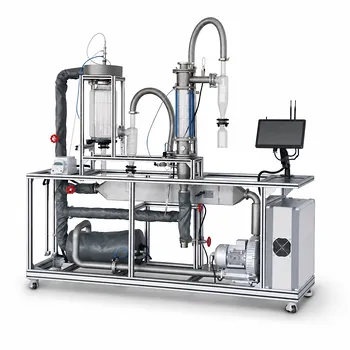
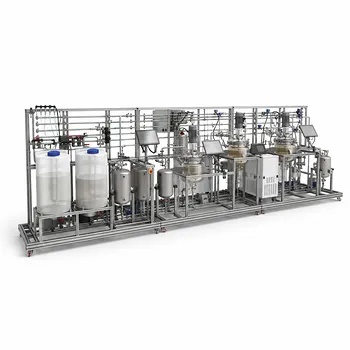
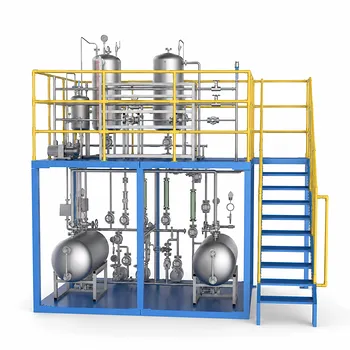
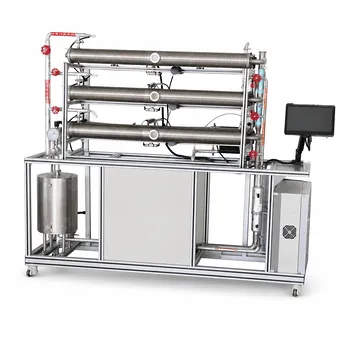
A unit operations pilot plant—whether a distillation, extraction, or absorption column—takes the debate out of the software environment and into controlled physical reality.
You charge the column with your actual multi-component mixture and bring it to steady state.

You then take stream samples from the reboiler, distillate, and side draws, analyzing them to determine the true composition distribution.
This real-world composition profile becomes the benchmark against which every simulation prediction is measured.

Calibrating Model Parameters with Steady-State Operation

Pilot plants do more than just validate; they generate the data needed for model regression.
If your preferred thermodynamic model fails to match the physical results, you use the pilot plant’s experimental tie-lines or vapor–liquid compositions to directly regress and optimize the binary interaction parameters.

This process transforms a generic, estimated model into a process-specific, tuned correlation that accurately reflects the true molecular interactions at play.
Only then does the simulation become a reliable platform for scale-up, because it has been anchored to physical truth.

Understanding the Trade-offs

Cost and Time vs. Certainty

A physical pilot plant campaign is undeniably resource-intensive. It demands capital, operator time, and process feedstock.
Skipping this step and moving straight to detailed design based on an unverified model is faster and cheaper in the short term.

However, that short-term saving is dwarfed by the long-term cost of a commercial-scale failure.
A pilot plant costs money to run; a failed plant costs a career to explain.

The Limits of Pilot Plant Data

A pilot-scale column cannot replicate every nuance of a thousand-ton-per-day facility. Mass transfer and fluid dynamics may not scale linearly.
Therefore, a successful pilot trial validates the underlying thermodynamics but does not, on its own, guarantee a flawless hydraulic design for the full-scale unit.

Furthermore, a pilot plant run measures only the specific feed composition and operating window you test.
Extrapolating to significantly different pressures or impurity profiles still requires engineering judgment, making the pilot data a powerful but not omnipotent tool.

Making the Right Choice for Your Process Development

Align your validation strategy with your project’s phase and risk profile.

  • If your primary focus is a preliminary feasibility study: Use estimation methods and software databases like DIPPR or DECHEMA, but always flag the thermodynamic model uncertainty as a key risk that requires future resolution.
  • If your primary focus is a tight, high-purity separation with expensive raw materials: A pilot plant distillation run is non-negotiable; it provides the definitive equilibrium data to regress your NRTL or UNIQUAC parameters and prevent costly specification misses.
  • If your primary focus is a retrofit or troubleshooting an existing unit: Run a test campaign on your pilot plant with the actual plant feed to isolate thermodynamic mispredictions from equipment fouling or hydraulic issues, giving you a clear diagnostic signal.

Run the physical experiment before you bet the plant on a line of code—that is how you turn process uncertainty into process safety.

Summary Table:

Aspect Software Simulation (NRTL/UNIQUAC) Physical Pilot Plant Validation
Data Source Estimated binary interaction parameters Real-world steady-state equilibrium data
Risk Level High (compounding uncertainties & yield loss) Low (anchored to empirical, physical truth)
Primary Use Preliminary feasibility & initial design Model calibration, scale-up, & troubleshooting
Key Limitation Output varies wildly with model choice Requires capital, feedstock, and testing time

Bridge the Gap Between Simulation and Reality with LABPARK

Don't risk your process scale-up on unverified simulation models. LABPARK provides state-of-the-art Educational and Vocational Unit Operations Pilot Plants in chemical engineering, bioprocess & biotech, and environmental & water treatment. Tailored for universities, research institutes, and enterprises, our systems deliver the real-world thermodynamic and phase equilibrium data needed to calibrate models and ensure operational success.

Ready to optimize your process design? Contact our experts today to find the perfect pilot plant solution for your facility.

Related Products

People Also Ask

Related Products

Multi-Functional Drying Educational Unit Operations Pilot Plant

Multi-Functional Drying Educational Unit Operations Pilot Plant

Versatile multi-functional drying educational unit operations pilot plant integrating tunnel, fluidized bed, and spray drying. Enables hands-on study of drying curves, psychrometry, and gas-solid separation for chemical engineering curriculum in higher education labs.

General Purpose Cosmetics Production Unit Operations Training Pilot Plant

General Purpose Cosmetics Production Unit Operations Training Pilot Plant

Integrated pilot-scale cosmetics production training plant for chemical engineering education featuring utility supply emulsification blending and filtration modules with dual touchscreen manual control customizable mobile design ideal for practical hands-on unit operations and advanced process control learning.

Dual-Mode Rectification Pilot Plant for Practical Training Unit Operations

Dual-Mode Rectification Pilot Plant for Practical Training Unit Operations

Industrial-scale dual-mode rectification pilot plant for chemical engineering practical training. Features real-material and simulated-material operation modes, sieve-plate column with sight glasses for visual observation of hydrodynamics, and customizable SCADA control for safe, hands-on learning of unit operations and mass transfer.

Multi-Reactor Educational Pilot Plant for Reaction Engineering Unit Operations

Multi-Reactor Educational Pilot Plant for Reaction Engineering Unit Operations

Integrated bench-scale educational pilot plant for chemical engineering teaching featuring fixed bed fluidized bed and stirred tank reactors with web-based digital twin controls and safety interlocks for hands-on unit operations and reaction engineering comparative studies in one compact system.

Multimodal Absorption and Desorption Pilot Plant for Unit Operations Training

Multimodal Absorption and Desorption Pilot Plant for Unit Operations Training

Multimodal absorption and desorption pilot plant for higher education labs. Bridges theory and industrial practice with transparent packed columns, three operational modes (real-material, simulated, semi-physical), and SCADA control. Students explore mass transfer, column hydraulics, and process control. Customizable.

Multi Pump Fluid Transport Process Piping Unit Operations Training Pilot Plant

Multi Pump Fluid Transport Process Piping Unit Operations Training Pilot Plant

Industrial-scale multi-pump pilot plant for unit operations training in fluid transport and process piping, featuring real-material and semi-physical simulation modes, comprehensive pump and flowmeter calibration, and safety-enhanced two-tier platform, bridging academic theory and industrial practice for chemical engineering education.

Three-Tube Heat Transfer Educational Pilot Plant for Unit Operations Training

Three-Tube Heat Transfer Educational Pilot Plant for Unit Operations Training

Three-tube heat transfer pilot plant for studying convective heat transfer enhancement and condensation. Allows comparison of smooth, corrugated, turbulent tubes, verifying empirical correlations. Ideal for chemical engineering education with safety and closed-loop steam recovery.

Two-Dimensional Fluidization Hydrodynamics Educational Pilot Plant for Unit Operations Training

Two-Dimensional Fluidization Hydrodynamics Educational Pilot Plant for Unit Operations Training

Explore gas-solid and liquid-solid fluidization hydrodynamics with our transparent 2D educational pilot plant. Ideal for chemical engineering unit operations labs, it demonstrates fixed to fluidized bed regimes, measures pressure drop, and integrates QR-code digital learning for enhanced student training.

Dual Mode Heat Transfer Pilot Plant for Unit Operations Training

Dual Mode Heat Transfer Pilot Plant for Unit Operations Training

Engineering-scale dual-mode heat transfer pilot plant for hands-on unit operations training in chemical engineering. Features real and simulated modes, multiple heat exchanger types, comprehensive coefficient determination, and advanced process control with data acquisition for engineering students and researchers.

Electrolytic Hydrogen Production Educational Unit Operations Pilot Plant

Electrolytic Hydrogen Production Educational Unit Operations Pilot Plant

Bench-scale electrolytic hydrogen production pilot plant designed for university engineering labs. Provides hands-on training in water electrolysis, gas-liquid separation, and process safety. Fully customizable system with digital PID control, corrosion-resistant components, and hydrogen gas detector. Ideal for chemical engineering curricula.

100L Continuous Loop Hydrogenation Educational Unit Operations Pilot Plant

100L Continuous Loop Hydrogenation Educational Unit Operations Pilot Plant

This 100L continuous loop hydrogenation pilot plant is designed for chemical engineering education, featuring 316 stainless steel construction, advanced gas-liquid mass transfer components, explosion-proof safety systems, and a 15.6-inch touchscreen with 5G connectivity, cloud data logging, bridging theory and industry.

Ethyl Acetate Synthesis Unit Operations Pilot Plant for Practical Training

Ethyl Acetate Synthesis Unit Operations Pilot Plant for Practical Training

Modular and customizable pilot plant for ethyl acetate synthesis practical training. Integrates esterification reaction, liquid-liquid extraction, neutralization, and sieve-plate distillation unit operations. Bridging theory and real-world industrial processes. Designed for university chemical engineering labs

Natural Product Extraction Unit Operations Training Pilot Plant

Natural Product Extraction Unit Operations Training Pilot Plant

Integrated natural product extraction pilot plant for chemical engineering training bridges theory and industrial practice with modular extraction and evaporation/concentration units, hybrid touchscreen and manual control, realistic process simulation, and self-contained softened water and vacuum utilities.

Multi-Modal Distillation Unit Operations Training Pilot Plant

Multi-Modal Distillation Unit Operations Training Pilot Plant

Multi-modal distillation pilot plant for practical unit operations training in chemical engineering education. Features real, analog, and semi-physical simulation modes, industrial construction, customizable for university labs. Hands-on fractionation columns, SCADA control, safety systems. Includes sight glasses, sampling ports, closed-loop recycling.

Solid Waste Pyrolysis and Refining Educational Pilot Plant for Unit Operations

Solid Waste Pyrolysis and Refining Educational Pilot Plant for Unit Operations

This pilot plant for solid waste pyrolysis and refining integrates pyrolysis, separation, distillation, and catalytic hydrogenation into one educational unit. It provides visual process observation, smart data logging, and industrial safety for hands-on learning of engineering unit operations.

Educational Unit Operations Pilot Plant for Intraparticle Diffusion Effective Factor Measurement

Educational Unit Operations Pilot Plant for Intraparticle Diffusion Effective Factor Measurement

Designed for chemical engineering university labs, this pilot plant allows hands-on determination of catalyst particle intraparticle diffusion effective factors and gas-solid reaction kinetics using a fixed-bed tubular reactor with industrial touchscreen control, bridging theory and practical reactor design.

Fixed-Bed Chemical Reaction and Gas Dust Tar Removal Unit Operations Pilot Plant

Fixed-Bed Chemical Reaction and Gas Dust Tar Removal Unit Operations Pilot Plant

Integrated educational pilot plant for studying catalytic gas-solid reactions and downstream gas purification. Features dual fixed-bed reactor, three-stage heating, and touchscreen control for hands-on engineering training. Ideal for chemical and environmental engineering curricula.

Multi-Functional Membrane Separation Educational Pilot Plant for Unit Operations Lab

Multi-Functional Membrane Separation Educational Pilot Plant for Unit Operations Lab

The Multi-functional Membrane Separation Educational Unit Operations Pilot Plant is an integrated bench-scale laboratory system designed for teaching undergraduate engineering education. It features Ultrafiltration, Nanofiltration, and Reverse Osmosis modules in a compact, mobile unit for practical hands-on learning.

Comprehensive Fluid Mechanics Educational Unit Operations Pilot Plant

Comprehensive Fluid Mechanics Educational Unit Operations Pilot Plant

Hands-on fluid mechanics pilot plant for engineering education covering over 13 principles including pipe flow, minor losses, flowmeter calibration, and pump performance with industrial-grade components, smooth and rough piping, venturi and orifice flowmeters, and centrifugal pump testing and analysis.

Methanol Synthesis and Catalyst Performance Evaluation Educational Unit Operations Pilot Plant

Methanol Synthesis and Catalyst Performance Evaluation Educational Unit Operations Pilot Plant

Bench-scale methanol synthesis and catalyst evaluation educational pilot plant for chemical engineering labs to study catalytic kinetics, high-pressure operations, process control, and unit operations under realistic conditions with industrial safety features, precision gas delivery, data acquisition, and intelligent monitoring.


Leave Your Message