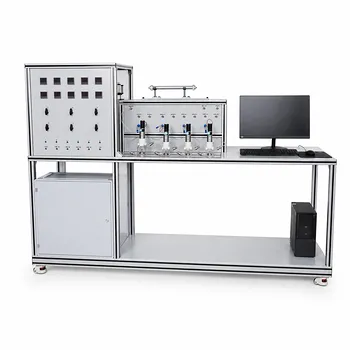
Precise thermal control and process intensification are the driving forces. Microchannel reactors are being integrated into chemical engineering unit operations pilot plants because their sandwich-like, sub-millimeter channel architecture provides exceptional heat transfer capabilities that make the safe and efficient study of highly exothermic or endothermic reactions fundamentally practical. They transform dangerous, hard-to-characterize reactions into manageable, data-rich experiments that directly teach process intensification principles.
The core reason is that microchannel reactors shrink heat and mass transport distances to less than a millimeter, yielding heat transfer coefficients 10 to 500 times greater than conventional reactors. This enables near-isothermal operation of reactions that would otherwise experience dangerous temperature spikes, eliminating the need for extreme cryogenic cooling while producing the clean kinetic data essential for both education and scale-up research.
The Fundamental Thermal Advantage
Unmatched Heat Transfer Performance
A conventional pilot-scale reactor might manage heat transfer coefficients between 100 and 700 W/m²K. A microchannel reactor, with its closely spaced channels and high surface-to-volume ratio, achieves values between 10,000 and 35,000 W/m²K. This order-of-magnitude leap means heat can be added or removed almost instantaneously, preventing the formation of destructive hot or cold spots.
High Surface-to-Volume Ratio
The channels, typically with gaps less than 1 mm, create an enormous surface area for heat exchange relative to the reaction volume. This dramatically reduces diffusion resistance, ensuring that heat and mass transfer do not obscure the true reaction kinetics. Students and researchers can therefore study a reaction running close to its intrinsic kinetic limit, rather than being limited by heat transfer lag.
Enabling the Safe Study of Dangerous Reactions
Taming Exothermic Runaway
Reactions like preferential oxidation (PROX) and the water-gas shift (WGS) can experience temperature spikes exceeding 100°C under adiabatic conditions. That surge risks thermal runaway and triggers unwanted side reactions, such as hydrogen oxidation, that ruin both selectivity and safety. Microchannel reactors combat this by sandwiching the catalyst—often in metal foam form—directly between integrated microchannel heat exchanger panels.
This active cooling keeps the reaction temperature tightly controlled within a band of ±20°C. Staged air addition within the channel network further flattens the temperature profile. The result is a stable, near-isothermal environment where researchers can safely evaluate catalyst performance without the constant threat of a runaway.
Efficient Heat Delivery for Endothermic Processes
The challenge for a reaction like methane steam reforming is getting enough heat into the catalyst, not removing it. Microchannel reactors solve this by placing interleaved combustor channels next to the reaction channels. These adjacent hot channels deliver heat precisely where it is consumed, allowing operators to minimize temperature gradients along the flow axis and achieve higher conversion in a much smaller volume.
Process Intensification and Operational Simplification
Eliminating Cryogenic Dependency
Many highly exothermic reactions in traditional batch processing require extreme cooling, sometimes down to -60°C, to control reaction rate and selectivity. This demands expensive, energy-intensive, low-temperature utility systems. Because microchannel reactors can remove heat so effectively, the same exothermic reactions can often be run safely at ambient temperatures.
Integrating a microreactor module into a pilot plant directly demonstrates this principle of process intensification. The plant footprint shrinks, energy costs drop, and utility requirements simplify dramatically. The educational value is immediate: students witness a cleaner, inherently safer chemical process.
Compact Footprint and Integrated Heat Exchange
The high heat transfer efficiency eliminates the need for separate, bulky shell-and-tube heat exchangers downstream. The heat exchange is built directly into the reactor structure, condensing entire unit operations into a single, compact device. This not only saves bench space but also teaches a critical lesson: reducing equipment size through clever engineering is a direct path to capital and operational cost savings.
A Platform for Kinetic Discovery
Collecting High-Quality Kinetic Data
In a pilot plant, the primary research goal is often to build a reliable rate equation. Microchannel reactors excel here because they provide real-time data on temperature, pressure, and concentration under exceptionally well-controlled conditions. With exotherms flattened and mass transfer limitations minimized, the mathematical model fitting reveals the true activation energy and rate constants, not artifacts of the equipment.
This empirical data is vital for validating models and designing safety relief systems for full-scale plants. It allows researchers to isolate and study reaction mechanisms across a wide temperature range without risking an industrial-scale catastrophe.
Bridging Theory and Industrial Practice
For students, the reactor is a hands-on tutorial in modern chemical engineering. It turns abstract concepts in heat and mass transfer into visible, measurable performance improvements. A pilot plant can directly compare gas-phase and liquid-phase operations, evaluate catalyst selectivity under isothermal conditions, and test strategies for taming even the most temperamental chemistries.
Understanding the Limitations and Trade-offs
Scale-Up Challenges
The tiny channels that provide such excellent heat transfer inherently limit throughput. Scaling production from a single channel to industrial volumes requires parallelization—stacking numerous identical channels. This creates a new engineering puzzle: ensuring perfectly uniform flow distribution across thousands of parallel paths to avoid hotspots in starved channels.
Susceptibility to Clogging
Particulate matter, catalyst fines, or fouling can easily block a sub-millimeter passage. Once a channel is clogged, cleaning the intricate internal network is difficult and can render the reactor module unusable. Reactions involving solid precipitation or sticky intermediates are generally poor candidates for a microchannel environment.
Higher Fabrication Complexity
Manufacturing the precise, multi-layer metal or ceramic sandwiches with embedded heat exchangers is more complex than welding a standard pressure vessel. This can mean higher initial fabrication costs and a more limited selection of materials compared to conventional stirred-tank or fixed-bed reactors. The decision to use a microchannel reactor is therefore a deliberate trade-off: the superior data quality and safety must justify the more complex hardware.
Choosing the Right Tool for Your Pilot Plant Study
Your specific research or educational goal determines whether a microchannel reactor is the correct investment.
- If your primary focus is isolating intrinsic reaction kinetics: The microchannel reactor is unmatched. Its ability to suppress temperature gradients and mass transfer limitations ensures the data you collect reflects the true chemistry, not the equipment.
- If your primary focus is safely demonstrating process intensification: This is the ideal platform. You can show students and stakeholders how compact, integrated heat exchange eliminates cryogenic cooling and shrinks the plant footprint by an order of magnitude.
- If your primary focus is studying catalyst performance under near-isothermal conditions: The precise temperature control within ±20°C allows for a clean comparison of catalyst formulations, preventing runaway side reactions from muddying the results.
By selecting a microchannel reactor for these specific, high-value applications, a pilot plant becomes more than a training tool—it becomes a window into the safer, more efficient, and kinetically pure chemical processes of the future.
Summary Table:
| Feature | Conventional Pilot Reactors | Microchannel Reactors |
|---|---|---|
| Heat Transfer Coefficient | 100 - 700 W/m²K | 10,000 - 35,000 W/m²K |
| Channel Gap / Size | Standard vessel/pipe dimensions | Sub-millimeter (< 1 mm) |
| Temperature Control | High risk of hot/cold spots | Near-isothermal (within ±20°C) |
| Cooling Requirements | Often requires energy-intensive cryogenics | Often runs safely at ambient temperatures |
| Primary Research Value | General macroscopic scale-up data | Intrinsic kinetic discovery & process intensification |
Bring Advanced Process Intensification to Your Lab
Looking to equip your facility with cutting-edge reactor technology? LABPARK provides state-of-the-art Educational and Vocational Unit Operations Pilot Plants in chemical engineering, bioprocess & biotech, and environmental & water treatment. Designed specifically for universities, research institutes, and enterprises, our pilot plants ensure safe, precise, and highly efficient process exploration.
Ready to elevate your research and training capabilities? Contact LABPARK today to discuss your custom pilot plant configuration!
Related Products
- Micro-Scale Gas-Solid Catalytic Reaction Educational Pilot Plant
- Multi-Stage Stirred Tanks in Series Residence Time Distribution and Mixing Performance Determination Educational Pilot Plant
- Photocatalytic Membrane Separation and Degradation Unit Operations Pilot Plant
- Internal Circulation Gradient Free Catalytic Reaction Educational Pilot Plant
- Methane Cracking Educational Unit Operations Pilot Plant
People Also Ask
- How to determine catalyst pore radius & porosity? Optimize your chemical engineering pilot plant.
- How does identifying the rate-limiting step optimize reaction conditions? Pilot Plant Guide
- Why is a multibed configuration necessary for exothermic reactions? Optimize your pilot plant trajectory.
- Fluidized vs. Fixed Bed Reactors: Comparing Heat & Complexity in Pilot Plants
- How to distinguish Knudsen vs molecular diffusion in catalytic reactor pilot plants?