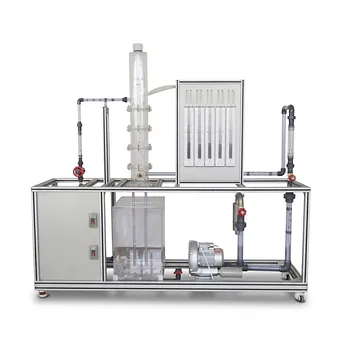
Selectivity is the canary in the coal mine for non-ideal flow. Consecutive reactions are used in educational pilot plants because the yield of their intermediate products—like B in a series A → B → C—is exquisitely sensitive to how long fluid elements spend inside the reactor. Any broadening of the residence-time distribution (RTD) caused by bypassing, stagnant zones, or channeling immediately distorts the product distribution in a measurable way, making the abstract concept of flow maldistribution tangible and quantifiable for students.
The goal isn't just to measure how long molecules stay in the reactor—it's to reveal how uneven time distributions directly sabotage the thing you're trying to manufacture: the desired intermediate. Consecutive reactions turn fluid dynamics into a chemical report card.
The Link Between Flow and Selectivity
Why a Simple Reaction Isn't Enough
A single, irreversible reaction A → Product depends only on the average extent of conversion; its rate might drop in a poorly mixed reactor, but the story is incomplete. Consecutive reactions force a deeper inquiry, because the intermediate product (B) is both formed and consumed. If some fluid elements reside for too short a time, they exit before B can be produced; if they linger too long, B overreacts to form undesired C.
The Goldilocks Principle of Residence Time
In an ideal plug-flow reactor, every element marches in lockstep, giving a single, optimal residence time to maximize B. A broad RTD creates a dispersion of reaction times, effectively running many small "reactors" in parallel, each with a different space time. The summed output from all these time slices yields a selectivity that is always worse than the ideal plug-flow benchmark—a perfect experimental proof of the damage done by backmixing.
Using the Intermediate as a Diagnostic Tool
The Chemical Report Card
By analyzing the outlet concentrations of B and C, students can distinguish between two common failure modes in a pilot plant. A drop in B’s yield accompanied by a rise in A’s concentration points to bypassing or short-circuiting—reactant slipping through too fast. A drop in B’s yield accompanied by a rise in C’s concentration indicates stagnancy or dead zones, where material overreacts well past the optimum.
Decoupling Catalyst Activity from Fluid Dynamics
In catalytic pilot plants, a performance decline can be mistakenly blamed on a deactivating catalyst when the real culprit is a degraded flow pattern. Consecutive reactions provide a chemical signature: if the ratio of C to B changes dramatically while total conversion remains similar, the RTD has likely shifted—not the intrinsic kinetics. This teaches a critical engineering lesson: you cannot troubleshoot a reactor’s selectivity without first understanding its flow distribution.
Grounding Abstract Theory in Measurable Reality
From Tracer Curves to Tangible Consequences
Students often learn to evaluate dimensionless RTD functions like F(θ) and f(θ) and calculate variance, but those curves can feel academic without a purpose. The intermediate yield acts as a physical integrator of the RTD, converting statistical moments like the mean and variance into cold, hard chemical numbers. When a student sees a CSTR-like broad distribution decimate B’s yield compared to a 10-stage tanks-in-series setup, the link between backmixing and selectivity becomes unforgettable.
Reinforcing the Segregation-Macromixing Spectrum
Ideal plug flow represents complete segregation of fluid elements; an ideal CSTR represents perfect macromixing. Consecutive reactions vividly illustrate this spectrum: a segregated flow preserves the narrow time history needed for selective production of an intermediate, while backmixing smears it out. This experimental contrast cements why reactor design—and often complex staging—exists in the first place.
Understanding the Trade-offs and Pitfalls
The Risk of Over-Interpreting Data
Without independent measurement of the RTD via a tracer test, a change in selectivity could still be misattributed. A true drop in catalyst activity might alter the ratio of rate constants (k1/k2), which would shift the optimal selectivity point even under perfect plug flow. The educational value lies in pairing the chemical analysis with a tracer test to deconvolute kinetics from hydrodynamics.
The Assumption of Known Kinetics
This method works brilliantly when students already know the consecutive reaction scheme and its rate constants from controlled batch experiments. If the reaction network is more complex, with parallel paths or reversibility, interpreting the intermediate’s fate becomes ambiguous. The educational setup must therefore select a robust, well-characterized model system (like certain esterification or catalytic oxidation trains) to isolate the RTD’s influence.
Scale-Up Caution
A pilot plant’s RTD is not necessarily a predictor of a full-scale unit’s RTD, but its impact on selectivity is a universal warning. The takeaway is not to clone the pilot RTD, but to understand that flow maldistribution at any scale is a selectivity killer that cannot be ignored in reactor design.
How to Apply This to Your Educational or Development Goals
The specific insights you emphasize will depend on your audience and what you want them to internalize.
- If your primary focus is undergraduate chemical engineering labs: Center the lesson around the direct comparison of a CSTR vs. a multi-stage PFR setup. Have them calculate the theoretical maximum B yield for each, then measure the shortfall, tying the loss directly to the RTD variance they calculated.
- If your primary focus is industry upskilling or research troubleshooting: Use the pilot plant to simulate bypassing or stagnancy faults on purpose. Challenge the trainees to diagnose the root cause using only the exit concentrations of A, B, and C, then validate with a tracer pulse—teaching them to trust chemical evidence when on-stream analyzers are all they have.
- If your primary focus is scale-up methodology: Frame the experiment as a safety audit. Demonstrate that even if the pilot’s mean residence time is correct, a wide RTD produces a dangerously misleading selectivity prediction. This justifies the investment in advanced CFD modeling or better internals.
Consecutive reactions transform the residence-time distribution from a statistical abstract into a competitive, chemical reality—once you see a broad RTD eat into your yield of a precious intermediate, you will never ignore flow maldistribution again.
Summary Table:
| Flow Pattern / RTD Shift | Impact on Reactant A | Impact on Intermediate B | Impact on Undesired C | Diagnostic Conclusion |
|---|---|---|---|---|
| Ideal Plug Flow (PFR) | Normal consumption | Maximum Yield (Optimal) | Minimal byproduct | Uniform residence time (no dispersion). |
| Bypassing / Short-Circuiting | High (Unreacted) | Reduced Yield | Low | Fluid elements exiting too quickly. |
| Stagnancy / Dead Zones | Low | Reduced Yield | High | Fluid elements trapped too long (overreacting). |
| High Backmixing (CSTR) | Normal consumption | Poor Yield | High | Broad RTD curve; poor staging performance. |
Bring Industrial Reality to Your Chemical Engineering Labs
Understanding reactor dynamics and flow distribution is crucial for preparing the next generation of engineers and researchers. LABPARK provides state-of-the-art Educational and Vocational Unit Operations Pilot Plants in chemical engineering, bioprocess & biotech, and environmental & water treatment for universities, research institutes, and enterprises.
Our pilot scale systems are designed to make abstract theories like RTD, selectivity, and mass transfer tangible and quantifiable.
Ready to upgrade your laboratory or training facility? Contact LABPARK today to discover how we can customize the perfect unit operations pilot plant for your curriculum!
Related Products
- Multi-Reactor Educational Pilot Plant for Reaction Engineering Unit Operations
- 100L Continuous Loop Hydrogenation Educational Unit Operations Pilot Plant
- Micro-Scale Gas-Solid Catalytic Reaction Educational Pilot Plant
- Fixed Bed Gas Solid Catalytic Reaction Educational Pilot Plant
- Internal Circulation Gradient Free Catalytic Reaction Educational Pilot Plant
People Also Ask
- How do reactor pilot plants define QbD design space? Master chemical process scale-up.
- When configuring a reactor unit operations pilot plant for highly exothermic reactions, how to prevent thermal runaway?
- How do metal ion-catalyzed reaction mechanisms inform chemical engineering pilot plant design? From kinetics to scale-up
- What role do educational pilot plants play in scaling green chemistry? Bridging the Lab-to-Industry Gap
- What are the barriers to process intensification & how do pilot plants help?