In modeling multiphase flows within a pilot‑plant stirred vessel, the momentum equations must explicitly account for drag, lift, and virtual mass forces. The Basset history force, which describes the unsteady viscous wake of an accelerating particle, is almost always excluded. While it is physically present, its contribution to interphase momentum transfer is negligible under the turbulent, high‑shear conditions of a stirred tank, and its numerical evaluation via a time‑history integral is computationally prohibitive.
Stirred‑vessel simulations rely on drag as the dominant interphase coupling, with lift and virtual mass providing essential corrections for radial dispersion and fluid inertia. The Basset history force, by contrast, adds massive computational cost without meaningful accuracy gains in pilot‑scale reactors – its omission is an intentional, physics‑backed simplification.
The Essential Interphase Forces for Accurate Modeling
Pilot‑plant stirred vessels operate at high energy dissipation rates, where multiphase flow stability and spatial distribution depend on a handful of momentum exchange mechanisms. Three forces form the practical core of any reliable Euler‑Lagrange or Euler‑Euler simulation.
Why Drag Force is Non‑Negotiable
Drag is the primary resistance a particle experiences as it moves relative to the continuous phase. In a stirred vessel, the impeller imparts high slip velocities, making drag the order‑of‑magnitude dominant force that dictates terminal velocity and macroscopic dispersion.
Without a well‑tuned drag model, the predicted phase holdup and circulation time will be fundamentally wrong. Pilot‑plant design goals – mixing time, mass transfer, and suspension quality – all scale with the accuracy of drag closure.
The Role of Lift Force in Radial Dispersion
Lift force acts perpendicular to the direction of relative motion, arising from velocity gradients in the continuous phase. In the impeller discharge stream and near vessel walls, sharp shear gradients push particles or bubbles laterally.
This lateral migration is critical for predicting radial phase distribution and preventing unrealistic accumulation near the shaft or the vessel wall. For stirred tanks, the Saffman lift force (shear‑induced) is typically sufficient to capture this behavior, though the Magnus lift (rotation‑induced) may be added when particle spin matters.
Virtual Mass Force: Accounting for Fluid Inertia
When a particle accelerates, it must displace the surrounding fluid, adding an effective “added mass” to its inertia. The virtual mass force accounts for the discrepancy between the true mass of the particle and the force required to accelerate it in a dense liquid.
In stirred vessels, the impeller zone subjects particles to rapid, repeated acceleration cycles. Without the virtual mass term, fast‑moving particles would appear to respond too quickly to flow fluctuations, distorting local accumulation and turbulence modulation. Though often smaller than drag, this force becomes essential when the continuous‑phase density is comparable to or greater than the particle density, or when precise velocity tracking is needed.
Basset History Force: A Costly Afterthought?
The Basset force represents the history‑dependent viscous drag resulting from the time‑developing boundary layer around a particle. It integrates the particle’s entire past acceleration weighed by a decaying kernel, which means evaluating it requires storing and processing the trajectory history of every computational parcel.
In a stirred vessel, the flow is chaotically unsteady on the microscale but statistically stationary on the macroscale. Particle acceleration events are frequent but short‑lived; the history kernel decays rapidly in a fully turbulent environment, and the net effect of the integral tends to average out. Consequently, the Basset contribution rarely exceeds a few percent of the instantaneous drag – and that small increment is lost amid the turbulence modeling uncertainties.
Understanding the Trade‑offs: Why Simplify?
Every additional force increases model fidelity but also computational cost and code complexity. The decision to omit Basset is a deliberate trade‑off that most pilot‑plant simulations accept.
Computational Cost vs. Marginal Accuracy
The Basset history integral is O(N²) if brute‑forced, or requires large sliding‑window approximations to become tractable. For a typical pilot‑tank simulation with millions of particle tracks, profiling the history term can easily consume 10‑100× more wall time, yet it shifts predicted holdup or mixing time by less than 1%.
The gain in accuracy is simply not worth the performance penalty when the reactor is operated far from the conditions where Basset dominates – namely, low‑Reynolds‑number, oscillatory, or highly unsteady creeping flows.
When Basset Truly Matters (And It’s Not a Stirred Vessel)
Basset becomes important when particle acceleration is long‑lived and viscous effects persist over a large portion of the trajectory. This occurs in:
- Laminar, oscillating flows (e.g., microfluidics, acoustics)
- Very small particles at low Reynolds numbers where boundary layer memory decays slowly.
- Flows with isolated, sustained acceleration events rather than chaotic, repeated bursts.
A pilot‑plant stirred vessel operates in the opposite regime: the turbulence intensity breaks any coherent wake memory, and the dense particle cloud ensures that drag‑driven interactions dominate.
The Risk of Adding Too Many Forces
Forcing the solver to include Basset often leads to numerical stiffness and convergence problems without a measurable benefit. More importantly, it can create a false sense of physical completeness while the real error sources – turbulence model, drag coefficient uncertainty, coalescence/breakage models – remain far larger.
Making the Right Modeling Choice for Your Goal
The practical “must‑have” set depends on what you need from the simulation. Use the following guidelines to balance accuracy and tractability.
- If your primary focus is macroscopic phase distribution and blending time: Include drag, lift, and virtual mass. These three give you the correct overall circulation and radial profiles without imposing history‑integration overhead.
- If your primary focus is particle residence time distributions near the impeller: Pay special attention to virtual mass and lift. Basset can be omitted as long as you validate against experimental RTD data first.
- If your primary focus is dense particle suspensions with high Stokes numbers: You can often drop the virtual mass in a first pass, but keep lift. Never drop drag.
- If you require a high‑fidelity baseline for model development: Consider running a short duration test with and without Basset on a coarser grid to quantify its impact for your specific geometry. In the vast majority of stirred‑vessel cases, you will confirm it is safe to omit.
Ultimately, the goal is to build a simulation that captures the physical phenomena that actually steer the process – and that means focusing on the forces that matter most while discarding the ones that only drain compute budget.
Summary Table:
| Interphase Force | Key Role in Stirred Vessels | Recommendation |
|---|---|---|
| Drag Force | Dominant resistance; dictates terminal velocity & dispersion. | Mandatory |
| Lift Force | Drives radial dispersion; prevents wall accumulation. | Recommended |
| Virtual Mass | Accounts for fluid displacement during acceleration. | Recommended |
| Basset History | Tracks viscous boundary layer history; computationally heavy. | Omit (Negligible in turbulence) |
Scale Up Your Chemical Engineering Processes with LABPARK
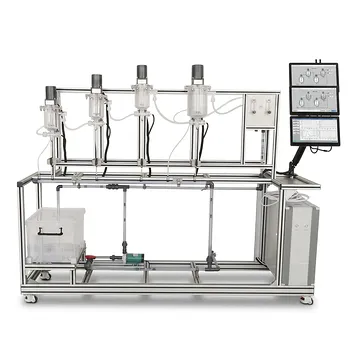
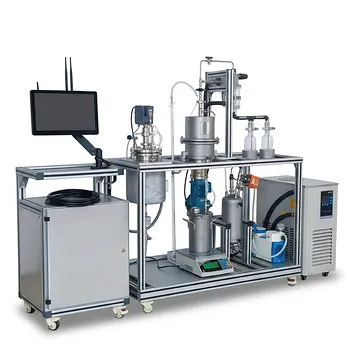
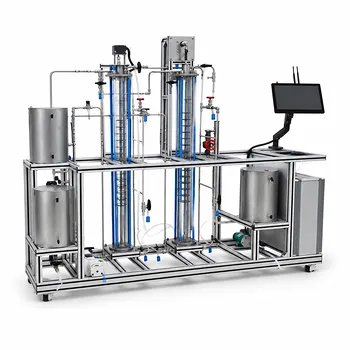
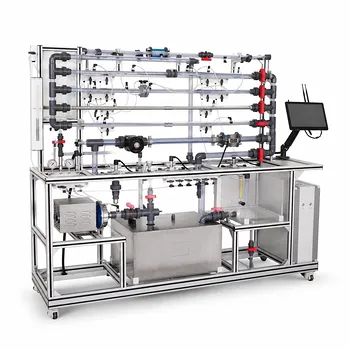
Accurate simulation is only half the battle—physical validation is key to scaling success. LABPARK offers premium Educational and Vocational Unit Operations Pilot Plants in chemical engineering, bioprocess & biotech, and environmental & water treatment. Designed to meet the rigorous demands of universities, research institutes, and enterprises, our systems provide the real-world data you need to validate your multiphase models.
Ready to elevate your research and training capabilities? Contact us today to discuss your pilot plant needs!
Related Products
- Multi-Stage Stirred Tanks in Series Residence Time Distribution and Mixing Performance Determination Educational Pilot Plant
- Multi-Reactor Educational Pilot Plant for Reaction Engineering Unit Operations
- Multi Functional Catalytic Reaction and Reactor Evaluation Educational Unit Operations Pilot Plant
- Multi Pump Fluid Transport Process Piping Unit Operations Training Pilot Plant
- Rising and Falling Film Evaporation Educational Unit Operations Pilot Plant
People Also Ask
- How does MRF model impeller rotation in CFD? Key Boundary Conditions Explained
- How can a CSTR pilot plant demonstrate reactor staging? Visualize volume savings.
- How does steady-state multiplicity affect the operation and safety of exothermic reactions within a CSTR pilot plant? - Guide
- What parameters to monitor transitioning from Batch to CSTR? Master Pilot Plant Setup
- Why is temperature regulation via a cooling jacket a critical feature in CSTR pilot plants used for laboratory training?