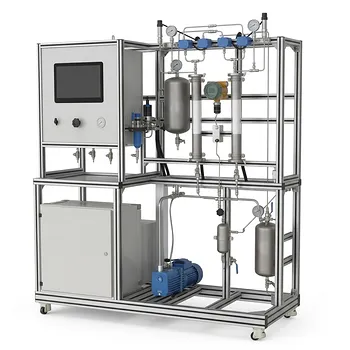
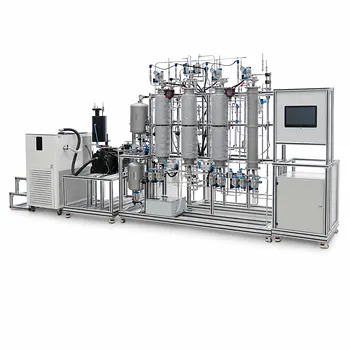
The practical advantage is simple: you can model complex multicomponent separations with drastically fewer experiments.
By predicting ternary vapor-liquid equilibria (VLE) entirely from binary cross-interaction parameters, pilot plant teams avoid measuring every possible combination of temperature, pressure, and composition. High-accuracy deviations as tight as 0.003 mole fraction and 0.16 bar pressure are achievable, so you can confidently design, simulate, and operate distillation or absorption columns using only binary data.
Binary interaction parameters serve as universal building blocks for ternary and higher-order systems, slashing the calibration burden of multicomponent pilot plants while preserving predictive precision. This strategy transforms resource-intensive experimental programs into manageable, data-light workflows—provided you stay within well-behaved VLE domains.
Why Predicting Multicomponent Behavior Matters in Pilot Plants
The High Cost of Experimental Data
Running a pilot plant for every multi-component mixture is a financial and time sink. Each data point for a ternary system requires careful control of concentration, temperature, and pressure, generating an exponentially growing matrix of experimental runs. Without a shortcut, process development stalls.
The Promise of Simplicity
Thermodynamic models unlocked a powerful shortcut: the one-fluid theory. For mixtures of normal fluids, you can treat the entire multicomponent system using only pure-component properties and pairwise binary interactions. This means the behavior of a carbon dioxide-ethane-ethylene mixture, for example, can be predicted without ever measuring its ternary equilibrium directly.
The Foundation: Binary Parameters as Building Blocks
How One-Fluid Theory Enables Prediction
An equation of state (EOS) combines pure-component constants with binary interaction parameters (k_ij) that quantify how two molecules behave together. The one-fluid theory assumes that the mixture can be represented as a single hypothetical fluid whose properties are averaged from those binary pairs. This collapses a massive parameter space into just a handful of binary values, each obtainable from simple binary VLE experiments or literature.
Proven Accuracy in Real Systems
For gas mixtures like carbon dioxide, ethane, and ethylene, ternary calculations using only binary parameters match experimental data extraordinarily well. Deviations of 0.003 in mole fraction and 0.16 bar in pressure are typical—errors often smaller than the uncertainty of the experiments themselves. This level of accuracy is more than enough for sizing fractionation columns, setting reflux ratios, and predicting product purities.
Direct Operational Benefits in Pilot Plants
Streamlining Calibration and Simulation
Your process simulator needs reliable phase equilibria to converge. Entering a full ternary parameter set is slow and error-prone; binary parameters are fast, standardized, and often already available in databanks. This slashes model setup time and lets you iterate column designs without waiting for new experimental campaigns.
Preventing Operational Failures
Inaccurate phase predictions can trigger real hazards. Unexpected liquid carryover, pump cavitation, or incorrect cryogenic metering—these failures often stem from using oversimplified generic combining rules instead of true binary interaction parameters. Using experimentally determined binary values (which are typically less than unity for chemically different mixtures) correctly maps critical lines, compression factors, and even the appearance of high-temperature azeotropes, keeping pilot runs safe.
Empowering Training and Education
For vocational training, binary prediction turns a complex multicomponent pilot plant into a teachable system. Students can compute ternary phase envelopes with minimal data, operate a real column, and see how binary interactions govern separation. It transforms an overwhelming experimental burden into a focused, conceptual learning experience.
Understanding the Trade-offs and Limitations
When Binary Predictions Fail: LLE and Azeotropes While the binary-prediction method excels for vapor-liquid equilibria, it often fails for liquid-liquid equilibria (LLE). Multicomponent liquid extraction units typically demand direct experimental verification because the subtle non-idealities that drive phase splitting cannot be captured by binary VLE parameters alone. Similarly, highly non-ideal mixtures that form azeotropes at high pressures may require more sophisticated models or ternary-specific data.
The Role of Experimentally Determined Binary Parameters
Generic combining rules (like geometric mean rules) are not enough for chemically dissimilar gases. The best predictions come from experimentally fitted binary interaction parameters, which are specifically tuned to match binary VLE data. In pilot plant settings, skipping this step and using default rules can lead to large errors in critical loci and compression factors, undermining the very simplicity you were chasing.
A Note on Non-Ideal Mixtures
Binary predictions hold best for “normal” fluids. With strong association (e.g., hydrogen bonding), electrolytes, or polymers, the one-fluid assumption can break down. In those cases, the pilot plant strategy must weigh the cost of additional ternary measurements against the risk of inaccurate modeling. Knowing where the method is reliable builds real engineering judgment.
Making the Right Choice for Your Pilot Plant Study
- If your primary focus is reducing experimental costs and turnaround time: Trust binary interaction parameters for VLE-intensive processes like distillation or gas absorption. They deliver near-experimental accuracy with a fraction of the measurements.
- If your primary focus is educational or operator training: Lean heavily on binary-based predictions. They make multicomponent separations tangible without overwhelming students with data collection, while still teaching core thermodynamic principles.
- If your primary focus is liquid-liquid extraction or highly non-ideal mixtures: Do not rely on binary VLE parameters alone. Augment your model with direct LLE measurements or use more advanced mixing rules; otherwise your pilot plant design will rest on a shaky foundation.
Binary cross-interaction parameters turn a potentially intractable pilot plant study into a focused, data-efficient endeavor—you just need to know when the shortcut is safe to take.
Summary Table:
| Aspect | VLE (Vapor-Liquid) Systems | LLE (Liquid-Liquid) Systems |
|---|---|---|
| Primary Data | Binary interaction parameters | Direct ternary experimental data |
| Typical Accuracy | High (deviation: 0.003 mole fraction, 0.16 bar) | Low reliability from binary data alone |
| Operational Benefit | Minimizes experiments, speeds up VLE modeling | Essential to prevent extraction failures |
Streamline Your Chemical Engineering Research with LABPARK
Simplify complex multicomponent separations and reduce experimental overhead. LABPARK provides advanced Educational and Vocational Unit Operations Pilot Plants in chemical engineering, bioprocess & biotech, and environmental & water treatment for universities, research institutes, and enterprises. Our high-precision pilot systems are designed to make thermodynamic modeling, process validation, and hands-on training highly efficient and data-light.
Ready to elevate your lab or research capabilities? Get a customized pilot plant quote today!
Related Products
- Multi-Component Gas Pressure Swing Adsorption Pilot Plant for Unit Operations Education
- Multifunctional Membrane Separation Educational Pilot Plant with Ultrafiltration, Nanofiltration, Reverse Osmosis
- Multi-Functional Membrane Separation Educational Pilot Plant for Unit Operations Lab
- Carbon Material Thermal Pretreatment Multiphase Separation Educational Pilot Plant
- Bench Scale Dual Column Gas Separation and Capture Educational Pilot Plant
People Also Ask
- How does Pressure Swing Adsorption (PSA) technology operate? Optimize gas separation with pilot plants.
- How is the direction and driving force of mass transfer determined in a gas absorption unit operations pilot plant?
- How do two-film & penetration theories apply to gas absorption pilot plant teaching? Key pedagogical insights.
- How does partial pressure behavior influence gas absorption pilot plants? Master Mass Transfer
- What are the limitations of Henry's Law in gas absorption pilot plants? Avoid critical lab errors.