Knowledge Chemical Engineering Education How do Electronegativity & Diagonal Rule Shape Catalyst Selection? Optimizing Pilot Plant Reactor Teaching
Author avatar

Tech Team · LABPARK

Updated 2 months ago

How do Electronegativity & Diagonal Rule Shape Catalyst Selection? Optimizing Pilot Plant Reactor Teaching


The hidden curriculum of catalysis starts with the periodic table. In chemical engineering pilot plants, concepts like electronegativity and the diagonal rule become the lens through which students predict adsorption strength, identify isofunctional metals, and troubleshoot reactor performance. By connecting electron arrangement to catalytic surface behavior, these atomic concepts transform trial-and-error screening into a rational design exercise, directly teaching how to optimize conversion and stability in reactor unit operations.

By anchoring catalyst selection in electronegativity differences and diagonal periodic relationships, pilot-plant education bridges the chasm between quantum chemistry and macroscopic reactor engineering. Students learn to see catalyst behavior as predictable, not mysterious—empowering them to select, modify, and troubleshoot catalysts with atomic‑level reasoning.

Bridging the Gap: From Periodic Trends to Pilot Plant Performance

How Electronegativity Dictates Catalyst–Reactant Interactions

In a pilot fixed-bed reactor, the catalyst surface (often a transition metal oxide) interacts with reactants through adsorption. Electronegativity determines the polarity of those bonds. A metal atom with high electronegativity pulls electron density toward itself, strengthening interactions with electron‑rich reactants. By alternating catalyst metals across a period, students observe how conversion rates shift as adsorption strength changes—epitomizing the Sabatier principle.

This atomic lens turns kinetic data into a logical story. A sudden drop in yield might not be a mechanical issue but a mismatched electronegativity causing reactant poisoning or excessive desorption barriers. Teaching this connection empowers students to troubleshoot pilot plants using periodic table intuition rather than guessing.

The Diagonal Rule: Predicting Unexpected Chemical Twins

The diagonal relationship—where Li resembles Mg and Be resembles Al—arises from similar charge‑to‑radius ratios and electronegativity values. In a fluidized‑bed pilot unit, this explains why a magnesium oxide catalyst may be interchangeable with a lithium‑based formulation for certain carbonate‑forming reactions. Students see that atomic similarity, not just group membership, governs catalytic behavior.

Pilot experiments can directly demonstrate this. For example, comparing the thermal stability of precipitated Li₂CO₃ versus MgCO₃ reveals a shared decomposition profile. This teaches students how mineral stability in a reactor environment can be anticipated from diagonal periodic trends, turning catalyst selection from a catalog search into a reasoning exercise.

Translating Atomic Insights into Reactor Parameters

Atomic properties cascade into macroscopic metrics. Stronger adsorption from higher electronegativity differences can boost conversion but may also increase catalyst poisoning risk, reducing long‑term stability. Instructors design pilot runs where students map the electronegativity of the active metal to the reactor’s hot‑spot temperature, showing how atomic bonding directly affects thermal management.

Similarly, the diagonal rule helps predict which catalytic materials resist sintering or dissolution under process conditions. This predictive ability is crucial when scaling from pilot to production, where a catalyst’s atomic identity directly influences economics and safety. Selectivity, too, shades from atomic origins: the electronic structure steers reaction pathways toward desired products.

Understanding the Trade‑offs: When Atomic Theory Isn’t Enough

The Danger of Atomic Reductionism

Electronegativity and the diagonal rule provide a strong start, but catalysts are more than their elemental composition. A pilot plant teaches that support interactions, dispersion, and pore architecture can override atomic trends. A high‑electronegativity metal poorly dispersed on alumina may underperform a less intuitive choice, confusing students if they rely only on periodic tables.

Exceptions and Industrial Realities

Not all diagonal pairs behave identically in catalytic applications. Differences in atomic radius or d‑orbital availability create deviations. Additionally, industrial selection must weigh cost, toxicity, and supply chain—factors never captured by electronegativity alone. The educational pilot plant must balance atomic theory’s elegance with the messiness of real‑world engineering.

Making the Right Choice for Your Teaching Goals

Tailor the integration of atomic concepts to your core learning objective.

  • If your primary focus is mechanistic understanding: Design experiments that isolate a single variable, such as catalyst metal electronegativity, and show its direct effect on conversion. Measure adsorption heats or use spectroscopy to let students witness how atomic properties manifest at the surface.
  • If your primary focus is industrial relevance: Frame diagonal relationships as a tool for catalyst substitution. Challenge students to identify a lower‑cost, more durable metal that mimics an expensive noble metal’s electronic character, then validate performance in the pilot reactor.
  • If your primary focus is troubleshooting and scale‑up: Use electronegativity to diagnose deactivation. When a catalyst fouls rapidly, guide students to analyze whether too‑strong adsorption from an electronegativity mismatch is the root cause, and propose a different metal or alloy.

Mastering the atomic foundations of catalysis transforms the pilot plant from a procedural exercise into a powerful teaching instrument—one where every reactor run becomes a live lesson in the periodic logic of chemical engineering.

Summary Table:

Atomic Concept Macroscopic Reactor Influence Educational Application
Electronegativity Dictates bond polarity & adsorption strength; affects conversion & catalyst poisoning Teach students to troubleshoot reactor yield drops using periodic trends
Diagonal Rule Explains similar catalytic behavior and thermal stability (e.g., Li & Mg) Guide students in low-cost catalyst substitution exercises
Reactor Parameters Impacts thermal management (hot-spots), sintering resistance, & selectivity Connect atomic-scale bonding to safety and scale-up economics

Elevate Chemical Engineering Education with LABPARK

Bridging the gap between atomic theory and real-world reactor operations requires high-quality, hands-on learning systems. LABPARK provides state-of-the-art Educational and Vocational Unit Operations Pilot Plants in chemical engineering, bioprocess & biotech, and environmental & water treatment for universities, research institutes, and enterprises.

Empower your students and researchers to master catalyst selection, reactor troubleshooting, and process scale-up. Contact our specialists today to find the perfect pilot plant solution for your curriculum.

Related Products

People Also Ask

Related Products

Multi-Reactor Educational Pilot Plant for Reaction Engineering Unit Operations

Multi-Reactor Educational Pilot Plant for Reaction Engineering Unit Operations

Integrated bench-scale educational pilot plant for chemical engineering teaching featuring fixed bed fluidized bed and stirred tank reactors with web-based digital twin controls and safety interlocks for hands-on unit operations and reaction engineering comparative studies in one compact system.

Fixed Bed Gas Solid Catalytic Reaction Educational Pilot Plant

Fixed Bed Gas Solid Catalytic Reaction Educational Pilot Plant

Fixed-bed gas-solid catalytic reaction unit operations pilot plant for chemical engineering education. Features split-furnace, mass flow controllers, PID control, safety interlocks. Ideal for heterogeneous catalysis, reactor dynamics, catalyst evaluation studies. Fully customizable configurations for university laboratories and academic research.

Fixed-Bed Chemical Reaction and Gas Dust Tar Removal Unit Operations Pilot Plant

Fixed-Bed Chemical Reaction and Gas Dust Tar Removal Unit Operations Pilot Plant

Integrated educational pilot plant for studying catalytic gas-solid reactions and downstream gas purification. Features dual fixed-bed reactor, three-stage heating, and touchscreen control for hands-on engineering training. Ideal for chemical and environmental engineering curricula.

Tubular Reactor Flow Characteristics Determination Educational Unit Operations Pilot Plant

Tubular Reactor Flow Characteristics Determination Educational Unit Operations Pilot Plant

Educational pilot plant for investigating tubular reactor flow characteristics and residence time distribution Features adjustable recycle for plug flow and backmixing studies industrial touchscreen interface and real-time data acquisition Ideal for chemical engineering unit operations laboratory training and education

Residence Time Distribution and Reactor Flow Characteristics Determination Educational Pilot Plant

Residence Time Distribution and Reactor Flow Characteristics Determination Educational Pilot Plant

This versatile educational pilot plant is designed for comprehensive study of residence time distribution and reactor flow characteristics, featuring multiple CSTRs in series, a tubular reactor, variable recycle loop, and automated real-time data acquisition, perfect for hands-on chemical engineering education.

100L Continuous Loop Hydrogenation Educational Unit Operations Pilot Plant

100L Continuous Loop Hydrogenation Educational Unit Operations Pilot Plant

This 100L continuous loop hydrogenation pilot plant is designed for chemical engineering education, featuring 316 stainless steel construction, advanced gas-liquid mass transfer components, explosion-proof safety systems, and a 15.6-inch touchscreen with 5G connectivity, cloud data logging, bridging theory and industry.

Multi-Functional Special Distillation Educational Pilot Plant

Multi-Functional Special Distillation Educational Pilot Plant

Versatile multi-functional special distillation pilot plant for chemical engineering education. Supports continuous, vacuum, azeotropic, reactive, extractive distillation. Transparent glass columns enable real-time visual observation of hydrodynamics and separation processes.

Natural Product Extraction Unit Operations Training Pilot Plant

Natural Product Extraction Unit Operations Training Pilot Plant

Integrated natural product extraction pilot plant for chemical engineering training bridges theory and industrial practice with modular extraction and evaporation/concentration units, hybrid touchscreen and manual control, realistic process simulation, and self-contained softened water and vacuum utilities.

Carbon Dioxide Hydrogen Methanol Synthesis Educational Unit Operations Pilot Plant

Carbon Dioxide Hydrogen Methanol Synthesis Educational Unit Operations Pilot Plant

Hands-on educational pilot plant for methanol synthesis from carbon dioxide and hydrogen. Enables practical study of high-pressure catalysis, unit operations, and process control. Features real-time data acquisition, safety systems, and customizable experiment modules for undergraduate and graduate chemical engineering laboratories.

Ethyl Acetate Synthesis Unit Operations Pilot Plant for Practical Training

Ethyl Acetate Synthesis Unit Operations Pilot Plant for Practical Training

Modular and customizable pilot plant for ethyl acetate synthesis practical training. Integrates esterification reaction, liquid-liquid extraction, neutralization, and sieve-plate distillation unit operations. Bridging theory and real-world industrial processes. Designed for university chemical engineering labs

O-Xylene Oxidation to Phthalic Anhydride Educational Unit Operations Pilot Plant

O-Xylene Oxidation to Phthalic Anhydride Educational Unit Operations Pilot Plant

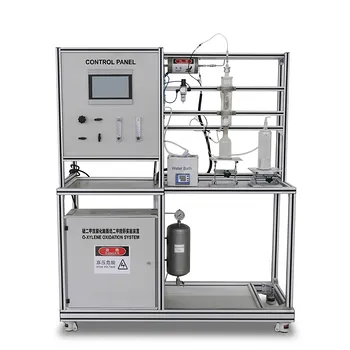
Explore our bench-scale educational pilot plant for o-xylene oxidation to phthalic anhydride, featuring a fixed-bed tubular reactor with visual observation, precise temperature control, and safety systems, ideal for chemical engineering hands-on training and industrial simulation, designed for university unit operations.

Multi-Modal Distillation Unit Operations Training Pilot Plant

Multi-Modal Distillation Unit Operations Training Pilot Plant

Multi-modal distillation pilot plant for practical unit operations training in chemical engineering education. Features real, analog, and semi-physical simulation modes, industrial construction, customizable for university labs. Hands-on fractionation columns, SCADA control, safety systems. Includes sight glasses, sampling ports, closed-loop recycling.

Green Anhydrous Ethanol Refining Practical Training Pilot Plant

Green Anhydrous Ethanol Refining Practical Training Pilot Plant

Advanced integrated pilot plant for university labs demonstrating extractive distillation to produce high-purity absolute ethanol from crude feedstock, featuring multi-column continuous operation, closed-loop solvent recycling, and customizable controls for hands-on engineering education, ideal for chemical engineering training and research.

Aspirin API Synthesis Unit Operations Training Pilot Plant

Aspirin API Synthesis Unit Operations Training Pilot Plant

An integrated pilot plant for aspirin API synthesis training, featuring batch reaction, recrystallization, and packed distillation modules. Offers dual-control operation, transparent vessels, and public utility simulation for safe, hands-on chemical engineering unit operations education. Ideal for university labs.

Methane Cracking Educational Unit Operations Pilot Plant

Methane Cracking Educational Unit Operations Pilot Plant

This bench-scale methane cracking educational pilot plant provides hands-on catalytic conversion training with a 1000°C furnace, seven mass flow controllers, and real-time automation for safe, curriculum-aligned experiments. Designed for university teaching of unit operations and reaction engineering.

Fluidized Bed Gas Solid Catalytic Reaction Educational Pilot Plant

Fluidized Bed Gas Solid Catalytic Reaction Educational Pilot Plant

Our educational fluidized bed gas-solid catalytic reaction pilot plant is ideal for chemical engineering labs. Students study fluidization dynamics, catalyst evaluation, and process control hands-on. Features include a customizable reactor, touchscreen HMI, and safety interlocks for safe, curriculum-aligned experiments.

Methanol Synthesis and Catalyst Performance Evaluation Educational Unit Operations Pilot Plant

Methanol Synthesis and Catalyst Performance Evaluation Educational Unit Operations Pilot Plant

Bench-scale methanol synthesis and catalyst evaluation educational pilot plant for chemical engineering labs to study catalytic kinetics, high-pressure operations, process control, and unit operations under realistic conditions with industrial safety features, precision gas delivery, data acquisition, and intelligent monitoring.

Internal Circulation Gradient Free Catalytic Reaction Educational Pilot Plant

Internal Circulation Gradient Free Catalytic Reaction Educational Pilot Plant

Internal circulation gradient free catalytic reaction educational pilot plant for chemical engineering unit operations. Provides isothermal gradient free operation and hands on study of heterogeneous catalysis kinetics and mass transfer with precise control. Ideal for academic labs.

Micro-Scale Gas-Solid Catalytic Reaction Educational Pilot Plant

Micro-Scale Gas-Solid Catalytic Reaction Educational Pilot Plant

Explore heterogeneous catalysis with this micro-scale gas-solid catalytic reaction educational pilot plant. Designed for university labs, it enables hands-on study of reaction kinetics and transport phenomena in a benchtop packed bed reactor with high-precision flow control and touchscreen automation.

Multi Functional Catalytic Reaction and Reactor Evaluation Educational Unit Operations Pilot Plant

Multi Functional Catalytic Reaction and Reactor Evaluation Educational Unit Operations Pilot Plant

Bench-scale educational pilot plant for catalytic reaction and reactor evaluation, integrating fixed bed, fluidized bed, and stirred tank reactors. Students compare reactor designs, evaluate catalysts, and study reaction kinetics and hydrodynamics. Perfect for unit operations labs in chemical engineering curricula.


Leave Your Message