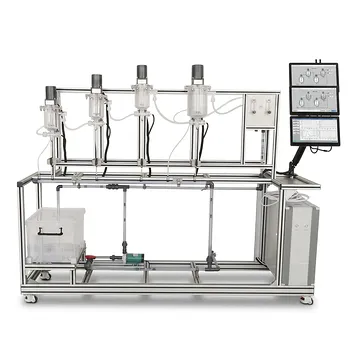
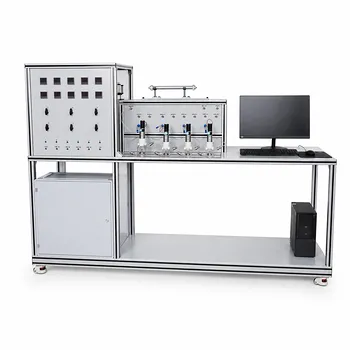
The number of possible steady states explodes exponentially. For a cascade of N nonisothermal Continuous Stirred-Tank Reactors (CSTRs) executing a first-order reaction, the system can exhibit at most 2^(N+1) – 1 steady states. Out of these, only N + 1 are stable. This dramatic scaling means that each additional reactor theoretically multiplies the complexity of the operating map, creating a rich, multi-layered landscape of low-conversion, intermediate, and high-conversion states.
While a single nonisothermal CSTR can show up to three steady states, linking N reactors in series creates a maximum of 2^(N+1) – 1 theoretical steady states. The stable ones—just N + 1—are the only states you’ll ever observe, but the exponential growth of possibilities reveals the intrinsic complexity of approximating a tubular reactor with CSTRs.
The Mathematical Scaling of Multiplicity
Why a Single CSTR Can Have Three Steady States
A nonisothermal CSTR with an exothermic first-order reaction exhibits multiplicity because the heat generation curve (exponential with temperature) can intersect the heat removal line (linear with temperature) at three points. These correspond to a low-conversion (cold) state, an unstable intermediate state, and a high-conversion (hot) state. This is the foundational nonlinearity that cascading amplifies.
How the 2^(N+1) – 1 Maximum Arises
When you connect N identical or similar CSTRs in series, the outlet of one feeds the next. Because each reactor can potentially settle into one of three states for each state of the inlet stream, the theoretical state space balloons. The excluding physically unrealistic extinction sequences mentioned in the primary reference trims the pure 3^N possibilities down to 2^(N+1) – 1. For N=1, that’s 2² – 1 = 3 steady states, and for N=2, it’s 2³ – 1 = 7—exactly matching experimental observations in pilot-scale cascades.
Contrast with a Plug-Flow Reactor
An ideal tubular reactor (PFR) solves an initial-value problem and therefore possesses only one steady state for a given set of inlet conditions. The cascade of CSTRs approximates the PFR concentration profile, but its multiplicity behavior persists until the number of stages becomes very large and the Péclet number (dispersion) approaches zero. In practice, pilot plants with 3–5 CSTRs in series lie in an intermediate regime where multiplicity is both measurable and educationally valuable.
Why This Exponential Explosion Matters in Pilot Plants
Demonstrating Reactor Stability and Runaway Hazards
For a cascade of two CSTRs, the system can have up to 7 theoretical steady states, of which 3 are stable. Pilot plant experiments can map these stable branches by slowly varying the Damköhler number (flow rate/residence time) while tracking outlet conversion. This directly shows students bifurcation and hysteresis—two cornerstones of process safety and control. You can physically see the reactor jump from a high-conversion state to a low-conversion state when a stability boundary is crossed.
Coupled Dynamics and Forced Oscillations
Even when each individual reactor would be stable alone, the coupled thermal dynamics can create self-sustained oscillations. A stable limit cycle in the first CSTR forces the second CSTR into an oscillating pattern, even if the second reactor’s intrinsic steady state is stable. This dynamic coupling is impossible to observe in a single-tank setup, making the series configuration a powerful tool for teaching transient behavior and advanced control strategies.
Bridging the Gap Between Ideal Reactors
A single CSTR has a flat residence time distribution; a PFR has zero axial mixing. A cascade of CSTRs allows you to tune the overall backmixing by changing N. As N increases, the system’s residence time distribution approaches that of a PFR. Yet the exponential multiplicity scaling means that even a modest cascade (N=3, giving up to 15 theoretical steady states) retains a rich nonlinear fingerprint. Understanding this trade-off is key when using cascade pilot plants to approximate tubular reactor performance.
Understanding the Trade-offs
Stability Is Gained at the Expense of Complexity
While 2^(N+1) – 1 steady states are theoretically possible, only N + 1 are stable. All the intermediate, unstable states are unobservable in practice because any small disturbance sends the reactor drifting to a stable branch. This means that a 3-reactor cascade may have 15 theoretical states but only 4 stable operating points you can actually hold. For educational pilots, the valuable insight comes from mapping the boundaries between these stable states, not from trying to visit every unstable point.
Startup and Shutdown Path-Dependence
Because multiple stable states exist for the same operating parameters, the final steady state you reach depends on initial conditions. A pilot plant can inadvertently lock into a low-conversion “cold” state if started up from ambient temperature without careful preheating. This is a direct demonstration of hysteresis, critical for teaching safe industrial procedures. Operators must recognize that a cascade is not simply a step closer to a PFR; it’s a system with memory of its past thermal history.
Limitations in True PFR Simulation
Even with a large N, the cascade does not fully eliminate multiplicity. In an ideal PFR (Pe→infinity), multiplicity vanishes. A finite-N CSTR cascade always retains at least N + 1 stable states. This restricts how closely you can replicate a pure PFR profile in a pilot plant that intentionally uses CSTRs. The safety training opportunity—showing when multiplicity appears and how to manage it—is often more valuable than a perfect one-state PFR simulation.
Applying This Knowledge to Your Pilot Plant
Tailor your experiments and demonstrations based on what you aim to achieve.
- If your primary focus is teaching reactor multiplicity: Start with a single CSTR to establish the basic three-state concept, then add a second reactor. Visualize the up to 7 states and map hysteresis loops by ramping flow rate. This N=2 system is pedagogically rich yet manageable.
- If your primary focus is process control and safety: Use a 3-reactor cascade to demonstrate coupled dynamics and forced oscillations. Intentionally vary the heat transfer parameters of the first reactor to create an oscillating feed for the second, and show how a stable downstream reactor can be forced into instability.
- If your primary focus is approximating a PFR for kinetic studies: Increase N as high as your pilot plant allows (e.g., 4–6) while maintaining isothermal operation if possible. This narrows the multiplicity window and pushes the residence time distribution toward plug-flow behavior, but always be aware that safe operating boundaries still hide multiple stable states.
Mastering the exponential scaling of steady states in a CSTR cascade gives you a profound, hands-on understanding of reactor engineering that goes far beyond textbook equations—you’ll see exactly why startup procedures, control design, and safety margins are non-negotiable in industrial operation.
Summary Table:
| Number of Reactors ($N$) | Max Theoretical Steady States ($2^{N+1} - 1$) | Stable (Observable) States ($N + 1$) | Key Educational & Operational Dynamics |
|---|---|---|---|
| $N = 1$ | 3 | 2 | Basic multiplicity (cold vs. hot states), hysteresis demonstration. |
| $N = 2$ | 7 | 3 | Mapping stable branches, bifurcation, and path-dependent startup. |
| $N = 3$ | 15 | 4 | Coupled thermal dynamics and forced downstream oscillations. |
| $N \to \infty$ (PFR Limit) | Exponentially scales | Linear scaling ($N+1$) | Approaches PFR profile but retains a multi-state nonlinear fingerprint. |
Bring Complex Reactor Dynamics to Life in Your Lab
Teaching phenomena like reactor multiplicity, hysteresis, and thermal runaway requires reliable, hands-on equipment. LABPARK designs and manufactures high-quality Educational and Vocational Unit Operations Pilot Plants in chemical engineering, bioprocess & biotech, and environmental & water treatment for universities, research institutes, and enterprises.
Our custom-engineered CSTR and tubular reactor pilot plants allow students and researchers to safely map bifurcation curves and master process safety control.
Contact LABPARK today to discuss your laboratory's training needs!
Related Products
- Multi-Stage Stirred Tanks in Series Residence Time Distribution and Mixing Performance Determination Educational Pilot Plant
- Multi-Reactor Educational Pilot Plant for Reaction Engineering Unit Operations
- Multi Functional Catalytic Reaction and Reactor Evaluation Educational Unit Operations Pilot Plant
- 100L Continuous Loop Hydrogenation Educational Unit Operations Pilot Plant
- Residence Time Distribution and Reactor Flow Characteristics Determination Educational Pilot Plant
People Also Ask
- How does MRF model impeller rotation in CFD? Key Boundary Conditions Explained
- How can a CSTR pilot plant demonstrate reactor staging? Visualize volume savings.
- How does steady-state multiplicity affect the operation and safety of exothermic reactions within a CSTR pilot plant? - Guide
- What parameters to monitor transitioning from Batch to CSTR? Master Pilot Plant Setup
- Why is temperature regulation via a cooling jacket a critical feature in CSTR pilot plants used for laboratory training?