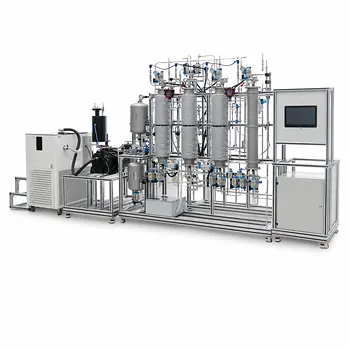
Teaching students to choose between wet and dry packing is about more than a recipe—it’s about instilling a sense of cause and effect in column performance. Start by recommending wet packing as the default method for beginners working with silica gel. It produces a uniform adsorbent bed, sharply reduces the risk of air bubbles that cause channeling, and delivers the consistent separation results essential for learning fundamental principles. Once students grasp this baseline, introduce dry packing as a faster, lower-solvent alternative, while making its high propensity for trapped air crystal clear.
The core of the lesson is not which method is “better,” but that packing quality directly governs separation efficiency. Wet packing offers the highest probability of a uniform, bubble-free bed for novice hands, while dry packing trades some reliability for speed and solvent savings—making it a valuable, albeit riskier, tool to understand.
Why the Packing Method Is a Critical Teaching Point
A chromatography column is only as good as the bed inside it. Any unevenness, crack, or trapped air pocket turns a clean separation into a broad, overlapping mess. For students, seeing this link between a manual preparation step and a physical outcome—channeling, band broadening, or even column cracking—is a foundational chemical engineering lesson in mass transfer and fluid dynamics.
The Hidden Costs of a Poorly Packed Bed
Channeling routes the mobile phase through one part of the bed, bypassing most of the stationary phase. The result is incomplete interaction, poor resolution, and irreproducible results. Trapped air bubbles create zones of zero liquid-solid contact, causing exactly the same failure. A packed column that looks good from the outside may have internal voids that silently sabotage the experiment.
Connecting Packing to Process Control
When students pack a column themselves, they directly experience how slurry viscosity, particle settling, and solvent flow interact. This translates abstract concepts like bed porosity and pressure drop into tangible observations. Show them that the cotton plug at the bottom must be fully wet before any adsorbent enters; otherwise, air will cling to the fibers and later rise through the bed as disruptive bubbles.
Wet Packing: The Method of Choice for Teaching Uniformity
Wet packing involves pouring a slurry of adsorbent and solvent into the column in one smooth motion, allowing particles to settle gently under the liquid’s weight and hand-tapping. Because the slurry is already de-aerated and the solvent wets every surface, air bubble entrapment is dramatically reduced.
How the Slurry Creates a Self-Leveling Bed
When silica gel particles settle from a solvent suspension, they arrange themselves with minimal bridging and void formation. Continuous solvent flow during settling flushes out remaining fine particles and compacts the bed evenly. This consistent packing density is the single most important factor in producing sharp, symmetrical bands.
The Solvent “Penalty” as a Teaching Opportunity
Wet packing consumes more solvent during preparation. Frame this not as waste, but as a deliberate design decision. It teaches students to weigh process robustness versus resource intensity—a classic engineering trade-off. Even in a pilot-plant setting, having students measure and compare solvent use across methods makes the cost-quality dynamic real.
Dry Packing: Faster, Leaner, and Far Less Forgiving
Dry packing involves pouring dry adsorbent directly into the column, tapping to settle, and then carefully wetting the bed with solvent. It uses less solvent and is quicker to set up, making it attractive for large-scale or rapid-turnaround demonstrations. However, air bubbles are almost guaranteed unless the wetting step is executed flawlessly.
Where Trapped Air Hides
As solvent moves down through dry powder, capillary forces can trap air in narrow spaces between particles. This air tends to coalesce into large bubbles that disrupt flow and even lift chunks of the bed. To mitigate this, students can use a vacuum line to pull solvent through from the bottom, or pour solvent extremely slowly down the column wall—but these techniques demand practice.
The Cracking Risk Under Pressure
A column packed dry and not fully wetted can develop internal stresses. When pressure is applied for faster elution, these weak points can cause cracks or channels to form. Demonstrating a column that fails mid-run because of dry-packing shortcuts leaves a lasting impression about the importance of method selection.
Understanding the Trade-offs for Educational Pilot Plants
The best approach is to teach both methods side by side, turning column preparation into a comparative experiment. Assign half of a student group to wet pack and the other half to dry pack, then run identical samples and compare band resolution, elution time, and solvent consumption.
When Wet Packing Is the Clear Winner
- Teaching fundamentals: Uniform bed → predictable retention → clear connection between theory and observation.
- Silica gel columns: These are sensitive to channeling; wet packing maximizes success.
- High-stakes separations: Where failure means losing a valuable sample or disrupting a multi-step lab schedule.
When Dry Packing Has an Edge
- Large-diameter or preparative columns: Where the sheer volume of solvent for wet packing becomes impractical.
- Quick screening runs: Where students need to test multiple conditions fast, and perfect resolution is secondary.
- Courses emphasizing resource efficiency: To provoke discussions on sustainability and process intensification.
Making the Right Choice for Your Teaching Goal
Use packing method selection as a capstone decision that forces students to integrate all they know about separation goals, material properties, and operating constraints. Provide a clear framework rather than a single answer.
- If your primary focus is mastering reproducible, high-resolution separations: Start with wet packing. It delivers the consistent results that let students see theory in action and builds confidence in their technique.
- If your primary focus is comparing mass transfer efficiency under different packing qualities: Assign wet and dry packing deliberately as an experiment. Let students measure peak width and asymmetry to quantify the performance gap.
- If your primary focus is preparing students for industrial or large-scale scenarios: Introduce dry packing with its solvent savings, but require a documented risk assessment and a controlled wetting protocol. Let them earn the right to use it.
- If your primary focus is troubleshooting and critical thinking: Have them pack one column perfectly and another poorly, then diagnose the resulting chromatograms. Link every defect—tailing, splitting, broadening—back to a specific packing error.
A single well-packed column is worth ten hurriedly assembled ones. Give students the tools to choose wisely, and they will carry an intuitive feel for mass transfer limitations into every unit operation they encounter thereafter.
Summary Table:
| Parameter | Wet Packing | Dry Packing |
|---|---|---|
| Best For | Beginners, uniform beds, high-stakes separations | Large-scale columns, rapid screening runs |
| Air Bubble Risk | Very low (self-leveling slurry) | High (requires precise wetting techniques) |
| Solvent Use | High (lower resource efficiency) | Low (higher sustainability) |
| Key Advantage | Symmetrical bands, predictable retention | Faster setup, saves solvent |
Elevate Your Chemical Engineering Lab with LABPARK
Hands-on training requires reliable, industry-grade equipment. LABPARK provides state-of-the-art Educational and Vocational Unit Operations Pilot Plants in chemical engineering, bioprocess & biotech, and environmental & water treatment.
Specifically engineered for universities, research institutes, and enterprises, our pilot plants allow students to safely master column preparation, liquid chromatography, and mass transfer dynamics.
Ready to upgrade your laboratory training systems? Contact us today to discover how LABPARK can bring your curriculum to life!
Related Products
- Gallium and Indium Selective Extraction Educational Pilot Plant
- Hot Filtration Educational Unit Operations Pilot Plant Laboratory System
- Multifunctional Membrane Separation Educational Pilot Plant with Ultrafiltration, Nanofiltration, Reverse Osmosis
- Gas-Solid Heterogeneous Separation Demonstration Educational Unit Operations Pilot Plant
- Binary System Vapor Liquid Equilibrium Data Determination Educational Unit Operations Pilot Plant
People Also Ask
- How do pilot plants differentiate physical vs chemical extraction? Enhance Chemical Engineering Training
- What is the significance of the isopycnic line in liquid-liquid extraction? Avoid Column Flooding
- How do droplet motion states affect kD in extraction pilot plants? Optimize Mass Transfer
- Why is predicting multicomponent LLE from binary data more challenging than VLE? Master your pilot plant design.
- How to Use McCabe-Thiele on an LLE Pilot Plant to Determine Column Efficiency