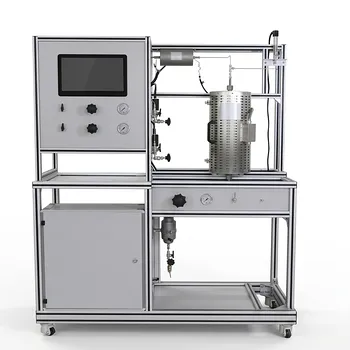
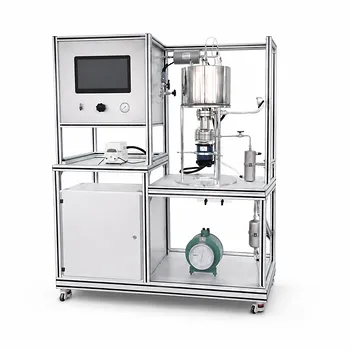
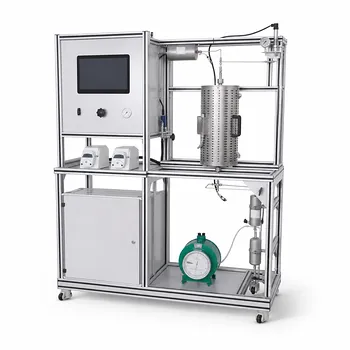
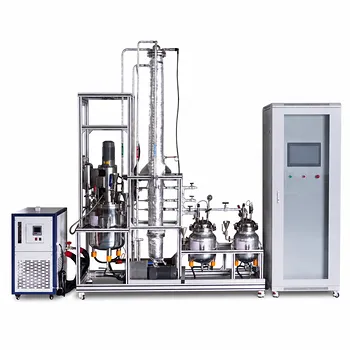
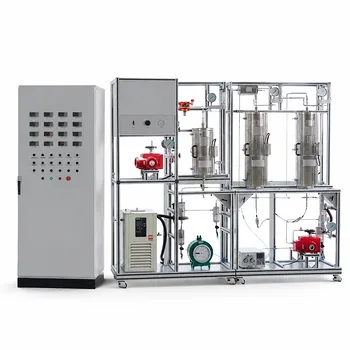
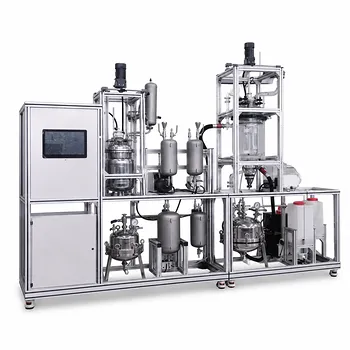
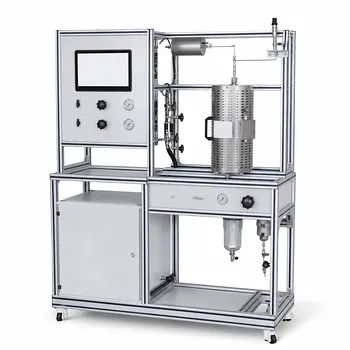
The single most important operational difference is the temperature and pressure regime: pilot plants for homogeneous catalysis are designed for significantly milder conditions than those for heterogeneous systems. In teaching settings, this directly translates into lower utility costs, simpler safety systems, and less demanding materials of construction.
They appear as two entirely different reactor worlds, but the real insight goes far beyond the temperature dial. While homogeneous pilot plants offer a gentler operational footprint ideal for student learning, the choice ultimately shapes the entire plant’s downstream separation train, control philosophy, and even the mathematical models you use to extract meaningful kinetic data.
The Core Operating Condition Gap
The most visible contrast between the two catalyst classes is the energy input required to drive the reaction. This is not a nuance; it is a design-defining difference.
The Temperature and Pressure Envelope
Homogeneous transition-metal processes—think oxo-alcohol synthesis or acetic acid production—run in a moderate window of roughly 350–505 K.
Heterogeneous counterparts like ammonia synthesis or fluid catalytic cracking demand a much harsher regime, typically 530–775 K.
This gap of 100–250 K completely reshapes your pilot plant specification.
Pressure often follows the same trend: homogeneous systems can operate at moderate pressures, while many iconic heterogeneous reactions run at elevated pressures that multiply the mechanical design load.
Direct Consequences for a Teaching Pilot Plant
Reactor material selection transforms. Lower temperatures allow a wider palette of gaskets, seals, and vessel materials, none of which need to withstand extreme thermal cycling.
Heating and cooling utilities scale down. Because you’re not fighting a 700-K reaction, your heat transfer fluids and exchangers are simpler and smaller, which slashes utility costs and installation complexity.
Safety relief systems become less onerous. A vessel designed for 5 bar and 200°C involves a fundamentally different hazard envelope than one designed for 200 bar and 500°C. For a teaching environment, this means fewer layers of protection and a more hands-on student experience.
Beyond the Vessel: What Happens After the Reaction
Focusing only on the reactor misses half the lesson. The catalyst’s physical state dictates the entire back-end architecture of the pilot plant.
The Homogeneous Separation Nightmare
Homogeneous catalysts are dissolved in the reaction mixture. That makes them highly active and selective under those mild conditions, but it creates a painful downstream reality.
You must add a separation sequence—distillation, extraction, or membrane steps—to recover the catalyst or remove it from the product. This immediately turns a neat teaching reactor into a complex mini-plant with solvent recovery and catalyst recycle loops.
The Heterogeneous Handling Simplicity
Heterogeneous catalysts sit as a solid bed or slurry. Once the reaction is done, the catalyst stays put.
No extraction columns, no solvent stripping, and no metal contamination in your product.
That simplicity, however, is traded for solid-handling challenges: loading, unloading, and understanding pressure drop across a fixed bed are all essential unit operations skills you must teach.
The Modeling Mindset: Why One-Size-Fits-All Fails
When you scale up data from a teaching pilot plant, the model you choose must match the physical reality. The operating condition difference forces a modeling choice that students must learn to make deliberately.
Pseudohomogeneous Models for Gentle Gradients
In a homogeneous liquid-phase reaction, the catalyst is molecularly dispersed. There is no particle surface to create temperature or concentration gradients.
You can safely assume the bulk fluid properties equal the reaction site properties. This lets you use a pseudohomogeneous model where (T = T_s) and (C = C_s), simplifying kinetic analysis and reactor design calculations.
Heterogeneous Models for Significant Gradients
Once a solid catalyst is present, that assumption crumbles. The fast, high-temperature reactions in a heterogeneous pilot plant create steep temperature and concentration differences between the bulk fluid and the catalyst surface.
You must switch to a heterogeneous model that explicitly accounts for interfacial mass transfer ((k_g)) and heat transfer ((h_f)) coefficients. Ignoring those gradients leads to skewed activation energies and unusable scale-up rules.
When the Choice Becomes Mandatory
For a teaching pilot plant, a heterogeneous plug-flow model is not an academic luxury when:
- The reaction rate is fast relative to diffusion.
- The heat of reaction is high.
- Internal pore diffusion resistance is significant.
Under those conditions, only a heterogeneous framework can decouple intrinsic kinetics from transport artifacts—a critical lesson for any student heading into industrial practice.
Understanding the Trade-offs
No single catalyst class makes a teaching pilot plant universally better. The choice forces compromises that you must weigh against your educational goals.
The Homogeneous Trade-off: Gentle Operation, Complex Separation
Advantage: Unmatched safety profile, low utility demand, and easy reactor hardware. Students can focus on kinetics and spectroscopy without worrying about pressure ratings or tube-wall thermocouples.
Disadvantage: The plant must include expensive separation and recycling steps, and many homogeneous catalysts suffer from thermal degradation at the upper end of their operating window, requiring precise temperature control. What you save in reactor steel you spend in distillation glassware.
The Heterogeneous Trade-off: Rugged Simplicity, Hidden Complexity
Advantage: Dead-simple product separation and no catalyst leaching. The plant visually mimics the big fixed-bed or fluidized beds of industry, giving students an authentic feel.
Disadvantage: Harsher conditions demand costlier alloys, serious safety interlocks, and high-capacity utilities. Moreover, mass transfer limitations can mask true kinetics, forcing students to untangle diffusion effects before they can do any meaningful analysis.
The Hidden Instability Factor
Homogeneous catalysts, while brilliant under mild conditions, can be temperamental. They often start to deactivate or decompose if the temperature drifts outside a narrow band. In a teaching environment where students are learning, that sensitivity can ruin a run but also provide a powerful lesson in process control.
Making the Right Choice for Your Teaching Goal
Your pilot plant’s operating conditions should be the servant of your curriculum, not the other way around. Align the design with the lesson you want to teach.
- If your primary focus is process safety and fundamental kinetic studies: Build a homogeneous pilot plant. The mild temperatures and pressures reduce risk and operating cost, while the absence of solid-phase gradients lets students directly observe concentration-time behavior without transport camouflage.
- If your primary focus is teaching realistic industrial reactor engineering and scale-up: Choose a heterogeneous system. The authentic high-temperature, high-pressure environment forces students to confront heat management, pressure drop, and the critical distinction between intrinsic and apparent kinetics using heterogeneous models.
- If your primary focus is end-to-end process development including downstream processing: A homogeneous unit with integrated separation teaches the full lifecycle—from catalytic reaction to product polishing. It turns the pilot plant into a true mini-factory rather than just a reactor stand.
- If your primary focus is solid handling and catalyst stability under stress: A heterogeneous pilot plant loaded with a commercial catalyst gives students direct experience with bed loading, attrition, and long-duration deactivation studies that are central to operations in the refining and petrochemical industries.
The operating condition gap is real, but it is never just about the reactor. It is a lever that pulls everything—utility demand, modeling depth, separation complexity, and safety philosophy—into alignment with your educational mission. Pick the one that teaches the lesson your students need most.
Summary Table:
| Feature | Homogeneous Catalysis | Heterogeneous Catalysis |
|---|---|---|
| Temperature | Mild (350–505 K) | Harsh (530–775 K) |
| Pressure | Moderate | High / Elevated |
| Separation | Complex (integrated recycle loops) | Simple (solid catalyst remains in reactor) |
| Modeling | Pseudohomogeneous (no gradients) | Heterogeneous (mass/heat transport limits) |
| Best For | Safety, fundamental kinetics | Industrial scale-up, transport phenomena |
Elevate Chemical Engineering Education with LABPARK
Bridge the gap between classroom theory and industrial practice. LABPARK provides high-quality Educational and Vocational Unit Operations Pilot Plants in chemical engineering, bioprocess & biotech, and environmental & water treatment.
Designed specifically for universities, research institutes, and enterprises, our pilot plants enable hands-on training in both homogeneous and heterogeneous catalytic processes under safe, controlled conditions.
Unlock your facility's potential—contact our engineering experts today to custom-design your laboratory pilot plant.
Related Products
- Methanol Synthesis and Catalyst Performance Evaluation Educational Unit Operations Pilot Plant
- Methane Cracking Educational Unit Operations Pilot Plant
- Carbon Dioxide Hydrogen Methanol Synthesis Educational Unit Operations Pilot Plant
- Internal Circulation Gradient Free Catalytic Reaction Educational Pilot Plant
- Fixed Bed Gas Solid Catalytic Reaction Educational Pilot Plant
People Also Ask
- Why is a purge system necessary when operating a gas recirculation loop in a methanol synthesis pilot plant? (Guide)
- How do temp & pressure affect methanol synthesis pilot plants? Optimize equilibrium and catalyst performance.
- Why do modern methanol pilot plants operate at lower pressures? Catalyst & Feed Requirements Explained
- What are the operational requirements for catalyst activation? Safe Methanol Pilot Plant Operation
- Why Compare Predicted and Experimental Excess Enthalpy? Key to Accurate Pilot Plant Scale-up