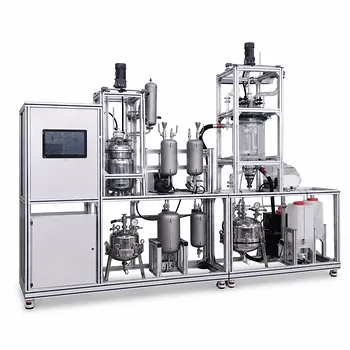
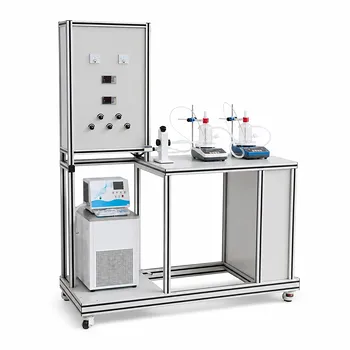
Material properties aren’t just a specification—they are the primary driver of extraction pilot plant design. For liquid-liquid extraction in an educational or R&D setting, the processing fluid’s density difference, interfacial tension, viscosity, and emulsification tendency dictate whether you select a simple packed column, a mechanically agitated rotating disc column, a mixer-settler, or a centrifugal extractor. Large density differences with low interfacial tension favor gravity-driven packed or sieve-plate columns, while small differences, high interfacial tension, or high viscosity demand energy-input systems like rotating disc columns or mixer-settlers. Ultralow density differences, heavy emulsification, or unstable compounds requiring extremely short contact times push the selection toward centrifugal extractors.
The fluid’s physical behavior—how easily it disperses, settles, or forms emulsions—determines which pilot-scale unit can actually deliver meaningful mass transfer and practical operation. Equipment choice isn’t about versatility; it’s about matching separation physics to the right technology.
How Fluid Properties Shape the Extraction Process
Before mapping equipment, you must understand why the fluid itself forces certain design decisions.
Density Difference and Settling Forces
Density difference drives the separation. A large density difference (often >0.1 g/mL) provides enough buoyancy for droplets to rise or sink quickly, making gravity-driven phase separation straightforward. When the difference drops below ~0.05 g/mL, settling becomes sluggish or incomplete, and you must supply external energy to create fine dispersions and then force coalescence.
Interfacial Tension and Droplet Breakup
Interfacial tension determines how readily one phase disperses into the other. Low interfacial tension allows droplets to break apart easily, so a gentle packing or a simple plate can provide sufficient surface area. High interfacial tension resists breakup, requiring intense mechanical shear—rotating discs, impellers, or pulsations—to create the interfacial area needed for fast mass transfer.
Viscosity and Mass Transfer Resistance
High viscosity in either phase slows molecular diffusion and droplet movement. In packed columns, viscous phases tend to channel or flood. Mechanically agitated columns and mixer-settlers overcome this by continuously renewing the interface and suppressing film resistance, but they add complexity and energy cost.
Emulsification and Residence Time Sensitivity
Some systems form stable emulsions when agitated. This is common with bioprocesses or feeds containing surfactants. The same intense mixing that creates dispersion can then prevent phase separation. Additionally, if a valuable product degrades on contact, the contact time must be kept to seconds. These scenarios require completely different separation forces—typically centrifugal—that decouple mixing from settling.
Equipment Selection Based on Property Profiles
With those principles in mind, the real decision tree follows directly from the fluid’s property profile.
When Gravity Is Enough – Packed Columns and Sieve Plate Columns
These are the simplest pilot-scale extraction units. They rely solely on density difference to counter-currently contact the two phases. Packed columns use structured or random packing to promote droplet breakup and coalescence with minimal energy beyond pump head. Sieve plate columns introduce multiple stages by forcing the dispersed phase through perforations.
- Best for: Systems with large density differences (e.g., >0.1 g/mL) and low interfacial tension (<10 mN/m).
- Typical R&D role: Demonstrating basic stage-wise extraction, mass transfer fundamentals, and distributor design.
Because they lack moving parts, these columns are easy to operate and scale, but they fail dramatically if the fluid’s density difference shrinks or if interfacial tension rises beyond what gravity can manage.
Adding Mechanical Energy – Rotating Disc Columns and Mixer-Settlers
Once density difference or interfacial tension becomes unfavorable, pilot plants must inject energy.
Rotating disc columns (RDCs) use a rotating shaft with flat discs inside a column to shear the dispersed phase into fine droplets, dramatically increasing interfacial area. This makes them suitable for systems with moderate density differences and moderate to high interfacial tension. They also keep the vertical footprint small, which is ideal when floor space is limited but overhead clearance is available.
Mixer-settlers achieve similar dispersion using an agitator in a separate mixing chamber, followed by a quiescent settling zone. Because mixing and settling are decoupled, mixer-settlers can handle high-viscosity fluids, fluids containing suspended solids, and systems with low density differences that would cause flooding in a column. They often achieve stage efficiencies above 80% and are excellent for demonstrating classic counter-current extraction in a cascaded train, though they trade off by demanding a larger horizontal footprint and higher solvent inventory.
Extreme Conditions – Centrifugal Extractors
When density differences become extremely small or emulsification is unavoidable, neither gravity nor gentle agitation will work reliably. Centrifugal extractors use rotational speeds producing hundreds to thousands of G’s to force separation. Contact times drop to seconds, making them essential for:
- Unstable biomolecules or pharmaceuticals that degrade upon prolonged contact.
- Systems with near-identical phase densities (e.g., Δρ < 0.01 g/mL).
- Feeds prone to forming stable emulsions that would otherwise require excessive settling volume.
For educational pilot plants, centrifugal extractors vividly illustrate the role of residence time and force field magnitude, but they come with higher capital and maintenance costs, and they are less forgiving of operational upsets.
Understanding the Trade-offs
No single unit type is universally best. Your fluid properties constrain the choice, but practical lab realities add further trade-offs.
Footprint vs. Stage Number
Vertical columns (packed, RDC, pulsed) pack many theoretical stages into a compact footprint, ideal when lab space is at a premium. But they often require high headroom and may be harder to clean between experiments. Mixer-settlers give you unmatched stage efficiency and visual observation of each equilibrium stage, but they spread out horizontally and require multiple pumps.
Operational Flexibility and Teaching Value
In education, mixer-settlers excel at illustrating the concept of an equilibrium stage, making them perfect for early mass transfer or rare earth extraction labs. Rotating disc columns allow students to vary agitation speed and observe its direct effect on flood point and droplet size, enriching fluid dynamics understanding. For advanced topics like bioprocess intensification, a centrifugal extractor demonstrates how to circumvent thermodynamic limits through mechanical force.
Cost, Maintenance, and Chemical Exposure
Chemical extraction processes often use aggressive extractants and acidic/basic solutions. This demands wetted materials such as borosilicate glass, PTFE, or high-grade stainless steel, potentially influencing the choice. Centrifugal units, with their high-speed seals and complex internals, can be costlier to maintain when exposed to corrosive feeds, whereas glass-packed columns offer excellent chemical resistance but limited pressure tolerance.
Making the Right Choice for Your Educational or R&D Goal
Ultimately, your fluid’s properties define the feasible equipment set, and your objectives zero in on the final selection.
- If your system has a large density difference and low interfacial tension: A packed or sieve plate column is the most cost-effective and educationally straightforward pilot plant, allowing you to focus on distributor hydraulics and mass transfer fundamentals without complex machinery.
- If you are dealing with a small density difference, high interfacial tension, or high viscosity: Choose a rotating disc column for compact, agitated counter-current operation, or a mixer-settler when you need high stage efficiency and the ability to handle solids/emulsions while demonstrating clear equilibrium stage concepts.
- If your process involves highly viscous phases, stable emulsification, or compounds requiring contact times under 30 seconds: A centrifugal extractor is your only practical option—justify the higher cost by its unmatched ability to separate what no gravity system can.
- If educational flexibility is paramount and you need to showcase multiple principles: Consider a lab that combines a simple gravity column (basic mass transfer), a mixer-settler (stage-wise separation), and a small centrifugal unit (intensified separation) so students can map fluid properties directly to equipment performance.
Let the fluid’s physical behavior be your compass. Matching the right separation mechanism to those properties not only yields successful experiments but also teaches the fundamental truth of chemical engineering: equipment follows the molecules.
Summary Table:
| Equipment Type | Ideal Density Difference | Interfacial Tension | Viscosity Handling | Key Applications / Strengths |
|---|---|---|---|---|
| Packed / Sieve Columns | Large (>0.1 g/mL) | Low (<10 mN/m) | Low | Basic mass transfer teaching, gravity-driven separation. |
| Rotating Disc Columns (RDC) | Moderate | Moderate to High | Low to Moderate | Compact vertical footprint, adjustable mechanical agitation. |
| Mixer-Settlers | Low to Moderate | High | High (handles solids) | High stage efficiency, visual observation of equilibrium. |
| Centrifugal Extractors | Very Low (<0.01 g/mL) | Any (resists emulsion) | Moderate to High | Short contact times, unstable biomolecules, emulsion resistance. |
Bring Advanced Unit Operations to Your Lab
Choosing the right liquid-liquid extraction pilot plant is crucial for accurate R&D and effective chemical engineering education. LABPARK provides high-quality Educational and Vocational Unit Operations Pilot Plants in chemical engineering, bioprocess & biotech, and environmental & water treatment specifically designed for universities, research institutes, and enterprises.
Ready to equip your facility with the ideal extraction system? Contact LABPARK today to discuss your process requirements with our engineering experts!
Related Products
- Educational Rotary Disc Liquid-Liquid Extraction Pilot Plant
- Comprehensive Liquid-Liquid Extraction Pilot Plant for Engineering Education
- Gallium and Indium Selective Extraction Educational Pilot Plant
- Ternary Liquid-Liquid Equilibrium Educational Pilot Plant
- Liquid-Liquid Mass Transfer Coefficient Determination Educational Pilot Plant
People Also Ask
- How do density and IFT affect liquid-liquid extraction pilot plants? Optimize Column Performance
- How to Estimate KD for Liquid-Liquid Extraction Pilot Plants Using Henry's Law when Lab Data is Limited
- How to Select a Liquid-Liquid Extraction Pilot Plant with Space Constraints: Key Factors
- In a liquid-liquid extraction pilot plant, how is a ternary-phase diagram utilized to determine solvent feed requirements?
- How to resolve emulsion in liquid-liquid extraction? 5 ways to ensure efficient phase separation