For operators in research and training pilot plants, the choice between Multiple Linear Regression (MLR) and Classical Least Squares (CLS) ultimately depends on whether you need to predict a single, easily isolated property—concentration or otherwise—or simultaneously resolve multiple overlapping analytes while compensating for real-world process variability. MLR is the inverse, automation-friendly method that thrives in simple, educational setups, while CLS is the direct, physically grounded approach that excels when you must know every spectrally active species in your mixture.
The decision is fundamentally about control versus simplicity. MLR lets you rapidly model a property—even a non‑concentration one—by selecting a handful of wavelengths, but it can overfit and crumble under severe spectral overlap. CLS uses the full chemical picture and the Beer‑Lambert Law to simultaneously estimate multiple concentrations and correct for path length shifts, yet it demands exhaustive knowledge of your process stream and resource‑intensive calibration standards.
The Fundamental Choice: Inverse vs. Direct Calibration
How MLR Simplifies the Modeling Task
MLR operates as an inverse model.
It directly relates the measured absorbance at a few selected wavelengths to the property of interest—bypassing the need to first calculate pure‑component spectra.
This abstraction makes MLR exceptionally intuitive for training purposes, because operators can see how a handful of key wavelengths drive the prediction.
How CLS Stays True to the Beer‑Lambert Law
CLS is a direct model that explicitly represents the linear relationship between concentration, absorptivity, and path length.
It reconstructs the entire spectrum of each analyte, then estimates all concentrations simultaneously.
Because it models the physical signal, CLS can correct for path length variations that often occur in flowing process lines, a feature that inverse methods like MLR lack.
When Simple Models Excel: MLR in Education and Research
The Power of Predicting Non‑Concentration Properties
Unlike CLS, which is strictly limited to concentration properties, MLR can be trained to predict bulk characteristics like viscosity, octane number, or density.
This flexibility makes it invaluable in vocational training, where operators often need to monitor process quality beyond just chemical composition.
Automation and Intuitive Troubleshooting
Selecting only a few informative wavelengths keeps MLR models lightweight and easy to explain.
In an educational pilot plant, learners can manually check sensor readings, understand which spectral regions matter, and quickly automate the analysis without wrestling with full‑spectrum data.
The model’s transparency fosters rapid skill development and reduces the cognitive load when diagnosing issues.
The Hidden Trap of Overfitting
Because MLR picks a small number of wavelengths, it becomes dangerously susceptible to overfitting—mistaking noise for structure.
If the chosen channels happen to correlate with random baseline fluctuations, the model will perform brilliantly in the lab but fail on fresh samples.
Operators must guard against this by validating on independent runs and never blindly trusting a seemingly high R² value.
When Precision is Paramount: CLS for Multi‑Component Control
Simultaneous Estimation Without Wavelength Selection
CLS uses the entire acquired spectrum to solve for every component at once, eliminating the guesswork of picking the “right” wavelengths.
This is critical in research pilots where multiple absorbing species—reactants, products, by‑products—overlap spectrally and must all be tracked to understand reaction kinetics.
Correcting for Physical Variability
Pilot plants rarely maintain perfectly constant flow cells.
CLS’s foundation in the Beer‑Lambert Law allows it to explicitly model changes in path length (e.g., from bubbles or thermal expansion), compensating for variations that would otherwise corrupt a simpler model.
This intrinsic correction keeps predictions robust even when the hardware drifts.
The High Price of Complete Chemical Knowledge
CLS demands that you identify and quantify every spectrally active analyte in the process mixture.
Any unknown component or unmodeled interferent will distort all concentration estimates, silently poisoning the result.
Moreover, calibration requires a suite of mixture standards where all component concentrations are accurately known—a resource‑intensive process that can strain academic or small‑scale pilot plant budgets.
Understanding the Trade-offs and Hidden Pitfalls
Collinearity and Noise: Where MLR Stumbles
In multi‑component mixtures, absorbances at nearby wavelengths often move together, creating collinearity.
When this happens, MLR’s coefficient estimates become unstable, and small noise levels produce wildly different predictions.
Pilot plant operators working with biologically sourced streams or catalysts that generate broad, overlapping bands must recognize that MLR alone may not be adequate—whole‑spectrum methods like PLSR or PCR often become necessary.
Model Lifespan and the Drift Factor
All calibration models decay as process conditions drift, but MLR and CLS are especially fragile if not monitored.
Supplementary references highlight that pilot plants should actively track T‑squared (T²) and Q‑residuals as health indicators.
Without this vigilance, a model that worked perfectly during initial commissioning can silently fail after a catalyst change or a feedstock shift.
The Burden of Documentation
Because CLS ties itself so tightly to the known chemistry, any undocumented change in the process—a new impurity, a different solvent lot—invalidates the model.
Operators must rigorously document the operational boundaries (temperature, pressure, concentration ranges) and swiftly recalibrate when deviations occur.
MLR, while more flexible in property type, shares this vulnerability if the selected wavelengths are no longer valid.
Making the Right Choice for Your Pilot Plant
- If your primary focus is fast, educational training or monitoring a non‑concentration property (e.g., viscosity, octane number): Choose MLR. Its intuitive wavelength selection and freedom from a full chemical inventory let you build models quickly and explain them clearly.
- If you must simultaneously quantify multiple known analytes in a well‑characterized system and need to compensate for path length fluctuations: Choose CLS. It leverages the Beer‑Lambert Law to deliver rigorous, physically sound concentration estimates.
- If your process exhibits severe spectral overlap and unknown interferences: Recognize that both MLR and CLS may underperform; consider supplementing your toolkit with a whole-spectrum inverse method (e.g., PLSR) that handles collinearity while still enabling property prediction.
- If you operate a pilot plant where process conditions evolve frequently: Regardless of the model, implement health monitoring with T² and Q‑residuals, and define clear recalibration triggers to prevent silent model failure.
The best calibration model is the one that not only fits your data but also reflects the complexity you can afford to manage—choose the tool that keeps your operators confident and your pilot plant reliably on target.
Summary Table:
| Feature | Multiple Linear Regression (MLR) | Classical Least Squares (CLS) |
|---|---|---|
| Model Type | Inverse (relates absorbances directly to property) | Direct (based on Beer-Lambert Law) |
| Data Used | A few selected key wavelengths | Full acquired spectrum |
| Predictive Range | Concentration and bulk properties (e.g., viscosity) | Concentration properties only |
| Key Advantage | Simple, intuitive, and easy to automate | Corrects for path length shifts; handles overlapping bands |
| Main Vulnerability | Susceptible to overfitting and collinearity | Requires complete chemical knowledge of all species |
Elevate Your Research and Training with LABPARK
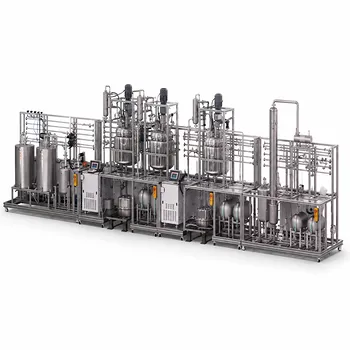
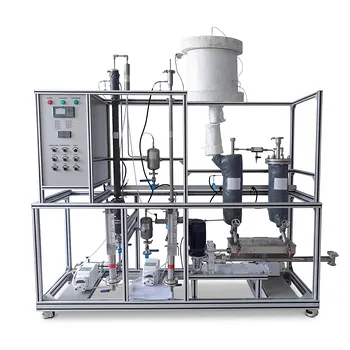
Integrating online spectroscopic analyzers requires robust, reliable process systems. LABPARK provides premium Educational and Vocational Unit Operations Pilot Plants in chemical engineering, bioprocess & biotech, and environmental & water treatment for universities, research institutes, and enterprises.
Our custom-engineered pilot plants offer the perfect platform to train operators, test calibration models like MLR and CLS, and optimize process control.
Contact LABPARK today to find the ideal pilot plant solution for your facility!
Related Products
- Fixed Bed Gas Solid Catalytic Reaction Educational Pilot Plant
- Multi Pump Fluid Transport Process Piping Unit Operations Training Pilot Plant
- Carbon Dioxide Hydrogen Methanol Synthesis Educational Unit Operations Pilot Plant
- Ethyl Acetate Synthesis Unit Operations Pilot Plant for Practical Training
- Natural Product Extraction Unit Operations Training Pilot Plant
People Also Ask
- How do reactor pilot plants safely study gas-solid reactions? Master kinetics with thermal & flow control.
- How does the Mears criterion evaluate transport resistance? Key Guide to Intrinsic Kinetics
- Fluidized vs. Fixed Bed Reactors: Comparing Heat & Complexity in Pilot Plants
- Why is a multibed configuration necessary for exothermic reactions? Optimize your pilot plant trajectory.
- How is the friction factor determined for fixed-bed pilot plants? Select the best pressure drop correlation.