Physical sample preparation is the silent killer of NIR model accuracy. In a pharmaceutical or chemical pilot plant, the explicit answer is to build a calibration set that deliberately spans all expected physical variability. For powders, that means experimental design to avoid confounding; for granules, it requires spiking pilot-produced matrices; and for intact tablets, calibration samples must be compressed on actual pilot-scale equipment. These strategies prevent particle size, shape, and compression state from masquerading as chemical changes in your spectra.
The root problem is that physical differences scatter near-infrared light, creating multiplicative and baseline spectral shifts that degrade quantitative predictions. The solution is not to “fix” the sample but to teach the model what normal physical variation looks like—using pilot-relevant preparation techniques that keep chemical and physical information separate. This transforms a fragile secondary method into a rugged process analytical tool.
Why Physical Variance Breaks NIR Models
Scattering Creates Illusions of Concentration Change
When particle size, shape, or compression changes, NIR light scatters differently. This produces multiplicative effects (tilt across the spectrum) and baseline shifts, both of which the model can easily misinterpret as variations in chemical composition. Without correction, your API or moisture content predictions will carry systematic bias.
The Secondary Method Trap
NIR is never a primary reference—it must be calibrated against a lab method like HPLC or Karl Fischer. That means the calibration set is the single source of truth. If the physical states of your calibration samples do not match pilot-plant reality, the model will be accurate in the lab but useless on the line. The deep need is therefore to build a chemometric bridge that is robust to real physical variability.
Engineering Robustness by Sample Type
For Powder Blends: Orthogonal Design Against Correlation
In powders, particle size and blend uniformity often correlate with composition. Experimental design breaks that link. Use factorial or D-optimal designs where physical attributes (milling time, blender speed) are varied independently from the API concentration. This supplies the model with spectra where physical effects are not aliased with the chemistry, enabling it to learn true concentration signals.
For Granulated Materials: Spike to Preserve Physical Integrity
If you grind or re-granulate a sample just to create a concentration range, you destroy the native particle size distribution and porosity. Instead, spike small, controlled amounts of active ingredient or key excipients into pilot-produced granule matrices. The bulk physical character stays identical to production material—the model learns to ignore it—while the chemical variation is safely introduced.
For Intact Tablets: Compression Matches the Process Fingerprint
Tablet hardness, coating thickness, and core density all scatter NIR light differently in transmission or reflectance mode. Calibration tablets must be produced on the same type of pilot-scale tableting equipment that will be used later. Hand-made slugs or lab presses create a different physical fingerprint, rendering the model fragile. Match the compression force range and dwell time exactly.
Navigating the Pilot Plant Reality
Start Offline, Deploy Online
Pilot environments rarely offer the luxury of exhaustive on-line calibration. A smarter path is to perform the initial model development offline in a controlled laboratory with collected samples, then transfer the validated model to the on-line analyzer. Model transfer techniques—like piecewise direct standardization—preserve calibration effort while adapting to the at-line hardware.
The Hidden Trade-off of Physical Diversity
Over-collecting physical variability can backfire. If granule size correlates with humidity and you fail to orthogonalize, the model will learn a noisy, confounded relationship. The greatest risk is overfitting to a specific physical state that does not reoccur. The calibration must be representative but never collinear. This demands rigorous, upfront experimental planning—an investment that pays off in robust, real-time release readiness.
Making the Right Choice for Your Goal
- If your primary focus is powder blends: Use factorial experiments that decouple particle size effects from API concentration, ensuring the model does not confuse one for the other.
- If your primary focus is granules: Spike pilot batches with small mass additions of the analyte instead of altering the granulation process, keeping the physical matrix intact.
- If your primary focus is intact tablets: Compress every calibration tablet on your actual pilot press at target hardness; never substitute lab-level preparation.
- If your priority is rapid deployment: Transfer an existing, robust calibration from a similar analyzer rather than attempting a full on-line calibration from scratch.
By deliberately encoding physical reality into your calibration set, you turn NIR from a fragile academic experiment into a rugged, decision-ready PAT workhorse.
Summary Table:
| Sample Type | Key Physical Challenge | Recommended Calibration Strategy |
|---|---|---|
| Powder Blends | Particle size & density correlation | Use factorial experimental design to decouple physical & chemical effects. |
| Granulated Materials | Porosity & size distribution changes | Spike pilot-produced matrices instead of grinding/re-granulating. |
| Intact Tablets | Hardness, coating & density variations | Compress calibration tablets on actual pilot-scale tableting equipment. |
Optimize Your Pilot Plant with LABPARK
Are you looking to scale up your pilot plant operations with high-precision systems? LABPARK provides state-of-the-art Educational and Vocational Unit Operations Pilot Plants in chemical engineering, bioprocess & biotech, and environmental & water treatment. Tailored for universities, research institutes, and enterprises, our pilot plants ensure robust, reliable, and industry-grade process optimization.
Ready to elevate your facility's capabilities? Contact LABPARK today to discuss your specific requirements!
Related Products
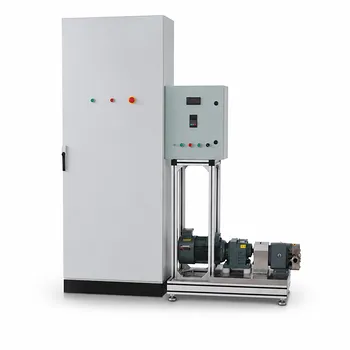
- Quantitative Dosing and Liquid Flow Control Educational Unit Operations Pilot Plant
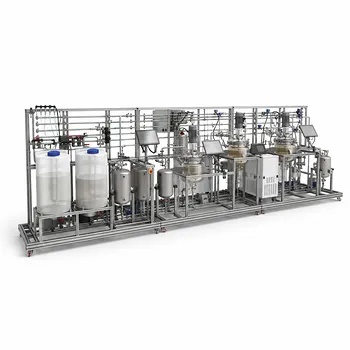
- Electrolyte Distillation Purification and Formulation Educational Pilot Plant
- General Purpose Cosmetics Production Unit Operations Training Pilot Plant
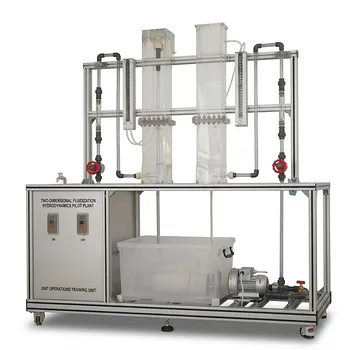
- Two-Dimensional Fluidization Hydrodynamics Educational Pilot Plant for Unit Operations Training
- Rising and Falling Film Evaporation Educational Unit Operations Pilot Plant
People Also Ask
- How do educational unit operations pilot plants bridge theory and design? Bridge the Engineering Gap
- How do educational unit operations pilot plants address safety and waste management when scaling up?
- Why is the attenuation path length (lA) critical when positioning pressure sensors in a fluid flow unit operations pilot plant?
- How do conservation equations guide fluid flow pilot plants? Key Scale-Up Principles
- What are the key differences in process analytics requirements from R&D to production?