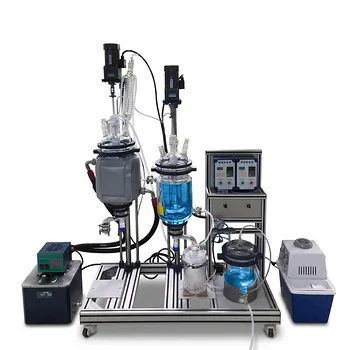
Your first decision isn't about which method is "better"—it's about what risk you're truly trying to manage. For a pilot plant, LOPA (Layer of Protection Analysis) will be your practical default in nearly all standard R&D, educational, or process development settings. You should only escalate to a full QRA (Quantitative Risk Analysis) when you are dealing with a novel, highly hazardous process whose consequences are too complex or severe to be captured by conservative, semi-quantitative estimates.
Most chemical and bioprocess pilot plants don't need the computational artillery of QRA. LOPA provides a fast, defensible, and resource-appropriate way to confirm that your existing layers of protection—alarms, relief valves, containment—are sufficient. QRA becomes essential only when the potential incident is so catastrophic or the chemistry so poorly understood that you must model the exact blast radius or toxic dispersion to make a design decision.
Understanding the Two Risk Assessment Methods
The core distinction is one of depth and resource intensity. You aren't choosing between a bad and good tool; you're selecting the right level of magnification for the risk you're examining.
The Quantitative Powerhouse: What QRA Actually Demands
QRA doesn't just count layers; it calculates numeric probabilities and physical consequences with painstaking detail. It requires you to model specific outcomes—fire, explosion, chemical dispersion—using computational fluid dynamics and historical failure rate databases.
This is intensely labor-intensive. You will need specialized personnel, significant time, and a mature process design with fully defined piping, equipment, and chemical inventories. For a pilot plant still under development, that level of data simply doesn't exist yet.
The core value of QRA is precision. It answers the question: "Exactly how many people, in which specific building, are at risk if this reactor ruptures?" It is the gold standard for siting hazardous facilities or justifying a massive capital expenditure to a regulator.
The Pragmatic Workhorse: How LOPA Streamlines the Process
LOPA takes a building-block approach. You start with a single, well-defined accident scenario—a cause-consequence pair, like "cooling water failure leads to thermal runaway."
Then you list every independent layer of protection that would stop that chain: the basic process control system, a hardwired high-temperature alarm, a relief valve, a containment dike. You assign each layer a conservative probability of failure on demand.
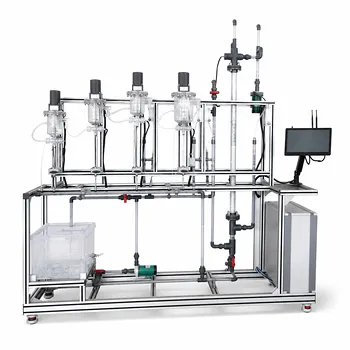
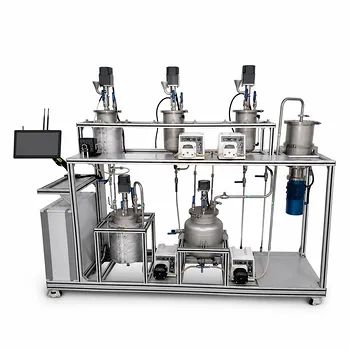
The final estimate is semi-quantitative. It won't tell you the precise overpressure in a corridor, but it will quickly reveal if you have enough independent safeguards to reduce the risk to a tolerable level. This is ideal for the standard unit operations—extraction columns, fermenters, distillation skids—found in most pilot plants.
Understanding the Trade-offs
No method is perfect. Acknowledging their limitations prevents you from misapplying them and eroding your safety culture.
The Trap of QRA's False Precision
A QRA model is only as good as its inputs. In a pilot plant, your failure rate data may come from large-scale industrial databases that don't match your novel miniaturized equipment. You can generate a number with four decimal places, but it might be based on a completely irrelevant assumption.
The sheer effort can also backfire. A QRA can cost more than some pilot-scale units themselves, slowing down the iterative, agile nature of R&D. If you require a full QRA for a minor modification to a benign separation process, you will paralyze your development timeline.
The Conservative Bluntness of LOPA
LOPA deliberately overestimates risk. It uses conservative, order-of-magnitude numbers to save time. For complex, cascading failures where multiple things go wrong simultaneously, LOPA struggles.
If your pilot plant involves a runaway reaction that can transition from containment venting to a major explosion in seconds, LOPA's focused, single-scenario approach may miss the interdependence. In that case, the conservatism isn't a safety factor—it's a blind spot that only the consequence modeling of QRA can illuminate.
Making the Right Choice for Your Pilot Plant
Your final decision hinges on the nature of the hazard and the maturity of your design. Use these priority-based guides to navigate the choice.
- If your pilot plant is for standard educational or routine R&D unit operations: LOPA is your definitive tool. It confirms that standard safeguards—relief valves, interlocks, emergency stops—are sufficient without drowning your team in unnecessary complexity.
- If you are designing a novel, high-hazard process with toxic or highly energetic materials: Use a staged approach. Start with LOPA to identify gaps in your protection layers, then apply QRA to quantify the specific, high-consequence scenarios that fall outside the scope of conservative assumptions.
- If you are late in the design phase and need to site a new, potentially hazardous module: QRA becomes non-negotiable. You will need the precise physical consequence models to demonstrate regulatory compliance and justify safety distances to management and authorities.
A well-designed safety analysis doesn't pick a single methodology; it picks the right resolution of data for the risk at hand, ensuring that a pilot plant remains a place for safe, rapid innovation.
Summary Table:
| Feature | Quantitative Risk Analysis (QRA) | Layer of Protection Analysis (LOPA) |
|---|---|---|
| Approach | Numerical probability & physical consequence modeling | Scenario-based verification of independent safety layers |
| Complexity | High (demands specialized software, historical data, and time) | Moderate (fast, conservative, order-of-magnitude analysis) |
| Best For | Novel, high-hazard processes & facility siting compliance | Standard unit operations & routine R&D settings |
Designing safe and compliant pilot plants requires the right technical expertise. LABPARK provides high-quality Educational and Vocational Unit Operations Pilot Plants in chemical engineering, bioprocess & biotech, and environmental & water treatment. Specifically tailored for universities, research institutes, and enterprises, our pilot plants integrate robust safety features tailored to your protocols. Contact us today to discuss how we can support your research and training goals!
Related Products
- Bio-fermentation Ethanol Production Practical Training Unit Operations Pilot Plant
- Residence Time Distribution and Reactor Flow Characteristics Determination Educational Pilot Plant
- Natural Product Extraction Unit Operations Training Pilot Plant
- Ethyl Acetate Synthesis Unit Operations Pilot Plant for Practical Training
- Electrolyte Distillation Purification and Formulation Educational Pilot Plant
People Also Ask
- Why Use PTFE & Hastelloy in Chemical Pilot Plants? Prevent Corrosion & Ensure Safety
- Why Compare Predicted and Experimental Excess Enthalpy? Key to Accurate Pilot Plant Scale-up
- Why is the chemical plant startup schedule crucial? De-risk scale-up with pilot plants.
- When to transition from PID to adaptive control in pilot plants? Key process indicators.
- Why must batch and fed-batch fermentation pilot plants be designed to accommodate changing rheological conditions?