The decision rests on a single, non-negotiable criterion: how your reaction mixture behaves when you try to separate it.
Reactive Distillation (RD) is the superior choice when at least one product is the most or least volatile component—allowing you to boil it away and continuously shift the equilibrium. Reactive Chromatography (RC) becomes mandatory the moment volatility differences vanish, azeotropes form, or heat-sensitive molecules would degrade at distillation temperatures. The entire selection process thus reduces to a rigorous assessment of your system’s phase-equilibrium landscape and thermal stability.
Reactive Distillation harnesses boiling point differences to purge a product; Reactive Chromatography harnesses differences in adsorption affinity. The moment your reaction mixture exhibits low relative volatility, tight-boiling behavior, or thermal fragility, RC is your definitive pilot plant path—not merely an alternative.
The Deciding Criterion: Volatility vs. Adsorptivity
Equilibrium-limited reactions demand product removal to drive conversion forward. The separation mechanism you choose determines everything: equipment complexity, operating window, and ultimate feasibility.
When Reactive Distillation Excels
RD integrates a reaction zone directly into a distillation column. It works brilliantly when one product is decidedly lighter or heavier than all other components.
For example, in esterification reactions, water often forms as the light boiler. You can continuously distill it from the top, pulling the equilibrium toward complete conversion.
Similarly, etherifications like MTBE production keep the heavy ether product in the bottoms while lighter reactants are refluxed. This is the classic reactive rectifier or stripper configuration—fast, industrial, and well-understood.
When Reactive Distillation Fails
The entire mechanism collapses when boiling points are too close. If relative volatility approaches unity, you cannot achieve a clean split; the column would need infinite stages and reflux.
Azeotropes present an even harder barrier. Even with distillation, you may hit a composition that boils at a constant temperature, locking the reaction and preventing pure product recovery.
At that point, the volatility-based driving force disappears. You need a fundamentally different separation principle.
How Reactive Chromatography Takes Over
Reactive Chromatography shifts the driving force from vapor-liquid equilibrium to solid-liquid adsorption. A column packed with a selective adsorbent separates components based on their differing affinities for the stationary phase, not their boiling points.
A liquid mobile phase carries the mixture through the bed, and the products elute at different times. When you couple this with a reaction (often using a catalytic adsorbent or in‑situ catalyst), you get continuous removal of the desired product by adsorption, even when volatilities are identical.
This is why RC effortlessly handles close-boiling isomers, non‑volatile molecules, and thermally delicate compounds. The classic example from the primary reference—ethyl lactate production—demands RC exactly because the reactants and products are not easily separable by boiling and are sensitive to heat.
Heat Sensitivity: The “Silent” Decision Driver
Sometimes the boiling points are favorable, yet RD is still a dangerous choice. Many modern target molecules—pharmaceutical intermediates, natural products, bio‑based building blocks—degrade at temperatures required for distillation.
The Temperature Reality of Distillation
Even under vacuum, distillation requires reboiler temperatures high enough to vaporize the mixture. That thermal load can destroy catalysts, denature proteins, or cause unwanted side reactions.
Moreover, the residence time in a reboiler or sump can amplify degradation. Even if the bulk temperature seems acceptable, hot spots in kettle‑type reboilers or prolonged exposure in forced‑circulation loops can ruin yield.
The Gentle Touch of Chromatographic Separation
Reactive Chromatography operates at ambient or mildly elevated temperatures. The separation does not depend on phase change; you simply pump a liquid through a packed bed.
This preserves stereochemistry, avoids pyrolysis, and keeps delicate functional groups intact. If your reaction mixture contains anything that would brown, char, or racemize in a distillation still, RC is not just preferred—it is the only safe pilot plant route.
Understanding the Trade‑Offs
No technology is universally perfect. Adopting RC over RD introduces a new set of practical concerns you must weigh before committing to a pilot plant design.
Throughput and Scalability
Distillation columns handle enormous volumetric flows and are the workhorses of the chemical industry. A pilot RD column easily demonstrates scalability to full production.
Chromatographic processes, especially batch column chromatography, often have lower throughput. However, continuous simulated moving bed (SMB) reactors—the industrial evolution of RC—can match significant production rates. Your pilot plant choice should align with the intended final scale. For high‑volume commodity chemicals, RD usually has the edge. For high‑value, low‑volume fine chemicals, RC is entirely appropriate.
Complexity of Design and Control
RD demands rigorous thermodynamic modeling: residue curve maps, reaction equilibrium manifolds, and identification of stable/unstable nodes to choose between rectifier, stripper, or middle‑vessel columns. That upfront analysis is deep but well‑established.
RC shifts the complexity to adsorption isotherms, solvent selection, mass‑transfer kinetics, and stationary‑phase stability. The pilot plant itself is mechanically simpler—no reboiler, no condenser, no vacuum system—but the separation design requires a different skill set. You trade one body of knowledge for another.
Cost and Consumables
An RD pilot plant uses energy (steam, cooling water) as its main operating cost, and the internals (trays, packing) are robust and reusable.
RC consumes specialized adsorbents, high‑purity solvents, and sometimes requires column regeneration cycles. The adsorbents can be expensive and have a finite lifetime. This can make long‑term pilot campaigns costlier, but for small, high‑value product campaigns, the overall economics still favor RC when distillation is impossible.
Making the Right Choice for Your Research Goal
Your decision tree should follow these specific, goal‑oriented rules. Use the bullets below to align your pilot plant selection with what you need to prove or produce.
- If your primary focus is demonstrating industrial feasibility for a bulk chemical with a clean boiling‑point separation: Choose Reactive Distillation in the configuration that matches your product’s node type (rectifier for a light unstable node, stripper for a heavy stable node). This will directly mirror future plant operations.
- If your primary focus is producing a heat‑sensitive high‑value molecule that would degrade at reboiler temperatures: Choose Reactive Chromatography, immediately. The ability to run at ambient temperature is non‑negotiable here.
- If your primary focus is breaking an azeotrope or separating a close‑boiling mixture that defies conventional distillation: Reactive Chromatography is your enabling technology. No amount of column stages or entrainer screening will overcome a fundamental lack of volatility difference—adsorption will.
- If your primary focus is rapid screening of catalyst and condition with a wide range of chemistries in an academic lab: Consider a modular RC setup. It can be reconfigured more quickly for different solvent systems and adsorbents without the massive cleaning and re‑staging a distillation pilot plant requires.
Ultimately, the selection is not about which technology is “better,” but which one physically resolves the separation bottleneck that limits your equilibrium. Follow the thermodynamic and thermal stability data, and the right pilot plant becomes self‑evident.
Summary Table:
| Feature | Reactive Distillation (RD) | Reactive Chromatography (RC) |
|---|---|---|
| Separation Basis | Volatility differences (vapor-liquid equilibrium) | Adsorption affinity (solid-liquid phase) |
| Thermal Sensitivity | High heat required (potential for degradation) | Low/Mild temperatures (safeguards delicate molecules) |
| Ideal Applications | Bulk chemicals, light/heavy product extraction | Heat-sensitive, close-boiling, or azeotropic mixtures |
| Scalability & Flow | High throughput; easily scaled to industrial size | Moderate throughput; scalable via Simulated Moving Bed (SMB) |
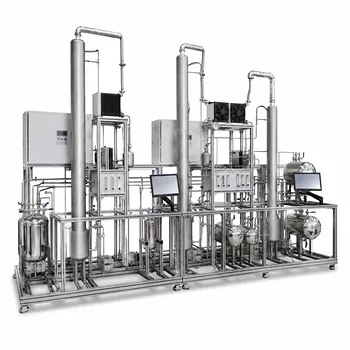
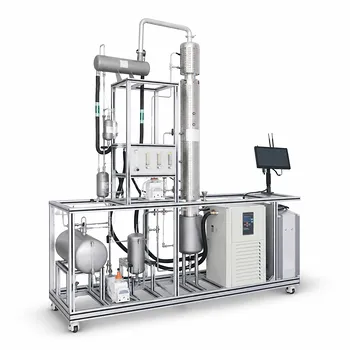
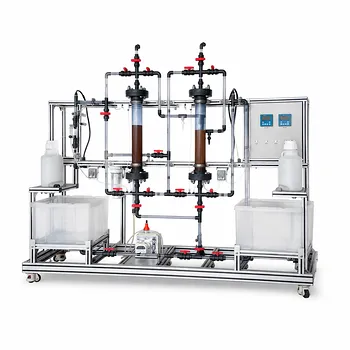
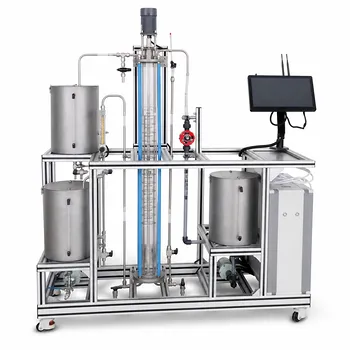
Are you designing a chemical engineering lab or research facility? LABPARK provides state-of-the-art Educational and Vocational Unit Operations Pilot Plants in chemical engineering, bioprocess & biotech, and environmental & water treatment. Designed specifically for universities, research institutes, and enterprises, our pilot systems deliver the precision and scalability required for cutting-edge research.
Contact LABPARK today to find the ideal pilot plant solution for your laboratory!
Related Products
- Multi-Functional Special Distillation Educational Pilot Plant
- Continuous Batch Extractive Distillation Educational Pilot Plant
- Electrolyte Distillation Purification and Formulation Educational Pilot Plant
- Green Anhydrous Ethanol Refining Practical Training Pilot Plant
- Green Anhydrous Ethanol Purification Extractive Distillation Unit Operations Training Pilot Plant
People Also Ask
- Why does simple distillation yield higher efficiency than flash distillation? Key thermodynamic differences.
- How does double temperature difference control improve distillation pilot plants? Stabilize purity.
- How to Integrate Spectroscopy in Distillation Pilot Plants for Advanced Process Control
- How to Verify Distillation Boundary Lines & Composition Regions with Pilot Plants
- Why is the acentric factor important in pilot plants? Fluid property prediction.