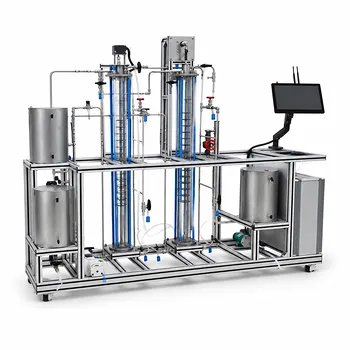
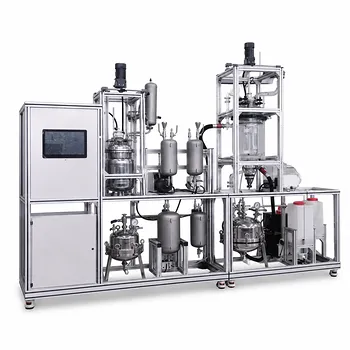
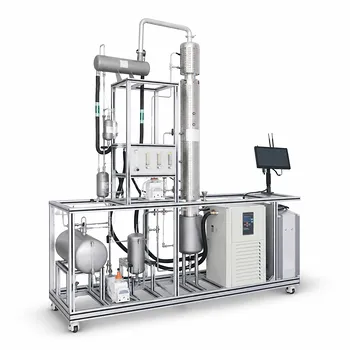
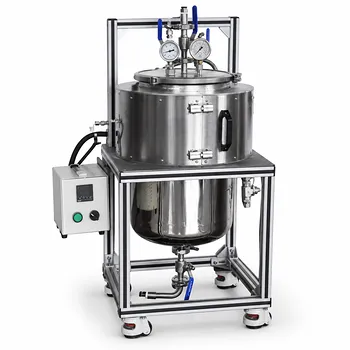
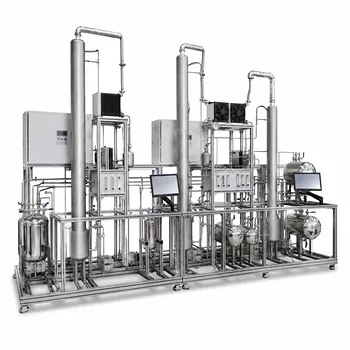
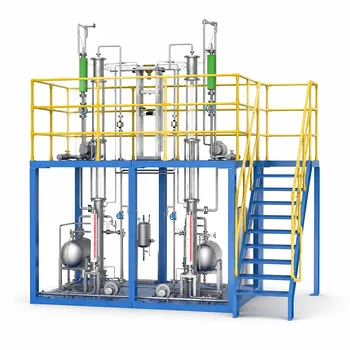
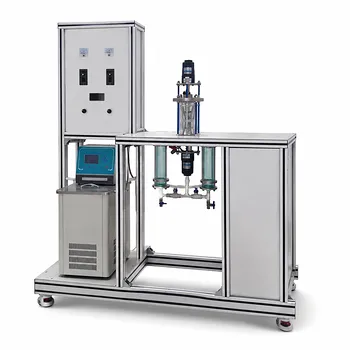
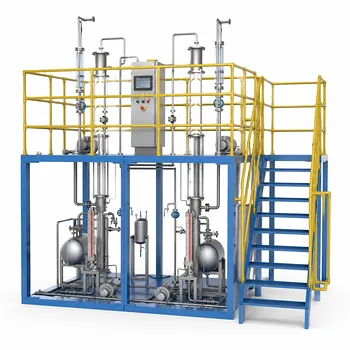
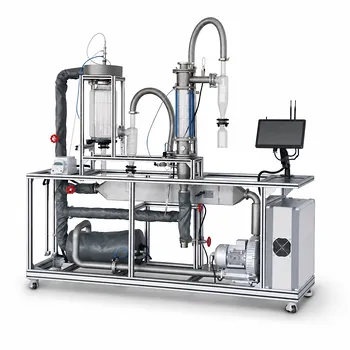
LLE pilot plants teach separation principles that thermal methods cannot. When a mixture contains heat-sensitive biomolecules or is so dilute that boiling off large amounts of solvent would waste enormous energy, distillation—the “go‑to” thermal method—becomes a liability. Liquid‑liquid extraction (LLE) circumvents that problem by using a selective solvent at near‑ambient temperature, preserving delicate compounds and concentrating low‑level solutes without a vapor‑phase overhead. In a university lab, a pilot‑scale LLE unit lets students see and measure those advantages directly, turning an abstract textbook idea into a tangible engineering skill.
The fundamental reason to include an LLE pilot plant is that real‑world separation challenges often involve thermally fragile or extremely dilute feeds—exactly where distillation fails or becomes economically irrational. LLE operates on solubility differences, not boiling points, so it protects heat‑sensitive solutes, handles azeotropes, and minimizes energy usage. A pilot plant bridges the gap between theory and practice, giving students the hands‑on insight they need to design, troubleshoot, and optimize separations for biopharma, fine chemicals, and environmental remediation.
When Distillation Reaches Its Limits
The Thermal Barrier of Heat‑Sensitive Compounds
Distillation requires boiling and condensing the components of a mixture. That thermal cycle is disastrous for many high‑value products—antibiotics, organic acids, natural extracts—that denature, decompose, or polymerize at elevated temperatures. Even vacuum distillation may not offer enough temperature reduction for especially fragile molecules. LLE, by contrast, can happen at room temperature. Solute molecules move from one liquid phase to another without ever being vaporized, so their chemical structure stays intact.
The Energy Trap of Low‑Concentration Feeds
When the target solute makes up only a fraction of a percent of the feed, distillation forces you to vaporize and condense the vast bulk of the solvent just to recover that tiny amount. For example, recovering acetic acid from dilute aqueous waste by distillation would boil off water for hours, consuming enormous energy. An LLE column can extract the acid into a small volume of solvent, concentrating it without boiling off the water. The pilot plant demonstrates this dramatic reduction in energy intensity, a lesson that simple calculation alone cannot fully convey.
The Azeotrope Dead‑End
Close‑boiling mixtures and azeotropes defy ordinary distillation because vapor and liquid phases have identical compositions—no net separation occurs. While special techniques like extractive distillation can break an azeotrope by adding a third component, those methods still operate at distillation temperatures. LLE can directly separate the azeotrope-forming components by exploiting chemical affinity. Even better, after extraction the solute‑loaded solvent often yields a mixture with wide‑boiling components that can then be distilled easily. The pilot plant reveals how unit operations integrate: extraction first, then a simple distillation column for final polishing.
What a Pilot‑Scale LLE Unit Teaches That Theory Alone Cannot
From Partition Coefficient to Phase‑Contact Reality
In the classroom, students calculate distribution coefficients and predict recoveries with a single equation. On the pilot plant, they see how mass transfer rates, droplet size, and phase disengagement shape the actual separation. They manipulate solvent‑to‑feed ratios and observe emulsion formation, flooding, or entrainment—phenomena that are barely mentioned in textbooks but dominate industrial performance.
Solvent Screening and Green Engineering Judgement
Choosing the right solvent is an art. A pilot unit lets students test different solvents, evaluating selectivity, density, viscosity, toxicity, and recoverability. They learn that the theoretical “best” solvent on paper may fail in practice due to slow settling or excessive solubility in the raffinate. This hands‑on experimentation builds the habit of systematically trading off separation power against operability and environmental impact.
Bridging Bioprocessing and Environmental Separations
Many emerging fields—fermentation product recovery, rare earth element purification, pharmaceutical intermediate isolation—depend on gentle, selective extraction. Distillation can’t handle the complex broth matrices or trace concentrations involved. By running actual feeds (or simulated ones) on a pilot plant, students experience the same challenges they’ll face when scaling up a bioseparation or treating contaminated water. It transforms them from “distillation‑only” thinkers into versatile separation engineers.
Integrating Unit Operations to Solve Industrial Problems
A well‑designed LLE pilot plant can be paired with a downstream distillation column. Students first extract the target solute, then distill the extract to recover pure product and recycle the solvent. This closed‑loop thinking—extraction coupled with solvent recovery—mirrors real‑world process flow diagrams, teaching students how to combine unit operations to overcome the shortcomings of any single method.
Understanding the Trade‑offs
Solvent Handling and Losses
Every LLE process introduces a foreign solvent that must be separated, recovered, and handled safely. Residual solvent in the raffinate can become an environmental or product‑quality concern. Students must grapple with solvent loss, regeneration costs, and disposal regulations—issues that a simple distillation column avoids.
Phase Separation Challenges
Emulsions, rag layers, and slow coalescence can cripple a commercial extraction column. Pilot‑plant experience quickly highlights the importance of proper internals, flow rates, and solvent properties. These operational pains are invisible in idealized calculations but become central learning moments in the lab.
Complementary, Not a Universal Replacement
LLE is not a silver bullet. For mixtures with large boiling‑point differences and no thermal sensitivity, simple distillation remains faster and cheaper. The pilot plant’s role is to fill the gap where distillation fails, not to replace it entirely. A well-rounded curriculum uses both—fractional distillation for straightforward hydrocarbon splits, and LLE for the “difficult” separations that define modern high‑value manufacturing.
Making the Right Choice for Your Curriculum
- If your primary focus is preparing students for the biotech, pharmaceutical, or food industries: Include an LLE pilot plant that demonstrates room‑temperature recovery of delicate biologicals. This experience directly mirrors the unit operations they will encounter in production and R&D.
- If your primary focus is petrochemical or bulk chemical education: Continue teaching distillation rigorously, but add a module on extractive or azeotropic distillation to show how a third component (often acting as a solvent) alters relative volatility. An LLE pilot plant still offers value as a precursor step for breaking azeotropes.
- If your goal is to teach integrated process design: Pair a liquid‑liquid extraction pilot plant with a simple distillation column. Let students see how extraction unloads the energy burden from distillation, concentrating the solute so that subsequent thermal separation becomes economical.
- If sustainability and energy efficiency are key learning outcomes: Use the LLE unit to quantify the drastic reduction in thermal energy when switching from distillation to extraction for dilute feeds. Compare the two methods’ carbon footprints and steam requirements on the same feed mixture.
- If you need to cover fundamentals of mass transfer with real‑world complexity: An LLE pilot plant reveals the impact of hydrodynamics, mass transfer coefficients, and phase equilibria in a way that a simple distillation column does not, because the two immiscible phases add a layer of mixing and settling behavior.
Every chemical engineer must master distillation, but the industries that define the future—biologics, advanced materials, sustainable processes—demand a broader separation toolkit. An LLE pilot plant gives students the tangible, tactile understanding they need to confidently handle heat‑sensitive and low‑concentration separations, transforming them from passive learners into capable, forward‑thinking problem solvers.
Summary Table:
| Feature | Distillation | Liquid-Liquid Extraction (LLE) |
|---|---|---|
| Separation Principle | Boiling point differences | Solubility & chemical affinity |
| Thermal Sensitivity | High heat (risks decomposition) | Ambient temperature (preserves molecules) |
| Low-Concentration Feeds | High energy (boils bulk solvent) | Low energy (concentrates solute directly) |
| Azeotropic Mixtures | Fails without special techniques | Directly separates via selective solvents |
Equip Your Lab with LABPARK's Advanced Pilot Plants
Enhance your curriculum and research capabilities with LABPARK. We provide state-of-the-art Educational and Vocational Unit Operations Pilot Plants in chemical engineering, bioprocess & biotech, and environmental & water treatment. Designed specifically for universities, research institutes, and enterprises, our pilot plants bridge the gap between theory and industrial reality—allowing students to master complex separations firsthand.
Ready to upgrade your laboratory? Contact us today to discover how LABPARK can customize the perfect pilot plant solution for your institution.
Related Products
- Comprehensive Liquid-Liquid Extraction Pilot Plant for Engineering Education
- Gallium and Indium Selective Extraction Educational Pilot Plant
- Continuous Sieve-Plate Distillation Pilot Plant for Unit Operations Laboratory Education
- Multi-Reactor Educational Pilot Plant for Reaction Engineering Unit Operations
- Multi-Modal Distillation Unit Operations Training Pilot Plant
People Also Ask
- How do pilot plants differentiate physical vs chemical extraction? Enhance Chemical Engineering Training
- How are ternary phase diagrams and LLE data applied in extraction experiments? Optimize Pilot Plant Scale-up
- How to Validate BIPs for LLE Pilot Plants? Steps to Align Simulations with Reality
- In a liquid-liquid extraction pilot plant, how is a ternary-phase diagram utilized to determine solvent feed requirements?
- How Do Selectivity & Distribution Coefficients Influence LLE Pilot Plant Solvent Choice?