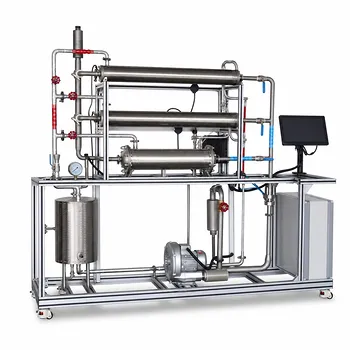
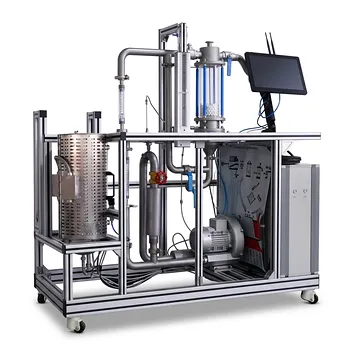
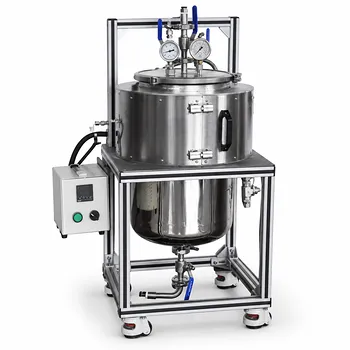
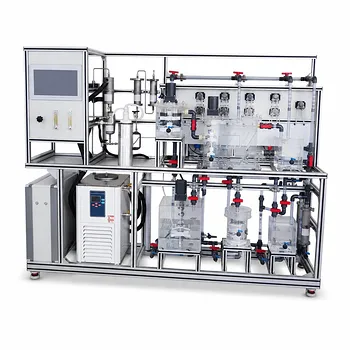
The core dilemma in heating a pilot plant boils down to a choice between operational agility and process safety. Electric heating offers a low-complexity, plug-and-play solution ideal for small, intermittent batches, while steam heating provides inherent safety and far more efficient heat transfer, but demands a more significant upfront infrastructure. The optimal choice hinges on your specific scale, the cyclic nature of your experiments, and the presence of flammable materials.
For small-scale bioprocess or chemical engineering pilot plants, electric heating wins on installation simplicity and rapid start-stop capability, but requires rigorous temperature control to prevent failures. Steam heating, though more complex to install, is inherently safer and delivers higher heat transfer coefficients, leading to smaller, more economical heat exchangers and supremely stable temperature control via pressure regulation.
Why Electric Heating Dominates Small-Scale Pilot Plants
Electric heating is the default choice for many educational and early-stage bioprocess labs because it aligns perfectly with the chaotic, experimental nature of pilot work.
Operational Agility with Fast Start-Stop Cycles
Pilot plants in bioprocess and chemical education rarely run 24/7. They are batch-oriented and highly cyclic. Electric heaters can be powered on almost instantly and shut down without any purge or condensate drain procedures. This drastically reduces turnaround time between student experiments or iterative process development runs.
Minimal Initial Installation Complexity
An electric heater often requires nothing more than a power connection, a controller, and a mounting point. There is no need for steam boilers, piping networks, steam traps, or condensate return systems. For a pilot plant that may be reconfigured frequently, this plug-and-play simplicity translates directly into lower capital cost and greater flexibility.
The Hidden Risk of Burnout and Code Compliance
However, the convenience of electric heating comes with a razor-sharp edge. If the heating element is energized but not fully submerged or if flow stops unexpectedly, the resulting overheating can destroy the element in seconds. This demands highly reliable temperature controllers, flow switches, and often complex safety interlocks. Furthermore, in pilot areas handling solvents or flammable atmospheres, electric heaters must meet stringent explosion-proof codes, which can erode much of their initial cost advantage.
The Safety and Efficiency Edge of Steam
Steam heating may seem like an old-fashioned industrial method, but at the pilot scale it delivers a level of safety and thermal performance that is difficult to match with electric systems.
Intrinsic Safety in Volatile Environments
Steam is fundamentally a non-sparking, non-flammable heat source. In a pilot plant processing biological fermentations that may produce volatile organic compounds, or in chemical unit operations with solvent washes, steam completely eliminates the electrical ignition risk. This inherent safety often simplifies the permitting process and reduces the need for elaborate explosion-proof enclosures.
Superior Heat Transfer Coefficients
The primary reference highlights a critical engineering advantage: steam provides much higher heat transfer coefficients than electric resistance heating. Because condensation of steam on a surface is an extremely efficient heat transfer mechanism, the required heat exchange area shrinks dramatically. For a pilot plant, this means you can use smaller, less expensive jacketed vessels and heat exchangers, which saves valuable bench space and reduces hold-up volumes—crucial for high-value bioprocess products.
Precise Temperature Control Through Pressure
With steam, temperature control becomes a matter of regulating the back-pressure on the steam side. A simple pressure regulator can maintain a constant, precise saturation temperature across the entire heating surface, eliminating the hot spots and thermal lag often seen with electric band heaters. This uniformity is invaluable in delicate microbial cultivation or exothermic chemical reactions.
Understanding the Key Trade-offs
No heating utility is universally superior. A clear-eyed view of their limitations is essential for pilot plant design.
Infrastructure Burden vs. Operational Simplicity
If you choose steam, you are committing to a steam generator (even a small electric one), blowdown systems, steam traps, condensate return piping, and regular maintenance. This infrastructure can overwhelm a small pilot facility designed for rapid experimentation. If you choose electric, you accept a dependency on sturdy electrical supply and sophisticated control logic to manage burnout risks, especially during the inevitable startup hiccups of pilot-scale work.
Thermal Uniformity vs. Bulk Power Delivery
Steam’s uniform heating is a double-edged sword. While it prevents scorching, an electric immersion heater can sometimes deliver higher power density into a liquid, enabling faster heat-up times for small batches if the control system is up to the task. However, this often comes at the cost of temperature gradients within the vessel, which can skew experimental data.
Long-Term Operating Cost and Sustainability
Small pilot plants often neglect the energy efficiency picture. Electric heating is nearly 100% efficient at the point of use, but steam generation upstream involves boiler losses and heat loss in distribution piping. For a purely intermittent pilot plant, the standby losses of a small steam system can be disproportionately high, making electric the more economical choice over the plant’s lifetime—provided safety codes are already met.
Making the Right Choice for Your Pilot Plant Goal
Your decision should flow directly from your highest operational priority. Use this framework to guide your selection.
- If your primary focus is maximum flexibility and minimal infrastructure for student-led or highly iterative projects: Electric heating is the clear winner. Accept the need for high-quality PID controllers and interlock systems as a necessary trade-off for its operational agility and low upfront complexity.
- If your primary focus is intrinsic safety and risk mitigation when handling volatile solvents or in ATEX/IECEx zones: Steam heating is the superior choice. Its non-electrical nature simplifies safety compliance and eliminates ignition risk, justifying the higher installation effort.
- If your primary focus is scaling up processes with tight, uniform temperature profiles for sensitive biologics: Steam’s high heat transfer coefficient and pressure-based control deliver the uniform heating and smaller equipment envelope that are essential for preserving product integrity in a benchtop setup.
Ultimately, the best pilot plant design often uses a hybrid approach, applying steam for fixed, safety-critical vessels and electric for portable skids or short-term experiments. This pragmatic blend respects the fundamental truth that utility selection is not about finding a perfect solution, but about aligning a heating technology with the unique risk and flexibility profile of your research.
Summary Table:
| Feature | Electric Heating | Steam Heating |
|---|---|---|
| Installation | Low complexity, plug-and-play | High complexity (requires boiler/piping) |
| Process Safety | Risk of element burnout; requires ATEX compliance | Inherently safe; no electrical ignition risk |
| Heat Transfer | Moderate heat transfer coefficient | High heat transfer coefficient (smaller footprint) |
| Temperature Control | Electronic controllers & interlocks | Highly uniform via pressure regulation |
| Best Suited For | Flexible, student-led batch runs | Scale-up, volatile media, uniform heat |
Build the Perfect Pilot Plant with LABPARK
Choosing the right heating utility is critical to the safety, flexibility, and success of your process scale-up. LABPARK provides high-quality Educational and Vocational Unit Operations Pilot Plants across chemical engineering, bioprocess & biotech, and environmental & water treatment.
Whether you are a university developing hands-on learning labs, a research institute testing novel pathways, or an enterprise scaling up production, LABPARK delivers tailored, compliant, and robust pilot systems engineered to your precise needs.
Ready to configure your next system? Contact LABPARK today to consult with our engineering experts and find the ideal heating configuration for your facility.
Related Products
- Comprehensive Multi-Modal Heat Transfer Unit Operations Pilot Plant for Engineering Training
- Dual Mode Heat Transfer Pilot Plant for Unit Operations Training
- Three-Tube Heat Transfer Educational Pilot Plant for Unit Operations Training
- Comprehensive Heat Transfer Coefficient Determination Educational Unit Operations Pilot Plant
- Solid Spherical Heat Transfer Coefficient Determination Educational Chemical Engineering Pilot Plant
People Also Ask
- When is ε-NTU preferred over LMTD in pilot plants? Predict heat exchanger performance without iteration.
- How can a heat transfer pilot plant demonstrate waste heat recovery? Learn to optimize industrial thermal systems.
- What engineering trade-offs must students analyze in a heat transfer pilot plant? Balance performance & cost.
- How to Verify Air-Side Heat Transfer Coefficient with a Pilot Plant? Practical Lab Guide
- How to configure heat transfer pilot plants for pinch analysis? Teach energy recovery.