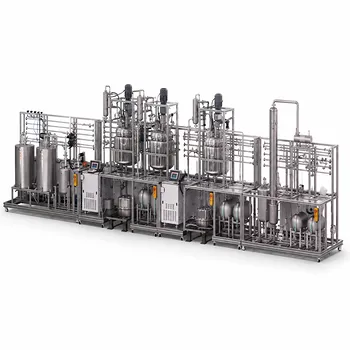
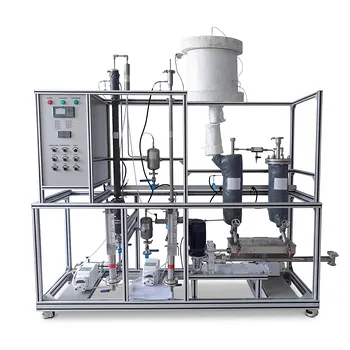
Your choice of materials is not simply a performance specification—it is the primary engineering control that prevents fires, contains deadly toxins, and halts runaway reactions before they start. When configuring teaching or research pilot plants, safety dictates that equipment materials be selected first for their inherent resistance to ignition, their ability to form a permanent, zero-leak barrier, and their passive stability when in contact with reactive chemicals. This material-first strategy embeds safety into the very fabric of the system, protecting students and researchers far more reliably than procedural controls or PPE alone.
True safety in a pilot plant begins long before a standard operating procedure is written. It starts with selecting construction materials that intrinsically neutralize the hazards of the chemicals you’ll be using. For flammable, toxic, or reactive substances, the material you choose is the barrier, the heat sink, and the first line of defense—get it wrong, and every other safety measure becomes a gamble.
The Foundation: Material Selection as a Primary Safety System
Regulations and checklists are essential, but they are downstream of a more fundamental decision. In a pilot plant, the walls of the pipe, the body of the reactor, and the seats of the valves are the true guardians of the lab. This approach converts chemical hazards from active threats into managed conditions.
Understanding the Chemical Hazard Triangle
Every material selection decision must address the three core hazards described in the primary reference: flammability, toxicity, and reactivity. A material that solves for only one of these can create a catastrophic blind spot. For example, a polymer that perfectly resists a corrosive acid might be dangerously permeable to a toxic vapor, or a strong metal alloy might spark when scratched with a tool, igniting a flammable atmosphere. The process begins by mapping each chemical in your experimental plan against these three properties.
The Inherent Safety Principle: Passive Over Active
The safest pilot plants do not rely on a complex computer to shut things down during an emergency; they use materials that make the emergency impossible. This is the principle of inherent safety. Selecting stainless steel over carbon steel for a mildly corrosive, flammable solvent is not just a durability choice—it eliminates the risk of a rust particle causing a hot-spark ignition or a pinhole leak forming over time. The design is safe by its nature, not by an add-on system.
Mitigating Flammability: From Spark Prevention to Vapor Control
Flammable solvents like acetone, ethanol, or toluene are staples in chemical engineering education and research. The material selection strategy here is two-fold: eliminate all potential ignition sources that the equipment could generate, and contain vapors absolutely to keep airborne concentrations below the lower flammability limit (LFL).
Inherently Non-Sparking and Static-Dissipative Materials
For process-wetted parts, the primary reference calls for materials like high-density polyethylene (HDPE), polypropylene, or stainless steel. These materials minimize fire and explosion risks in fundamentally different ways. HDPE and polypropylene are non-sparking and do not generate mechanical sparks upon impact. However, they can accumulate static charge, so they must be specified with conductive additives or used where grounding is assured. Stainless steel (particularly 304 or 316 grades) is the gold standard: it is inherently non-sparking, readily grounded to dissipate static electricity, and provides the mechanical strength to contain a deflagration. The choice between polymer and metal becomes a balance of cost, chemical resistance, and pressure rating.
The Critical Role of Construction Geometry
The form of the material is as important as its composition. Supplementary references emphasize that to prevent vapor leaks, construction should prioritize high-quality welded joints over flange connections. A single flange with a deteriorating gasket is the most common leak point in a pilot plant. By switching to a fully welded stainless steel piping system, you dramatically reduce the number of potential fugitive emission points. This inherently safer geometry is a direct material specification: you are choosing a welded pipe structure over a bolted one.
Managing the Vapor Space
Even with perfect containment, vessels must be opened for sampling and maintenance. Here, material compatibility extends to the safety infrastructure. The design must accommodate nitrogen gas blanketing systems that purge vapor spaces, keeping the oxygen concentration below the limiting oxygen concentration. The material of the tank and piping must be compatible with dry nitrogen (most are) and must not become brittle or permeable. For pilot plants in educational settings, supplementary references recommend aligning the overall design with NFPA 69 (explosion prevention systems) , which often requires the vessel material itself to be robust enough to handle the pressure of a controlled inerting process.
Containing Toxicity: The Imperative of a Zero-Leak Barrier
When handling toxic chemicals, the permissible exposure limit (PEL) is often measured in parts per million. The primary reference correctly identifies robust sealing as the core requirement. But "sealing" is a system-level property of the chosen material set.
Material Permeability and Gasket Science
A stainless steel pipe wall is effectively impermeable to all process fluids, but the gaskets, valve packing, and flexible hose linings are not. For toxic service, you cannot rely on generic elastomers. You must select gasket materials with proven low permeation rates and chemical resistance to the specific toxin. PTFE (Teflon) enveloped gaskets or chemically inert perfluoroelastomers (FFKM) become non-negotiable. The primary reference’s call for "robust sealing" translates directly into a specification: "All soft goods in contact with a toxic stream must be selected from materials with permeation data showing a breakthrough time far exceeding the expected contact duration at operating temperature."
Corrosion Resistance as a Toxicity Safeguard
A toxic chemical that slowly corrodes its containment doesn't need a catastrophic failure to kill—a micro-leak is enough. This is why supplementary references insist on materials that prevent rust and degradation, particularly in humid educational lab environments. While carbon steel is economical for non-corrosive training fluids, the moment a toxic or even mildly corrosive chemical is introduced, the safety calculation shifts overwhelmingly in favor of 316 stainless steel. The slight additional molybdenum in 316 provides the pitting and crevice corrosion resistance needed to guarantee that a sealed system stays sealed, year after year.
Taming Reactivity: Materials That Refuse to Participate
Highly reactive chemicals—including concentrated sulfuric acid, hydrogen peroxide, or hydrofluoric acid—pose a threat not just of leak, but of a violent, energetic event. The primary reference states that materials must "withstand potential heat generation, pressure build-up, or violent reactions." This means the material itself must be a passive thermal sink and a sacrificial barrier that doesn't fuel the reaction.
Corrosion-Resistant Alloys and Non-Metallic Linings
For strong oxidizers like hydrogen peroxide, even standard stainless steel can catalyze dangerous decomposition. Material selection must move to specifically passivated or ultra-pure alloys, or to non-metallic materials. For teaching plants, the supplementary references highlight the utility of glass, glass-lined steel, and PTFE to provide broad chemical compatibility. A glass-lined reactor is effectively inert to almost all reactive chemistries, allowing students to safely study exothermic reactions because the vessel wall does not introduce a catalytic variable. For hydrofluoric acid, which attacks glass, this rule flips; you must turn to specific plastics (like polyethylene or certain fluoropolymers) that the supplemental references correctly identify as essential for preventing rapid degradation.
Thermal Management Through Material Mass and Design
Passive safety against runaway reactions often means designing the equipment as a heat sink. A thick-walled, jacketed stainless steel reactor can absorb and remove heat from a reaction that begins to exotherm faster than a thin-walled glass vessel. The material selection isn't just about corrosion; it's about specifying a wall thickness and a jacket design with sufficient heat transfer area. This directly addresses the primary reference's requirement for "temperature control or specific corrosion-resistant vessels." You are selecting a material and a geometry that together form an emergency cooling system that requires no power to function.
Understanding the Trade-offs: Safety in the Real World
A completely inert, frictionless safety decision rarely exists. Every material choice involves an exchange of competing values, and ignoring them leads to an unworkable plant or a false sense of security. Recognizing these tensions is the mark of a true technical advisor.
The Cost-Performance-Safety Triangle
Stainless steel is safe and durable, but it is expensive and heavy. HDPE is cheap and inert to many reactive chemicals, but it can’t handle high temperatures or pressures and is mechanically weak. Glass offers total visibility and full chemical inertness for teaching, but it shatters and has very low pressure ratings. The decision tree must grade each material against your specific set of experimental conditions. For a basic heat transfer experiment using water, a carbon steel pipe with a viewing window is perfectly safe. For research with a novel Grignard reaction in an ether solvent, only an all-welded, glass-lined or stainless steel system with nitrogen blanketing is acceptable.
The Visibility vs. Containment Dilemma
In educational settings, seeing process phenomena is a must. Supplementary references note that training plants should feature transparent sections like glass columns to allow observation of flooding or weeping. However, a large glass column filled with boiling acetone is a disaster waiting to happen. The material solution here is a composite design: use a stainless steel column body with strategically placed, pressure-rated borosilicate glass sight-glasses of minimal diameter, equipped with metal shielding. You gain visual data without turning the entire process into a fragile glass bomb.
Making the Right Choice for Your Safety and Educational Goals
Your specific mission—whether teaching fundamentals or pushing research boundaries—defines where you land on the spectrum of material options. Here is a goal-oriented decision guide derived directly from the safety principles discussed.
- If your primary focus is teaching basic unit operations with non-hazardous fluids: Select cost-effective, durable materials like carbon steel or clear acrylic, but ensure pressure ratings and corrosion resistance for water. The safety win is budget for more workstations and visual clarity.
- If your primary focus is training students on industry-standard flammable solvent handling: Invest in all-stainless-steel (304/316) construction, fully welded joints, nitrogen blanketing infrastructure, and fixed gas detection. Integrate explosion-proof designs compliant with NFPA 69. This makes the inherent hazard a controlled part of the curriculum.
- If your primary focus is researching highly toxic or potent compounds: Specify zero-leak materials with documented performance: seamless 316L tubing, FFKM or PTFE gaskets, and metal-seated valves. Pair them with a total-containment philosophy, using down-flow booths as secondary engineering controls.
- If your primary focus is exploring highly reactive chemistries (strong acids, oxidizers): Select a glass-lined reactor or a fluoropolymer (e.g., PTFE) system as your baseline, and verify compatibility charts for every single wetted component. Prioritize passive thermal mass and jacket cooling capacity to act as your first line of defense against runaways.
- If your primary focus is maximum flexibility for an unknown future research portfolio: Choose 316L stainless steel with tri-clamp connections as your default backbone, a library of verified PTFE gaskets, and have a clear material substitution protocol for any chemical that falls outside its compatibility envelope.
Your pilot plant’s safety record will be written before the first experiment begins, in the language of its material of construction. Choose materials that do not just contain the hazard, but fundamentally neutralize it.
Summary Table:
| Hazard Category | Recommended Materials | Primary Safety Function | Common Applications |
|---|---|---|---|
| Flammability | 304/316 Stainless Steel, HDPE, Polypropylene | Eliminates ignition sources, dissipates static, contains vapors | Flammable solvent handling (acetone, toluene) |
| Toxicity | PTFE (Teflon), FFKM, 316 Stainless Steel | Zero-permeability sealing, prevents corrosion micro-leaks | Toxic vapor containment, corrosive processes |
| Reactivity | Borosilicate Glass, Glass-Lined Steel, PTFE | Passive chemical inertness, acts as a passive heat sink | Strong acids (HF), oxidizers, exothermic reactions |
Build a Safer, High-Performance Pilot Plant with LABPARK
Ensure the highest safety standards in your teaching and research labs. LABPARK provides advanced Educational and Vocational Unit Operations Pilot Plants in chemical engineering, bioprocess & biotech, and environmental & water treatment. Designed specifically for universities, research institutes, and enterprises, our systems utilize premium, hazard-resistant materials to keep your students and researchers safe.
Ready to configure your pilot plant? Contact LABPARK today to consult our engineering team and find the perfect material setup for your application.
Related Products
- Fixed Bed Gas Solid Catalytic Reaction Educational Pilot Plant
- Multi Pump Fluid Transport Process Piping Unit Operations Training Pilot Plant
- Carbon Dioxide Hydrogen Methanol Synthesis Educational Unit Operations Pilot Plant
- Ethyl Acetate Synthesis Unit Operations Pilot Plant for Practical Training
- Natural Product Extraction Unit Operations Training Pilot Plant
People Also Ask
- How do reactor pilot plants safely study gas-solid reactions? Master kinetics with thermal & flow control.
- How does the Mears criterion evaluate transport resistance? Key Guide to Intrinsic Kinetics
- Why is a multibed configuration necessary for exothermic reactions? Optimize your pilot plant trajectory.
- Fluidized vs. Fixed Bed Reactors: Comparing Heat & Complexity in Pilot Plants
- How is the friction factor determined for fixed-bed pilot plants? Select the best pressure drop correlation.