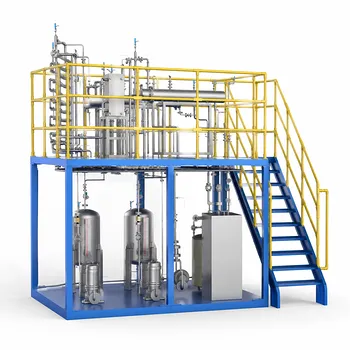
Choosing between a gas-sparged and mechanically agitated contactor for your teaching pilot plant is the single most defining decision you'll make. It dictates not just the experiments you can run, but the very engineering principles your students will internalize. The trade-offs center on mechanical complexity, operating flexibility, and the depth of fundamental insight you can provide. Gas-sparged reactors excel in demonstrating mechanical simplicity and industrial scalability, while mechanically agitated reactors are unmatched for teaching the core interplay between agitation, suspension, and mass transfer in dead-end hydrogenation processes.
For an educational pilot plant, the mechanically agitated reactor usually offers the richest pedagogical return. It allows students to directly manipulate and measure the trade-offs between shaft power, gas dispersion, catalyst suspension, and heat transfer—the very heart of multiphase reactor design. A gas-sparged system, however, becomes the superior choice when the curriculum emphasizes industrial scale-up, high gas throughput, or the avoidance of rotating seals.
The Pedagogical Goals of a Multiphase Slurry Reactor Pilot Plant
Your teaching reactor is not a production tool; it's a physical embodiment of chemical engineering principles. The contactor choice must therefore map directly to learning outcomes.
What Should Students Learn?
A well-designed lab module forces students to confront the competing demands of momentum, mass, and heat transfer.
They must see how mechanical power input translates into bubble break-up and solid suspension.
They must also quantify the gas-to-liquid mass transfer coefficient, the most common rate-limiting step in slurry catalysis.
Heat removal is the hidden beast—exothermic reactions like hydrogenation require rapid, controllable cooling to avoid runaway.
The right contactor makes these invisible phenomena observable, measurable, and tunable.
Deep Dive: Gas-Sparged Contactors
Gas-sparged systems rely solely on the buoyant energy of rising gas bubbles to mix the liquid and suspend solids. They contain no internal moving parts.
Mechanical Simplicity and Scale-Up Advantages
The absence of a shaft and seal is their greatest asset.
They completely avoid shaft seal leaks and shaft stability issues, which become critical at scale.
This makes them highly advantageous for pure gas recycle loops and very large vessels, where a mechanical agitator becomes a massive maintenance liability.
From a teaching standpoint, you can directly demonstrate how the industry often trades precise control for sheer mechanical reliability.
The Fluidization Link and Operating Limits
Depending on solid loading and particle size, a gas-sparged slurry reactor begins to behave similarly to a three-phase fluidized bed.
This allows students to bridge their understanding of bubble columns and fluidized beds in a single experiment.
However, the working principle is also their vulnerability. At low gas flow rates, the bubble-driven energy becomes insufficient to suspend the catalyst particles.
When the catalyst settles, the reaction stops. This hard operating limit is a perfect lesson in the coupling of fluid dynamics and reaction engineering.
Deep Dive: Mechanically Agitated Contactors
By adding a motor-driven impeller, you insert a new, powerful degree of freedom into the system—but at a cost in complexity.
Precise Control Over Catalyst Suspension
When gas flow is low or even zero, the mechanical agitator remains the gold standard for ensuring catalyst suspension.
This is why they are ideal for "dead-end" operations, like headspace gas pressurization in edible oil hydrogenation, where the gas is consumed without flowing through the reactor.
Students can run experiments at the lowest imaginable gas rates and observe exactly how changes in impeller speed bring solids off the vessel floor. The link between cause (power input) and effect (suspension) is direct and pedagogical.
Optimizing Gas Dispersion Through Impeller Design
The gas-liquid interfacial area and bubble dispersion quality can be optimized by adjusting impeller configurations.
For instance, placing a smaller secondary impeller near the gas-liquid interface helps pull gas down from the headspace, enhancing mass transfer.
This allows a lab curriculum to explore the impact of Rushton turbines versus pitched-blade impellers, and teaches the difference between flooding and loading of an impeller.
Students gain hands-on insight into why the choice of hardware directly dictates the rate-limiting mass transfer step.
Flexibility for Batch Hydrogenation Studies
Mechanically agitated reactors are highly useful for demonstrating batch hydrogenation processes.
In a teaching lab, they enable the classic experiment: studying the trade-off between mechanical agitation power, gas dispersion, and heat transfer efficiency.
By varying the stirrer speed, students can deliberately move the system from a mass-transfer-limited regime to a kinetically controlled one, generating a data set that brings reactor design theory to life.
Understanding the Trade-offs
No single contactor is perfect. The selection creates a set of pedagogical and operational compromises you must accept.
When Gas Flow Is the Limiting Factor
A gas-sparged reactor only works when there is enough gas velocity to mix the slurry. Its operating window is directly tied to the gas flow rate.
In contrast, the mechanically agitated reactor thrives in low-flow and dead-end scenarios, but its complex shaft and seal introduce potential failure points.
If your course aims to explore reactions with minimal gas flow, the sparged reactor ceases to function as an effective teaching tool, forcing you toward the agitated solution.
Heat Transfer and Safety in Exothermic Reactions
Maintaining temperature control during a batch hydrogenation is critical for both safety and kinetic data integrity.
A mechanically agitated reactor relies on cooling jackets or coils designed around the vessel. Heat removal is directly influenced by impeller-induced turbulence at the wall.
While gas-sparged reactors can also have jackets, the mixing intensity near the wall is less controllable. For advanced teaching, you might contrast this with a jet loop (venturi) reactor, which uses an external liquid recirculation loop and heat exchanger to provide dramatically higher heat removal capacity—a superior but more complex alternative.
This comparison highlights the fundamental trade-off between relying on internal mechanical mixing versus external pumped circulation for thermal control.
The Learning Curve and Operational Complexity
A gas-sparged contactor is simpler to assemble, maintain, and operate. Students can see the immediate effect of gas flow on bed expansion without the abstraction of a motor drive.
The mechanically agitated system introduces shaft alignment, seal gas, and variable-frequency drive controls. While more complex, this complexity itself provides a richer learning experience, teaching students about the real-world challenges of rotating equipment in pressurized, hazardous gas environments.
Your choice is ultimately between elegant, low-complexity demonstrations and hands-on encounters with the messy reality of industrial agitation.
Making the Right Choice for Your Teaching Goal
Your decision should be guided by the specific engineering principles you wish to emphasize.
- If your primary focus is demonstrating industrial scale-up and mechanical robustness: Select a gas-sparged contactor. It vividly shows why industry often sacrifices control to eliminate shaft seals and achieve reliable, large-scale operation.
- If your primary focus is teaching the fundamentals of multiphase mixing and mass transfer: Choose a mechanically agitated reactor. It gives students the experimental knobs to control suspension, gas dispersion, and heat transfer separately, illuminating the core trade-offs of reactor engineering.
- If your curriculum demands a comparative analysis of multiple reactor technologies: Design a modular pilot plant that can be reconfigured, allowing students to first benchmark a stirred tank and then contrast its performance with a gas-sparged or even a jet loop reactor for an advanced mass transfer project.
Your teaching pilot plant is a narrative. Choose the contactor that tells the most compelling engineering story.
Summary Table:
| Feature | Gas-Sparged Contactors | Mechanically Agitated Contactors |
|---|---|---|
| Mechanical Complexity | Low (no moving parts or rotating seals) | High (motor, shaft, and seals required) |
| Catalyst Suspension | Dependent on gas velocity/flow rate | Independent; controlled by impeller speed |
| Heat Transfer Control | Less controllable wall turbulence | Highly controllable via impeller agitation |
| Primary Pedagogical Value | Demonstrates industrial scale-up & simplicity | Teaches mass-transfer vs. kinetic regimes |
Build the Ultimate Teaching Lab with LABPARK
Choosing the right reactor configuration is key to delivering impactful chemical engineering education. LABPARK designs and manufactures premium Educational and Vocational Unit Operations Pilot Plants in chemical engineering, bioprocess & biotech, and environmental & water treatment for universities, research institutes, and enterprises.
Whether you require gas-sparged columns, mechanically agitated reactors, or custom modular setups, we provide the high-quality hardware and educational support to bring reactor theory to life. Contact us today to discuss your laboratory needs!
Related Products
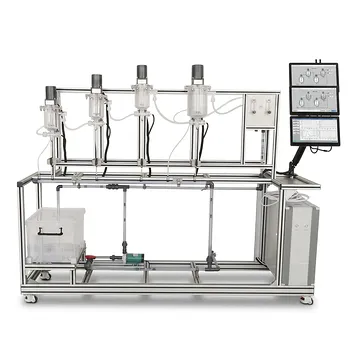
- Multi-Reactor Educational Pilot Plant for Reaction Engineering Unit Operations
- Multi-Stage Stirred Tanks in Series Residence Time Distribution and Mixing Performance Determination Educational Pilot Plant
- Carbon Material Thermal Pretreatment Multiphase Separation Educational Pilot Plant
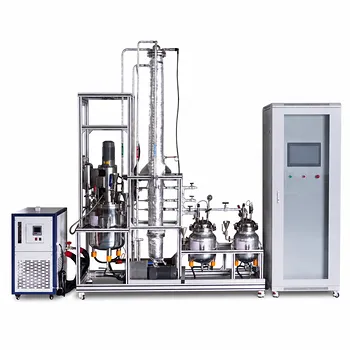
- Multi Functional Catalytic Reaction and Reactor Evaluation Educational Unit Operations Pilot Plant
- Fixed-Bed Chemical Reaction and Gas Dust Tar Removal Unit Operations Pilot Plant
People Also Ask
- How do educational unit operations pilot plants address safety and waste management when scaling up?
- How do educational unit operations pilot plants bridge theory and design? Bridge the Engineering Gap
- Why Compare Predicted and Experimental Excess Enthalpy? Key to Accurate Pilot Plant Scale-up
- How to study gasification in pilot plants? Compare exit gas composition & efficiency
- Why Use PTFE & Hastelloy in Chemical Pilot Plants? Prevent Corrosion & Ensure Safety