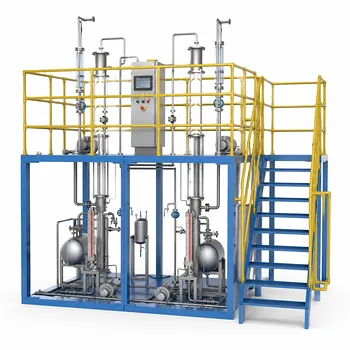
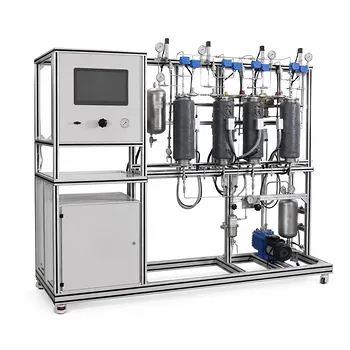
Even the most permeable membrane is useless if its performance decays before the next lab group arrives. In an educational gas separation pilot plant, physical aging of high-free-volume polymers like PIM-1 manifests as a relentless, time-dependent collapse of internal free volume. This directly undermines long-term experimental reproducibility because the baseline permeability drifts continuously, turning a controlled student experiment into a moving target where the "same" conditions yield ever-diminishing flux and shifting selectivity.
Physical aging in PIM-1 causes a progressive loss of permeability that makes it nearly impossible to compare data across different weeks or semesters. The only path to reproducibility is a pilot-plant design that acknowledges this decay—treating the membrane as a consumable component and surrounding it with aggressive in-situ diagnostics.
Why PIM-1 Physically Ages—and What That Means for Your Lab
The Fundamental Problem: Free Volume Doesn’t Sit Still
High-free-volume polymers derive their exceptional permeability from a loosely packed, void-rich structure. PIM-1’s contorted backbone prevents efficient chain packing, creating an initial interconnected microporosity that gives it an oxygen permeability of ~370 Barrer. That structure is thermodynamically unstable. At ambient temperatures, polymer segments undergo slow, cooperative motions that gradually collapse these voids toward a denser equilibrium state.
The consequence is a steady decrease in gas diffusion coefficients. Since solution-diffusion governs transport in dense membranes, this directly reduces permeability without necessarily altering the intrinsic selectivity mechanism. In a pilot plant running across a semester, the same feed pressure and temperature will yield a different permeate flow rate every week simply because the membrane itself has changed.
How Aging Sabotages the Educational Lab Cadence
Educational labs operate in discrete, often widely spaced sessions. A group may run an O₂/N₂ separation experiment on Monday, while a different cohort repeats the same procedure the following Friday. If the PIM-1 module sat idle during that interval, the cumulative physical aging—enhanced by any remaining gas sorption history—will have shifted the effective permeability baseline.
This drift creates a false impression of experimental error. Students will record different flux and selectivity numbers despite following identical procedures. They cannot differentiate between operational mistakes and genuine membrane aging unless the pilot plant explicitly tracks and flags the degradation. The pedagogical value of the unit operation then collapses: the exercise no longer teaches stable separation principles but instead an uncontrolled material instability.
Engineering the Pilot Plant for Aging-Aware Reproducibility
Embrace the Membrane as a Consumable
Modular, swappable membrane housings are the single most important design feature. The primary reference correctly identifies that easy module swaps allow instructors to install a fresh PIM-1 coupon for each laboratory rotation. This resets the aging clock to zero, guaranteeing that every student group encounters the same initial material state. The housing must allow quick, leak-free exchange without damaging the active layer.
Standardized storage protocols between sessions are essential. Even short idle periods can accelerate aging if the membrane remains in contact with certain gases. The pilot plant should incorporate a nitrogen-purge or vacuum hold system that stores unused membranes under a controlled, inert atmosphere to slow the free-volume collapse.
Embed Ultra-Precise In-Situ Diagnostics
Drift cannot be eliminated, but it can be quantified. High-accuracy mass flow meters and pressure transducers—with data logged continuously—become the pilot plant’s memory. By regularly measuring the pure-gas permeability of a reference species (e.g., N₂) under a fixed standard condition, the system builds a real-time aging curve for the installed membrane.
A standardized calibration protocol turns that curve into a correction factor. Before every student experiment, the pilot plant can execute an automated diagnostic run, compare the current permeability to the virgin reference value, and flag the module if performance has declined beyond a pre-set tolerance (e.g., 15% loss). This does not restore the lost permeability, but it prevents the accumulation of meaningless data by explicitly telling the operator that the membrane is no longer in its “teachable” window.
Understanding the Trade-offs
High Permeability vs. Reproducible Pedagogy
PIM-1 offers a spectacular initial performance that makes gas separation dramatically visible. This can be highly engaging for students: fluxes are high enough to be measured quickly with basic equipment. However, that excitement comes at the cost of stability. In contrast, industry-standard materials like polysulfone or Matrimid polyimide exhibit orders-of-magnitude lower permeability—Matrimid’s O₂ permeability is just 2.13 Barrer—but remain virtually unchanged over months of operation.
An educational pilot plant that runs continuously for a semester will see far less drift with a conventional glassy polymer. The supplementary references reinforce that robust, technically proven materials are preferred in pilot plants precisely to avoid the reproducibility traps caused by plasticization and physical aging. If the core learning objective is to understand parametric sensitivity (pressure, temperature, stage-cut) in a stable system, PIM-1 introduces a confounding variable that may undermine those lessons.
Temperature Accelerates the Decay—and You’re Already Limited
Polymeric membranes in pilot plants are typically operated below 100°C to avoid thermal degradation. While this is a general constraint, it also influences physical aging kinetics. Physical aging is a thermally activated process; the closer you run to the polymer’s glass transition, the faster chain segments relax. Even within the safe operating window, a modest temperature increase from 25°C to 80°C can dramatically accelerate free-volume collapse, making long baselines even more elusive for PIM-1. Therefore, strict temperature control is doubly important: it ensures both membrane survival and the consistency of aging rates across runs.
Making the Right Choice for Your Educational Lab
The configuration of your pilot plant must match the pedagogical goal, not simply the allure of headline-grabbing permeability numbers. Consider these scenarios when deciding how to handle PIM-1—and whether to use it at all.
- If your primary focus is demonstrating a stable industrial separation process: Select a module based on polysulfone or a standard polyimide like Matrimid. These will yield reproducible data across an entire academic year without the need for frequent membrane swaps, perfectly mirroring the long-term stability expected in a real plant.
- If your primary focus is advanced materials research and you must use PIM-1: Design the pilot plant with hot-swappable, single-use membrane cartridges and install an automated, high-precision diagnostic routine that runs before every student experiment. Accept that the membrane is a consumable that must be replaced at the start of each new lab cycle.
- If your primary focus is teaching the phenomenon of physical aging itself: Configure dual parallel modules—one with a stable commercial polymer and one with PIM-1. Have students run identical separation experiments on both, then track the PIM-1’s decay over the semester. This transforms a reproducibility nightmare into a powerful, hands-on lesson in material science.
A gas separation pilot plant in an educational setting is fundamentally a tool for building repeatable insight. If the membrane won’t stay still, your design must actively manage its motion—either by resetting it frequently or by measuring its every step.
Summary Table:
| Membrane Material | Initial Permeability | Stability (Aging Resistance) | Recommended Educational Use Case |
|---|---|---|---|
| PIM-1 | Extremely High (~370 Barrer) | Low (Fast aging & baseline drift) | Advanced materials research & studying aging kinetics |
| Conventional (e.g., Matrimid) | Low (~2.13 Barrer) | High (Stable over months) | Teaching standard, repeatable industrial processes |
Optimize Your Lab's Teaching and Research Efficiency
Are you looking to build a reliable and reproducible laboratory environment? LABPARK provides premium Educational and Vocational Unit Operations Pilot Plants across chemical engineering, bioprocess & biotech, and environmental & water treatment for universities, research institutes, and enterprises.
Whether you need robust, stable industrial membranes or advanced diagnostic systems to study membrane aging, our tailor-made pilot plants ensure your students and researchers get accurate, consistent data every time.
Contact LABPARK today to discover how we can elevate your laboratory infrastructure!
Related Products
- Gas-Solid Heterogeneous Separation Demonstration Educational Unit Operations Pilot Plant
- Multi-Functional Membrane Separation Educational Pilot Plant for Unit Operations Lab
- Multi-Component Gas Pressure Swing Adsorption Pilot Plant for Unit Operations Education
- Bench Scale Dual Column Gas Separation and Capture Educational Pilot Plant
- Multifunctional Membrane Separation Educational Pilot Plant with Ultrafiltration, Nanofiltration, Reverse Osmosis
People Also Ask
- Why is pressure drop characterization critical in separation pilot plants? Key operational insights.
- What are the key thermodynamic considerations for gas mixture modeling? Expert Guide
- What are the primary operational objectives and physical requirements when running heterogeneous separation pilot plants?
- What are the trade-offs in olefin-paraffin separation? Optimize Pilot Plant Performance
- What are the material limitations of gas separation pilot plants? Key factors to consider.