Here’s the core truth every vocational trainer must communicate: auxiliary time directly forces the batch reactor to be physically larger than a continuous reactor achieving the same conversion.
In constant-density systems, a batch reactor and a plug flow reactor (PFR) need the identical theoretical reaction time ($t$) to reach a target conversion. Yet the batch reactor also demands non-productive auxiliary time ($t'$) for filling, discharging, and cleaning. This dead time means the batch reactor cannot produce continuously. To match the annual output of a PFR, the batch system’s volume must be scaled up by the factor $(t + t') / t$, inflating its capital cost. The most memorable way to demonstrate this is with a chemical engineering unit operations trainer, where students directly record downtime, measure productivity, and see the hidden cost of idle minutes.
Sizing is a function of total cycle time, not just reaction kinetics. A batch reactor must compensate for every minute of auxiliary time by increasing its physical size to meet production targets. In vocational training, a hands-on comparison of a batch reactor’s full cycle against a PFR’s steady-state output transforms this abstract equation into an unforgettable lesson on industrial equipment economics.
The Fundamental Productivity Gap
Before a student can size a reactor, they must see why a batch system’s calendar tells a different story than a PFR’s stopwatch.
Theoretical Reaction Time: A Level Playing Field
For a given conversion in a constant-density liquid-phase reaction, the reaction time required in a well-mixed batch reactor is identical to the space time needed in a plug flow reactor. This is a cornerstone of chemical reaction engineering—the rate law dictates the same active reaction duration. On paper, they look equal. A student running a simple saponification or decolorization reaction would measure the same concentration drop in both configurations if they only looked at the active chemistry window.
The Hidden Thief: Auxiliary Time
The batch reactor, however, never runs chemistry 100% of the time. It goes through a mandatory sequence: draining the previous batch, cleaning the vessel, recharging fresh reactant, and heating up to operating temperature. This auxiliary time ($t'$) can range from a few minutes in a pilot-scale trainer to hours in an industrial rubber or pharmaceutical reactor. While the PFR quietly produces product every second, the batch reactor sits idle. The vocational student who physically times these steps on a trainer internalizes this loss; the smartboard slide suddenly feels visceral.
Translating Downtime into Reactor Volume
Capital cost is proportional to equipment size. Here’s how idle minutes inflate the vessel diameter.
The Sizing Multiplier Formula
To deliver a specified annual production rate, the batch reactor must process larger batches to compensate for dead time. The required volume multiplies by the factor:
[ \text{Volume Factor} = \frac{t + t'}{t} ]
Where $t$ is the active reaction time and $t'$ is the total auxiliary time per batch. If a trainer’s reaction takes 10 minutes but cleaning and refilling consume another 5 minutes, the factor is 1.5. The batch reactor must be 50% larger—and more expensive—than its "kinetics-only" size suggests.
A Practical Numerical Example
Consider a trainer experiment where a PFR achieves 95% conversion with a 10-minute residence time. The continuous reactor can process 6 reaction volumes per hour, non-stop. A batch reactor with the same 10-minute reaction time but a 20-minute auxiliary cycle (including heating and cleaning) spends 30 minutes per batch. It processes only two batches per hour. To match the PFR’s daily pound output, the batch vessel must be built to handle three times the instantaneous inventory, tripling the investment in material and footprint.
Demonstrating the Principle in Vocational Training
The most effective session moves from a graph to a gloved hand.
The Unit Operations Trainer: Your Experimental Platform
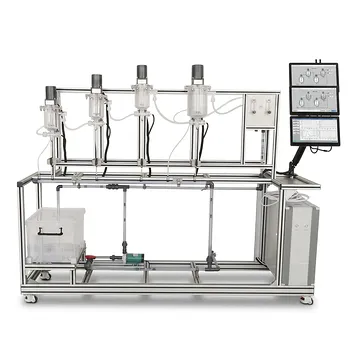
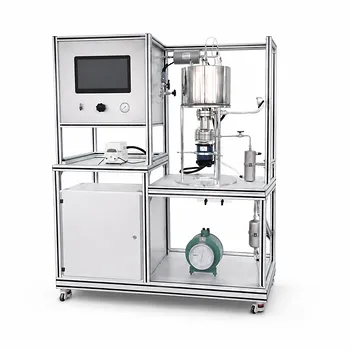
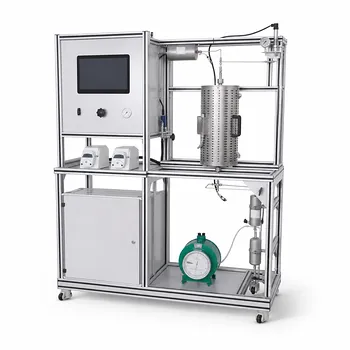
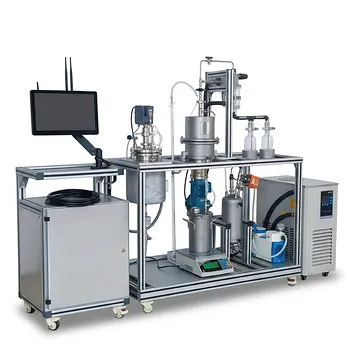
A modern chemical engineering unit operations trainer—often a benchtop skid with a batch tank and a tubular plug flow reactor—is the ideal demonstrator. It allows students to run an identical aqueous-phase reaction (such as a color change or pH shift reaction) in both modes under controlled temperature conditions. These skids are designed to make changeover times explicit and measurable, not hidden behind software simulations.
The Batch Experiment: Measure the Complete Cycle
Instruct students to first operate the batch reactor:
- Start the stopwatch when they begin draining the previous run.
- Record every subsequent step—cleaning, refilling with a graduated charge, heating to set point—as total auxiliary time ($t'$).
- Then run the reaction and record the exact reaction time ($t$) until the endpoint is reached.
- Calculate the cycle’s effective production rate (liters of product per hour). Most students are shocked to see how much clock time vanishes before any chemistry begins.
The Continuous Benchmark: A PFR in Steady State
Now switch to the plug flow reactor. Set the pump flow rate to achieve the same reaction time (space time) as the batch chemistry. Once a steady-state outlet composition is confirmed, the students can simply read the flow rate multiplied by the outlet concentration. There is no cleaning cycle, no filling lag; the system produces continuously. The trainer's flow meter effectively becomes a direct productivity counter, giving an instantaneous rate that dwarfs the batch’s averaged output.
From Data to Decisions: Comparing Productivity
Finally, have students answer a business question: “What vessel volume do you need to produce 100 liters per day with each technology?” The batch team will be forced to factor in their measured $(t + t')/t$ multiplier, while the PFR team uses the space time alone. Plotting the required reactor volumes side-by-side makes the capital cost consequence of auxiliary time instantly clear. This single chart often becomes the most photographed slide of the term.
Understanding the Trade-offs
An objective technical advisor never presents one system as universally superior. Vocational training must teach when the batch penalty is acceptable.
When Batch Reactors Still Win
Batch systems offer unmatched flexibility for multi-product campaigns and long, complex reactions where a PFR would be impractically long. In pharmaceutical and specialty chemical manufacturing, a single skilled batch reactor can produce dozens of different materials. Here, the volume penalty from auxiliary time is a cost willingly incurred for operational agility. Students must learn to weigh capital cost (size) against operational flexibility.
Avoiding Over-Simplification in the Lab
A common pitfall is using a trainer with unrealistically quick changeovers that mask real-world auxiliary time. If students can clean and refill in 90 seconds on a glass rig, they may underestimate the factor for a 10,000-gallon industrial vessel that requires hours of cleaning validation. Ensure your demonstration includes a discussion of scale-up: auxiliary time grows in the real world, making the $(t + t') / t$ factor even more punishing. Also, note that this comparison holds strictly for constant-density systems; for variable-density or gas-phase reactions, the volume change affects the PFR design equations differently.
Making the Right Choice for Your Training Goal
The best way to structure a lab session around auxiliary time depends on the core message you want your students to retain.
- If your primary focus is teaching the kinetics-sizing link: Use a slow, easily observable reaction and artificially increase the auxiliary time (e.g., force a drying step). Let students calculate the exact volume factor and design both reactors.
- If your primary focus is industrial cost and decision-making: Add a simple capital cost curve to the lab. Have students price out the batch and PFR vessels based on their calculated volumes and justify which technology they would recommend for a given annual production volume.
- If your primary focus is building respect for non-productive time: Take a stopwatch to the plant floor. Have trainees time a real cleaning or setup procedure on a pilot line, then correlate that raw data back to the $(t + t') / t$ equation they learned in class.
Measurement makes the invisible visible, and in the battle between batch and continuous, the stopwatch never lies.
Summary Table:
| Feature | Batch Reactor | Plug Flow Reactor (PFR) |
|---|---|---|
| Reaction Time ($t$) | Identical (active chemistry duration) | Identical (space time) |
| Auxiliary Time ($t'$) | Required (filling, cleaning, heating) | None (continuous operation) |
| Total Cycle Time | $t + t'$ | $t$ (steady state) |
| Sizing Factor | Multiplied by $(t + t') / t$ (requires larger volume) | Baseline (1.0 sizing ratio) |
| Educational Value | Explains industrial downtime costs | Demonstrates steady-state efficiency |
Bring Industrial Reality to Your Chemical Engineering Lab
Help your students master the economics of reactor design and process optimization. LABPARK provides state-of-the-art Educational and Vocational Unit Operations Pilot Plants in chemical engineering, bioprocess & biotech, and environmental & water treatment for universities, research institutes, and enterprises.
Equip your training facility with physical pilot systems that make abstract chemical engineering principles—like reactor sizing and auxiliary downtime—fully measurable and visual.
Contact LABPARK today to discuss your lab requirements and receive a customized solution!
Related Products
- Continuous Batch Extractive Distillation Educational Pilot Plant
- Methanol Synthesis and Catalyst Performance Evaluation Educational Unit Operations Pilot Plant
- Multi-Reactor Educational Pilot Plant for Reaction Engineering Unit Operations
- Multi-Stage Stirred Tanks in Series Residence Time Distribution and Mixing Performance Determination Educational Pilot Plant
- 100L Continuous Loop Hydrogenation Educational Unit Operations Pilot Plant
People Also Ask
- Wilson vs. UNIQUAC: How to Choose the Right Thermodynamic Model for Your Pilot Plant
- How to Configure a Distillation Pilot Plant? Key Steps for Multi-Mode Setup
- Why use non-ideal VLE calculations in distillation pilot plants? Ensure accurate scale-up & purity
- How does the feed thermal state influence distillation pilot plant design and utility consumption?
- How to Integrate Spectroscopy in Distillation Pilot Plants for Advanced Process Control