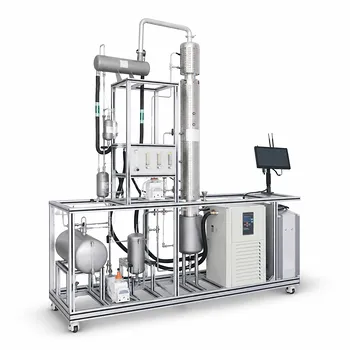
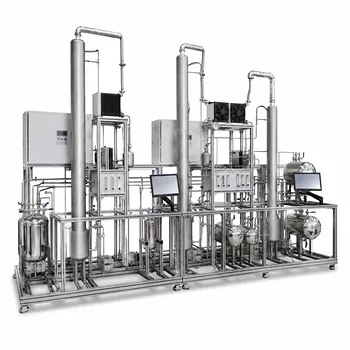
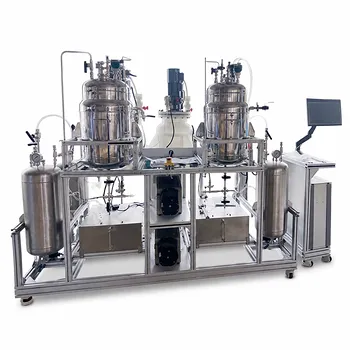
The core of a versatile distillation pilot plant lies in making its physical connections and control logic reconfigurable. A unit operations pilot plant demonstrates batch versus continuous distillation by using adjustable feed points at multiple column heights, dedicated feed pumps, and a set of collection vessels that can be arranged for either sequential fraction cuts or steady product draws. To compare atmospheric and vacuum distillation, the same column is fitted with a vacuum pump, vacuum-rated seals, and high-accuracy pressure sensors, allowing a direct study of how reduced pressure lowers boiling points and preserves heat-sensitive compounds. This modular design lets students and researchers move from simple steady-state balances to transient, pressure-dependent separations within a single teaching tool.
A true multi-mode distillation pilot plant does far more than swap glassware. It becomes a living laboratory that connects fundamental vapor–liquid equilibrium, energy conservation, and dynamic process control. The physical flexibility is secondary to the pedagogical value: it forces operators to confront why a change in pressure or feed location fundamentally alters the separation, thereby turning a hardware configuration question into a deep learning experience.
Configuring the Plant for Batch vs. Continuous Operation
Switching between batch and continuous modes is first a matter of where and how feed enters the system, and how products are withdrawn. The same column can serve both roles if it is built with multiple feed nozzles, a multi-purpose reboiler, and reconfigurable piping manifolds.
Adjustable Feed Points and Reboiler Roles
In continuous distillation, the feed stream enters at a dedicated tray or section of the column, chosen to match the feed’s thermal condition (bubble-point liquid, subcooled liquid, or vapor–liquid mix). A pilot plant achieves this by installing several feed nozzles along the column height, each with isolation valves.
For batch operation, the feed is charged entirely into the still pot (the reboiler) at the bottom before heating starts. Modular piping allows the reboiler to function either as a total charge vessel for batch runs or as a steady-state heater with a small holdup for continuous duty. Quick-connect fittings and swing-elbow connections make this changeover practical from one lab session to the next.
Collection Vessels and Fraction Cut Points
A continuous column needs constant product withdrawals: distillate and bottoms are removed continuously through product drums with level control. Pilot plants designed for both modes use the same product receivers but with different control strategies: level controllers and metering pumps for continuous, and timed or temperature-triggered valve sequences for batch fraction collecting.
In batch distillations, students learn to switch collection bottles as top temperature changes, cutting light ends, main fractions, and tails manually. The pilot plant facilitates this by placing multiple product drums in parallel, often behind a glass sight glass and a three-way valve, making the transient nature of batch processing tangible.
Control System and Sensor Architecture
A truly reconfigurable plant runs on a flexible distributed control system (DCS) or PLC. When instructors switch from continuous to batch, they load a different control recipe: reflux ratio programs, dynamic reboiler heating profiles, and automated cut-point switching replace steadied-flow PID loops. The same temperature and pressure sensors serve both modes, but the plant’s software interprets them differently—tracking steady-state approach in one, and running a dynamic distillation curve in the other.
Demonstrating Atmospheric vs. Vacuum Distillation
The second dimension of flexibility—operating pressure—introduces a completely different set of physical hardware and safety considerations. It also opens a window into the thermodynamic heart of distillation.
Vacuum-Rated Hardware and Leak Integrity
To run under vacuum, the column must be fitted with a vacuum pump and a pressure control system capable of holding pressures as low as a few millibar. This means replacing standard gaskets with vacuum-rated O-rings, using glassware or metal components designed for full vacuum service, and adding a vacuum-tight collection receiver.
Pressure sensors with high accuracy in the sub-atmospheric range are essential. The plant typically includes an absolute pressure transmitter atop the column and a differential pressure cell across the packing to monitor flooding. A bleed valve or controlled nitrogen purge allows the operator to hold any pressure setpoint, simulating industrial vacuum columns.
Why Pressure Defines the Separation
Operating pressure changes boiling points. Mixtures that would thermally degrade at their atmospheric boiling points—such as fatty acids, high-boiling hydrocarbons, or bioproducts—can be separated safely under vacuum. The pilot plant makes this connection physical: students measure the temperature profile at atmospheric pressure, then apply vacuum and watch the reboiler temperature drop while the same separation proceeds.
The plant’s instrumentation also reveals the pressure-drop profile across the column packing. Under vacuum, pressure drop becomes a larger fraction of absolute pressure, which affects flooding behavior and tray/packing efficiency. Running the same mixture at multiple pressures lets students construct VLE data and compare relative volatilities, directly verifying pressure–temperature relationships from textbooks.
Atmospheric and Pressurized Mode Transitions
Though the question highlights atmospheric and vacuum distillation, the same modular plant can be rated for low-pressure (positive) operation. Pressurized distillation is needed for mixtures with boiling points below room temperature at atmospheric pressure—such as light hydrocarbons or refrigerant blends—where increasing pressure raises the boiling point enough for condensation with standard cooling water. A pressure-rated column with a back-pressure regulator and relief valve enables this third mode, covering the complete range of industrial distillation conditions.
Expanding the Educational Scope Beyond Basic Modes
A well-configured pilot plant doesn’t stop at batch/continuous or atm/vacuum switches. It becomes a platform for comparing process efficiency and introducing advanced separation techniques.
Comparing Energy Consumption and Separation Efficiency
With the same column and mixture, students can run a fixed number of theoretical stages under batch reflux control and then under continuous steady-state operation, recording energy input and product purity. The plant’s wattmeter on the reboiler heater and overall material balances allow direct calculation of heat duty per kilogram of product. This hands-on comparison—batch requiring dynamic reflux ratio increases versus continuous steady heat input—cements the energy conservation lessons that are otherwise abstract.
Introducing Azeotropic and Enhanced Distillation
By adding an auxiliary feed point and a decanter, the same modular column can be used for azeotropic or extractive distillation demonstrations. An entrainer is introduced at a specific stage to break the azeotrope, and students observe phase separation in the decanter, measure the temperature profiles, and calculate mass balances that reveal increased relative volatility. This transforms a basic unit ops pilot plant into a miniature process-development tool, preparing students for complex industrial separations.
Understanding the Trade-offs of a Flexible Design
A multi-mode pilot plant is a pedagogical dream, but it comes with compromises that must be acknowledged.
- Leak integrity is harder to maintain when many connections are meant to be reconfigured. Vacuum operation amplifies even minor leaks, demanding meticulous assembly and regular leak testing.
- Holdup volume in the reboiler and piping can smear batch distillation curves, making precise cut points less sharp than in a dedicated batch still. Continuous runs may suffer from dead zones if piping isn’t properly flushed.
- Control system complexity increases, requiring more training for operators and more maintenance of software configurations. The temptation to use all features can overwhelm students if the curriculum isn’t carefully scaffolded.
- Capital cost is higher than a purpose-built single-mode column, although it is lower than owning two separate units. The investment must be justified by the educational range it provides.
Making the Right Choice for Your Educational or Research Goal
When designing or selecting a unit ops pilot plant for distillation, align the configuration with your primary learning outcomes or research needs.
- If your primary focus is teaching transient process dynamics and small-scale separations: Configure the plant as a batch distillation unit first, with a large reboiler, multiple product receivers, and a flexible reflux controller. You can always add a feed pump later to demonstrate continuous concepts.
- If your primary focus is simulating industrial steady-state operations: Prioritize a continuous configuration with accurate feed preheaters, level-controlled product drums, and a stable reboiler heating system. Integrate the ability to shift feed location for optimizing separation efficiency.
- If you need to handle heat-sensitive compounds or study pressure-dependent VLE: Include a high-quality vacuum pump, absolute pressure transmitters, and vacuum-rated column internals from the start. The ability to toggle between atmospheric and vacuum operation is non-negotiable for bioprocess or specialty chemical curricula.
- If you want the broadest pedagogical coverage: Invest in a fully modular plant with multiple feed nozzles, interchangeable reboiler functions, a vacuum/pressure envelope, and a configurable control system. The up-front complexity pays off by enabling experiments from simple Rayleigh batch distillation to advanced azeotropic separations in a single footprint.
The true power of a multi-configuration pilot plant lies not in the hardware itself, but in how it forces students to answer the question “why”—why we switch from batch to continuous, why we lower pressure, and why energy integration matters. That questioning transforms a laboratory exercise into genuine engineering insight.
Summary Table:
| Distillation Mode | Key Hardware Configurations | Primary Control & Educational Focus |
|---|---|---|
| Batch | Reboiler still pot charge, multi-receiver manifold | Dynamic reflux control, fraction cut-points, transient curves |
| Continuous | Adjustable feed nozzles, level-controlled product drums | Steady-state PID loops, feed preheating, material balances |
| Atmospheric | Standard vents, atmospheric pressure sensors | Baseline VLE calculations, standard boiling point separations |
| Vacuum | Vacuum pump, vacuum-tight seals, absolute pressure transmitters | Reduced-temperature boiling, heat-sensitive separation, pressure-drop dynamics |
Elevate Your Engineering Lab with LABPARK
Are you looking to provide hands-on, multi-mode distillation training for your students or researchers? LABPARK designs and manufactures high-quality Educational and Vocational Unit Operations Pilot Plants tailored for universities, research institutes, and enterprises.
Our versatile systems span:
- Chemical Engineering: Multi-mode distillation, extraction, absorption, and reaction pilot plants.
- Bioprocess & Biotech: Fermentation and bioseparation pilot systems.
- Environmental & Water Treatment: Advanced filtration, desalination, and wastewater purification units.
Whether you need a flexible distillation column that seamlessly toggles between batch, continuous, and vacuum operations or a custom-engineered setup, we deliver reliable, safe, and pedagogically rich solutions.
Contact LABPARK Today to Request a Proposal
Related Products
- Continuous Sieve-Plate Distillation Pilot Plant for Unit Operations Laboratory Education
- Continuous Batch Extractive Distillation Educational Pilot Plant
- Multi-Functional Special Distillation Educational Pilot Plant
- Electrolyte Distillation Purification and Formulation Educational Pilot Plant
- Multi-Modal Distillation Unit Operations Training Pilot Plant
People Also Ask
- How can real-time carbon number prediction improve distillation pilot plants? Optimize control.
- What are the primary reflux ratio control strategies? Master Distillation Unit Operations
- Why is vacuum operation capability an essential feature for a distillation unit operations pilot plant? Unlock Efficiency
- How to select the right activity coefficient model (Wilson, NRTL, UNIQUAC) for distillation pilot plants?
- How does catalyst water concentration affect distillation pilot plant design? Key separation train choices.