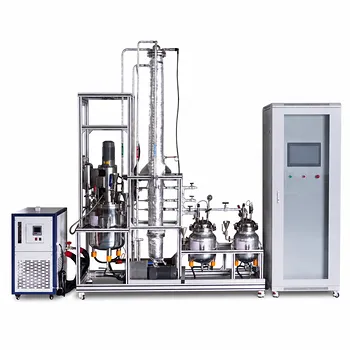
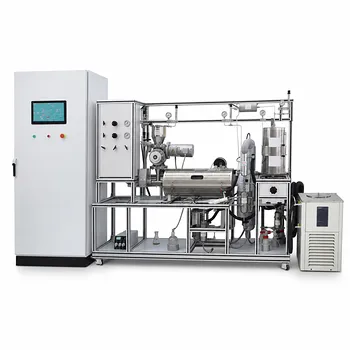
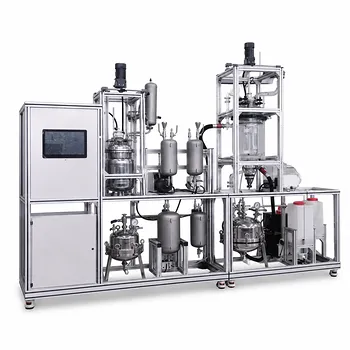
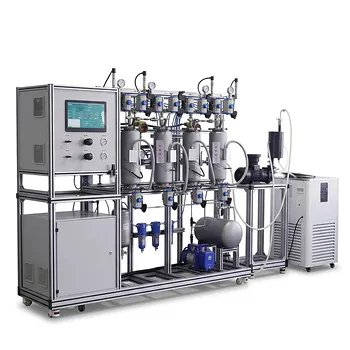
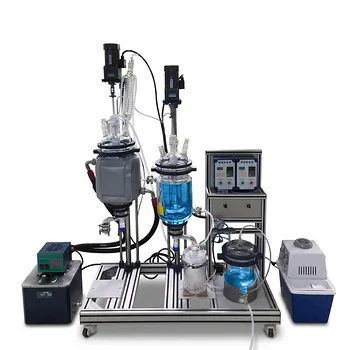
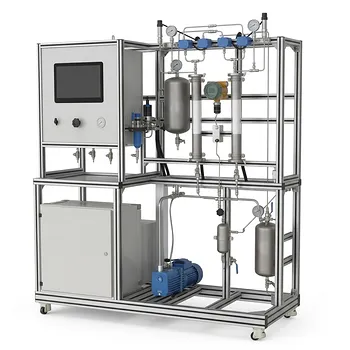
The core separation technique in a chemical engineering pilot plant for isolating nitration products from spent acid is a gravity separation unit, enhanced by precise control of dilution, temperature, and interfacial chemistry. This initial liquid-liquid phase split is then followed by a sequence of washing steps to achieve the required purity.
Separating nitration products from spent acid is fundamentally a density-driven process, but its success depends on manipulating solubility and interfacial tension. The pilot plant achieves this through a cascade of operations—gravity settling, water dilution, temperature adjustment, and optional demulsifier dosing—before the crude product moves on to water and alkaline washes.
How the Core Separation Leverages Phase Behavior
Most nitrated products, like dinitrotoluene, are liquids or low-melting solids with very limited solubility in the strong acid mixture. That creates a natural opportunity for a simple, robust separation.
The Principle of Gravity Settling
The product and the spent acid form two immiscible liquid phases because of their density difference. In a continuous gravity separator (often a decanter or a settler), the heavier acid phase sinks while the lighter organic product phase rises, allowing each to be withdrawn separately. This is the primary unit operation at the heart of the pilot plant.
Why Water Dilution Is Essential
Freshly nitrated product still carries some solubility in the concentrated acid. Adding a controlled amount of water dilutes the spent acid, which dramatically reduces that solubility and pushes more product out of the acid phase. It’s not just about helping the layers form; it directly improves your product yield and prevents the acid from dragging valuable material downstream.
Temperature Control as a Process Lever
The phase separation is temperature-sensitive. For example, in dinitrotoluene production, cooling the mixture from around 90 °C to 70 °C makes the two phases less mutually soluble and increases the density contrast, giving a cleaner, faster split. Pilot plants carefully monitor and adjust temperature because even a few degrees can mean the difference between sharp phase boundaries and persistent rag layers.
Using Demulsifiers to Break Rag Layers
Sometimes surface-active impurities or fine droplets create a stable emulsion—a “rag” layer—at the liquid-liquid interface. Small additions of demulsifiers like octyl amine can accelerate coalescence, collapse the emulsion, and restore a sharp interface. This keeps the separation running continuously and prevents product losses in the acid stream.
Post-Separation Washing: The Polishing Step
The gravity-separated organic stream is never completely clean. Residual inorganic acids, trace water, and phenolic byproducts remain dissolved or entrained. A polishing sequence transforms this crude product into a specification-ready material.
Water Washing
The organic phase goes through a water wash—an extraction step that pulls out residual sulfuric and nitric acid. This is typically done in a mixer-settler or a packed column pilot unit, where intimate contact between the organic phase and clean water transfers the acid into the aqueous phase. Removing acid here prevents corrosion downstream and protects product quality.
Alkaline Washing
After the water wash, an alkaline wash (often using dilute sodium hydroxide or soda ash) neutralizes any remaining acidity and extracts acidic phenolic byproducts, which form water-soluble salts. This final wash dramatically improves the product’s thermal stability and color, fulfilling purity requirements that the gravity separator alone cannot meet.
Understanding the Trade-offs
No separation sequence is perfect. Running these operations in a pilot plant forces you to confront practical limits.
- Dilution vs. Acid Recovery Cost: Adding water improves separation yield, but it reduces the acid concentration. That downstream spent acid must later be reconcentrated using energy-intensive vacuum evaporation, raising the overall process cost.
- Demulsifier Contamination: Octyl amine or similar surfactants can end up in the product or the spent acid. Traces can interfere with subsequent catalytic steps or acid recovery loops, so you have to prove that the benefit outweighs the risk.
- Emulsion Stability: Even with dilution and temperature control, certain impurities (like tarry byproducts) can stabilize emulsions beyond what demulsifiers can handle. A pilot trial might reveal the need for an alternative separation step, like centrifugal extraction, if settling alone fails.
- Washing Waste Streams: Each wash step generates an aqueous effluent containing acid, salts, and organics. Managing these streams at pilot scale requires additional treatment (neutralization, stripping) before disposal or recycle, adding complexity beyond the main product recovery.
Making the Right Choice for Your Pilot Plant Goal
Your selection and sequencing of these unit operations will depend on what you need to prove or optimize.
- If your primary focus is yield optimization: Start by mapping the solubility curve with water addition and temperature. Maximize product recovery from the acid phase before worrying about perfect purity.
- If your primary focus is product purity: Invest extra pilot runs on the washing cascade—test water wash contact times, alkaline strength, and temperature—to eliminate the last traces of acidity and phenolics.
- If your primary focus is emulating industrial recovery loops: Couple the separation area with a spent acid reconcentration skid (denitration and vacuum evaporation) so you can quantify the real trade-off between dilution water and energy costs.
- If your primary focus is teaching or demonstrating fundamentals: Use the gravity separator as a vivid lesson in mass transfer and phase equilibria, then let students measure how temperature and diluent rate change the rag layer and product acid number.
What begins as a simple density cut becomes a rich playground of thermodynamic and kinetic trade-offs—exactly what a chemical engineering pilot plant is built to explore.
Summary Table:
| Unit Operation | Role in Nitration Separation | Key Parameters & Mechanisms |
|---|---|---|
| Gravity Separator | Primary phase separation of organic product and acid | Density difference, coalescence rate |
| Water Dilution | Reduces product solubility in spent acid to boost yield | Dilution ratio, phase behavior |
| Temperature Control | Enhances density contrast and sharpens phase split | Temperature optimization (e.g., 70°C - 90°C) |
| Demulsifier Dosing | Breaks rag layers at the liquid-liquid interface | Chemical coalescence (e.g., octyl amine) |
| Washing Cascade | Removes residual acids and acidic byproducts | Water wash (extraction), Alkaline wash (neutralization) |
Build Practical Chemical Engineering Expertise with LABPARK
Whether you are training future engineers or scaling up complex chemical processes, LABPARK delivers high-performance Educational and Vocational Unit Operations Pilot Plants tailored for chemical engineering, bioprocess & biotech, and environmental & water treatment. We help universities, research institutes, and enterprises bridge the gap between theory and industrial reality with safe, reliable, and versatile systems.
Contact our team today to find the perfect pilot plant solution for your lab or facility!
Related Products
- Natural Product Extraction Unit Operations Training Pilot Plant
- Multi-Functional Special Distillation Educational Pilot Plant
- Gas-Solid Heterogeneous Separation Demonstration Educational Unit Operations Pilot Plant
- Methane Cracking Educational Unit Operations Pilot Plant
- Multi-Modal Distillation Unit Operations Training Pilot Plant
People Also Ask
- How to Demo Solubility Sensitivity in SFE Pilot Plants? Practical Thermodynamics
- How do pilot plants differentiate physical vs chemical extraction? Enhance Chemical Engineering Training
- How are HTU and NTU applied to determine extraction column height? Guide to Pilot Plant Scaling
- How can Hotelling's T² & Q statistics detect pilot plant abnormalities? Optimize Safety
- Why use split-plot designs in pilot plants instead of CRD? Optimize process parameters effectively.