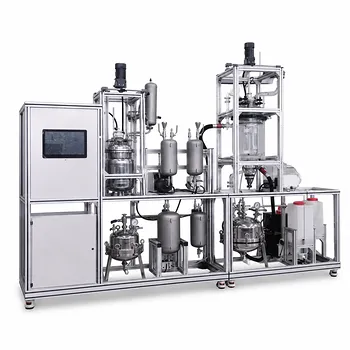
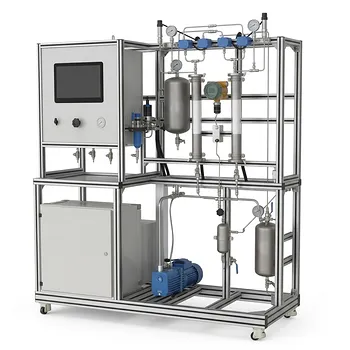
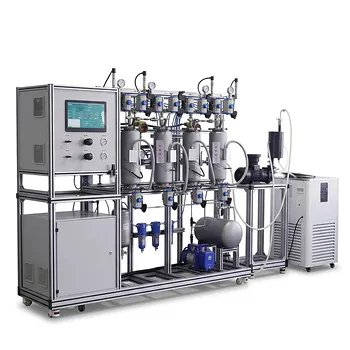
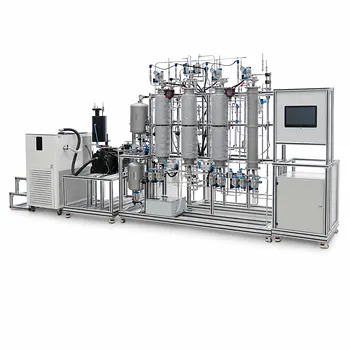
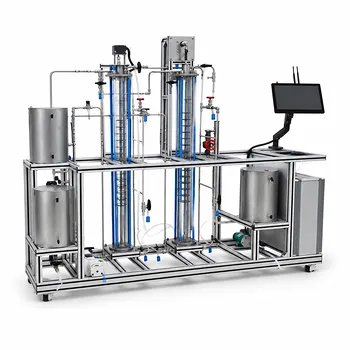
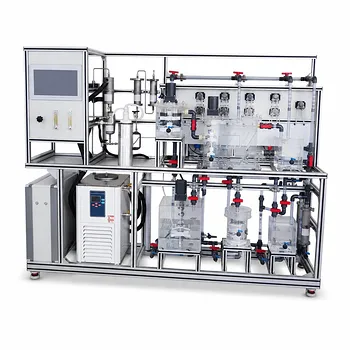
The essential unit operations for demonstrating oil and tar separation from complex gas liquors in a pilot plant are gravity settlers, coalescence-enhanced oil-water separators, and polishing filtration units.
These three steps form the backbone of an industrial wastewater pre-treatment train. In a controlled pilot-scale setup, they allow researchers and students to directly observe how differences in density, droplet size, and solid contaminant load govern separation performance.
The core insight: No single unit operation can efficiently split oil, tar, and water simultaneously. A deliberate sequence—heavy-phase settling, light-phase coalescing, and final solids removal—mirrors real-world refinery and gasworks practice, turning the pilot plant into a miniature but faithful replica of a full-scale treatment line.
Why Gas Liquors Demand a Multi‑Stage Approach
The Composite Nature of the Contaminant Load
Gas liquors are not a simple oil-in-water emulsion. They carry condensed water, heavy tar droplets, light oily fractions, and often fine dust or fly-ash particles.
Each contaminant type responds to a different separation mechanism. Skipping any stage in the train will leave one phase behind, making downstream water reuse or disposal impossible.
What a Pilot Plant Must Teach
A well-designed environmental pilot plant is not just for demonstration; it is a process research tool.
By adjusting residence time, settling area, and coalescer media, students extract the core principles of hydraulic design, phase behavior, and the economic limits of physical separation.
The Core Unit Operations for Oil and Tar Removal
Step 1: Gravity Settling for Bulk Tar Separation
Heavy tar droplets have a density greater than water and will settle if given sufficient quiet residence time.
A pilot-scale gravity separator (often a simple decanter or lamella clarifier) exploits this density difference. Students measure how inlet flow rate and temperature alter the settling velocity, watching the tar layer accumulate on the vessel floor.
Step 2: Coalescence‑Enhanced Oil‑Water Separation
Once the heavy tar is removed, the remaining mixture still holds dispersed oily fractions that are lighter than water but too fine to rise quickly.
A dedicated oil‑water separator—fitted with coalescing media such as corrugated plates or oleophilic meshes—encourages small oil droplets to merge. The enlarged droplets then rise to a top-oil skimming zone, leaving a much cleaner water phase below.
Step 3: Polishing Filtration for Residual Solids
Even after gravity and coalescing steps, the effluent may carry sub‑micron solid particles (fly ash, carbon fines).
A polishing filtration unit—using depth filters, bag filters, or membrane cartridges—traps these solids. In the pilot plant, measuring the pressure drop buildup teaches students how solids loading influences filtration run length and cleaning frequency.
Pre‑Treatment That Prepares the Feed
Degassing Before Any Liquid‑Liquid Separation
Complex gas liquors frequently contain dissolved gases such as carbon dioxide, ammonia, and hydrogen sulfide.
If these gases flash during gravity settling, they create turbulence that breaks the quiescent zones needed for effective separation. A small expansion or flash vessel upstream removes dissolved gases, stabilising the liquid feed and preventing gas bubble interference in the downstream settlers.
Understanding the Trade‑offs in Pilot Plant Operation
Density, Viscosity, and Temperature
Tar viscosity drops sharply with heating. Elevated temperature speeds settling but increases energy cost and risks vapour breakout.
Pilot plants let you map exactly where this trade-off tips from beneficial to uneconomical, a lesson no textbook alone can deliver.
Residence Time vs. Throughput
Gravity separators demand enough vessel volume to give droplets time to migrate. Shortening residence time to increase throughput inevitably reduces separation efficiency.
The pilot plant demonstrates that there is no free lunch—higher flow means larger equipment, and the dimensionless numbers behind this become visible on the control panel.
The Emulsion Stability Wall
Some gas liquors form tight emulsions stabilised by phenols or surface-active compounds. Coalescence units may struggle unless the interfacial tension is broken.
This reveals a key limitation: physical separation alone may not suffice, and chemical demulsifiers or gentle heating must be integrated into the pilot protocol.
How to Configure a Pilot Plant for Your Objective
- If your primary focus is teaching fundamental transport phenomena: Keep the setup simple—gravity settler, coalescer, and cartridge filter. Use clear piping and transparent vessels so students can visually track phase boundaries and droplet movement.
- If your primary focus is replicating industrial pre‑treatment reality: Add a heated feed tank, a flash vessel, and instrumentation for online turbidity and pressure-drop measurement. This mirrors the complexity of a real gasworks effluent plant.
- If your primary focus is comparing technologies: Run the same feed through a parallel train that replaces the coalescer with a dissolved‑gas flotation cell or a membrane unit. Students then perform a genuine techno‑economic evaluation based on energy, chemical, and maintenance data.
A thoughtfully configured pilot plant turns a murky, three-phase mixture into a transparent sequence of physical laws, giving you the concrete evidence needed to judge what works, what fails, and what it all costs.
Summary Table:
| Unit Operation | Target Contaminant | Separation Mechanism | Key Teaching / Process Variable |
|---|---|---|---|
| Degassing (Pre-treatment) | Dissolved gases (CO2, NH3, H2S) | Pressure drop / flash evaporation | Feed stabilization and turbulence prevention |
| Gravity Settling | Heavy tar droplets & bulk solids | Density differences | Temperature (viscosity) vs. residence time |
| Coalescence Separation | Dispersed oil fractions | Droplet growth via oleophilic media | Media surface properties & flow rates |
| Polishing Filtration | Sub-micron ash & carbon particles | Physical trapping (depth/membrane) | Pressure drop buildup vs. filtration run length |
Bring Real-World Water Treatment Processes into Your Lab
Demonstrating complex multi-phase separation requires robust, configurable, and highly visual training systems. LABPARK provides state-of-the-art Educational and Vocational Unit Operations Pilot Plants in chemical engineering, bioprocess & biotech, and environmental & water treatment for universities, research institutes, and enterprises.
Our custom-engineered pilot plants empower students and researchers to master hands-on process dynamics, hydraulic designs, and physical separation principles in a safe, controlled environment.
Contact LABPARK today to discuss your laboratory requirements and get a tailored solution for your curriculum or research needs!
Related Products
- Fixed-Bed Chemical Reaction and Gas Dust Tar Removal Unit Operations Pilot Plant
- Gallium and Indium Selective Extraction Educational Pilot Plant
- Gas-Solid Heterogeneous Separation Demonstration Educational Unit Operations Pilot Plant
- Bench Scale Dual Column Gas Separation and Capture Educational Pilot Plant
- Pressure Swing Adsorption Educational Unit Operations Pilot Plant
People Also Ask
- When to transition from PID to adaptive control in pilot plants? Key process indicators.
- How do deviations in estimating latent heat impact pilot plant thermal systems? Avoid hardware mis-sizing.
- Why Compare Predicted and Experimental Excess Enthalpy? Key to Accurate Pilot Plant Scale-up
- Why Use PTFE & Hastelloy in Chemical Pilot Plants? Prevent Corrosion & Ensure Safety
- How to study gasification in pilot plants? Compare exit gas composition & efficiency