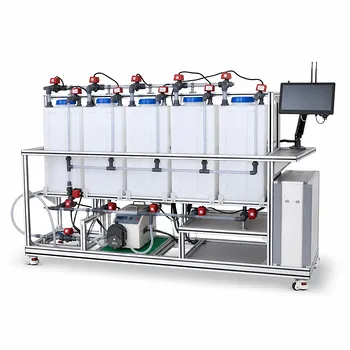
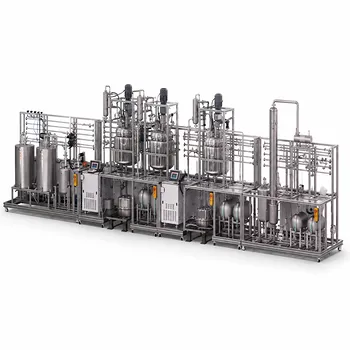
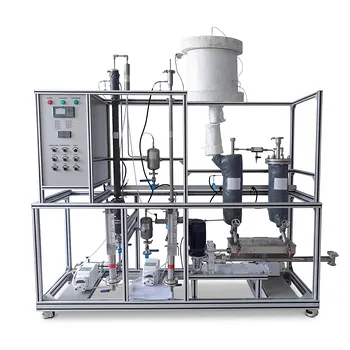
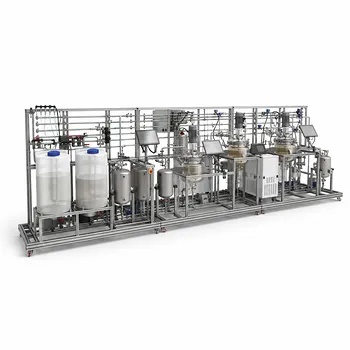
The Contact process is a cornerstone of industrial chemistry, and a pilot plant simulation must replicate its sequence of critical unit operations. To truly understand sulfuric acid production, you need to physically operate the gas purification train, the fixed-bed catalytic reactor, and the absorption system. These integrated modules teach you how to prevent catalyst poisoning, manage the intense exothermic heat from SO2 conversion, and control gas absorption efficiency to safely produce high-purity acid.
A pilot plant for the Contact process must faithfully reproduce three interdependent stages—feed pretreatment, catalytic reaction, and product absorption—because the real-world impact of impurities and thermal management on catalyst lifetime and acid quality cannot be captured by computer simulations alone.
The Three Phases of the Contact Process
The industrial Contact process naturally divides into three physical and chemical transformation stages. Simulating each in a dedicated unit is essential to observe how upstream decisions directly throttle downstream performance.
Feed Pretreatment: Safeguarding the Catalyst
The first critical module is a gas purification system, typically comprising a dust catcher, a scrubbing tower, and a gas cooling heat exchanger. Sulfur dioxide generated from burning sulfur or sulfide ores carries catalyst poisons like arsenic, halogens, and fine particulates that permanently deactivate the vanadium pentoxide catalyst.
The pilot-scale scrubber removes these trace impurities while the heat exchanger brings the SO2-rich stream to the precisely controlled inlet temperature required by the reactor. Operating these pretreatment steps reveals how even minor slip in impurity removal causes a measurable, often irreversible drop in SO2 conversion across the reactor bed.
The Catalytic Reactor: Managing Exothermic Heat
The heart of the pilot plant is a fixed-bed catalytic reactor maintained between 350°C and 400°C. This is where sulfur dioxide (SO2) is oxidized to sulfur trioxide (SO3) over a carefully packed catalyst bed, releasing a substantial 45,200 calories per 2 moles of SO3 formed.
Controlling the exotherm is the central operational challenge. You must directly manipulate flow rates and interstage cooling to prevent hot spots that sinter the catalyst and reduce active surface area. A pilot reactor equipped with multiple temperature probes allows you to verify heat transfer coefficients and reaction kinetics that purely mathematical models often over-idealize.
Product Absorption: From SO3 to Sulfuric Acid
The final critical unit is the absorption column, where gaseous SO3 is contacted with concentrated sulfuric acid to produce oleum or additional acid strength. Simply bubbling SO3 into water is impractical—it creates a mist of tiny acid droplets that is extremely difficult to collect and poses a severe safety risk.
In the pilot plant, you learn to optimize gas-liquid contact by adjusting acid circulation rates and concentration, directly correlating absorption efficiency to the final product purity. This step makes the connection between reaction yield and market-ready output tangible.
Why Physical Simulation Matters
Computer simulations are cost-effective tools, but they require empirical validation to be trusted for scale-up. A physical pilot plant bridges this gap by forcing you to collect performance data under real-world constraints.
Validating Theoretical Models
When you run the integrated pilot plant, you generate real mass and energy balances. You can measure inlet and outlet stream compositions, calculate heat transfer coefficients across the reactor and heat exchangers, and determine actual reaction kinetics under varying space velocities. Comparing these results with the predictions of your process simulator reveals where your mathematical model oversimplifies fluid dynamics or neglects heat loss.
Confronting Real-World Constraints
Physical operation exposes problems no simulation will flag. You see how catalyst pellets degrade over time due to thermal cycling, how fouling in heat exchangers creeps up and reduces cooling efficiency, and how absorption efficiency drops if the acid circulation rate falls below a critical threshold. These empirical insights teach you to design with safety factors and to anticipate maintenance cycles—lessons that are essential for industrial practice.
Understanding the Trade-offs
A pilot plant that perfectly replicates every industrial nuance is neither feasible nor wise. You must objectively weigh the benefits of physical realism against practical limitations.
A fully integrated pilot plant requires significant capital and floor space, forcing you to prioritize which unit operations to build at meaningful scale. The reactor’s high temperature and the corrosive nature of the SO3/H2SO4 system demand expensive materials of construction and rigorous safety protocols that may restrict student access.
Scale-down effects can also mislead. Heat loss through vessel walls is proportionally far higher in a small pilot reactor, which can artificially shift temperature profiles and make you underestimate the risk of thermal runaway in a full-scale adiabatic bed. You must consciously account for these disparities when extrapolating pilot data to an industrial design.
Making the Right Choice for Your Goal
Your selection of unit operations and their level of instrumentation should directly align with what you need to learn.
- If your primary focus is vocational training: Build modular, transparent units for gas scrubbing, catalytic reaction, and absorption. Emphasize manual control and visual observation so students can see cause-and-effect links between impurity removal, hot spots, and acid mist formation.
- If your primary focus is kinetic model validation: Invest heavily in the catalytic reactor’s measurement suite. Prioritize multi-point thermocouples, precise gas analyzers at inlet and outlet, and the ability to vary space velocity, while keeping pre-treatment and absorption as reliable but less granular support modules.
- If your primary focus is catalyst poisoning and lifetime studies: Center the pilot plant on the pretreatment train and reactor. Allow deliberate, controlled injection of known contaminants to quantify the exact rate of catalyst deactivation under different scrubbing efficiencies.
Ultimately, the most powerful pilot plant is not the most complex, but the one that faithfully reproduces the specific physical and chemical constraints that govern your primary research or educational question.
Summary Table:
| Phase / Unit Operation | Key Function | Simulation Objective |
|---|---|---|
| Feed Pretreatment | Removes catalyst poisons (dust, halogens) & heats gas | Prevent catalyst deactivation & control inlet temperature |
| Catalytic Reactor | Converts SO2 to SO3 over V2O5 catalyst | Manage intense exothermic heat & study reaction kinetics |
| Product Absorption | Absorbs SO3 into concentrated H2SO4 | Optimize gas-liquid contact & prevent hazardous acid mist |
Bring Industrial Processes to Life in Your Lab
Ready to enhance your curriculum or research with hands-on engineering systems? LABPARK provides premium Educational and Vocational Unit Operations Pilot Plants in chemical engineering, bioprocess & biotech, and environmental & water treatment.
Designed specifically for universities, research institutes, and enterprises, our systems offer:
- Accurate Physical Simulation: Replicate complex, multi-stage industrial processes with high safety and fidelity.
- Flexible & Modular Design: Tailor equipment setups for student training, process optimization, or catalyst lifetime studies.
- Robust Quality: Engineered to withstand corrosive chemicals and extreme thermal conditions.
Empower your students and researchers to master chemical process scale-up. Contact LABPARK today to configure your custom pilot plant solution!
Related Products
- Fixed-Bed Chemical Reaction and Gas Dust Tar Removal Unit Operations Pilot Plant
- Multi-Functional Special Distillation Educational Pilot Plant
- Methane Cracking Educational Unit Operations Pilot Plant
- Electrolyte Distillation Purification and Formulation Educational Pilot Plant
- Continuous Batch Extractive Distillation Educational Pilot Plant
People Also Ask
- When to transition from PID to adaptive control in pilot plants? Key process indicators.
- How do deviations in estimating latent heat impact pilot plant thermal systems? Avoid hardware mis-sizing.
- Why Compare Predicted and Experimental Excess Enthalpy? Key to Accurate Pilot Plant Scale-up
- How to study gasification in pilot plants? Compare exit gas composition & efficiency
- Why Use PTFE & Hastelloy in Chemical Pilot Plants? Prevent Corrosion & Ensure Safety