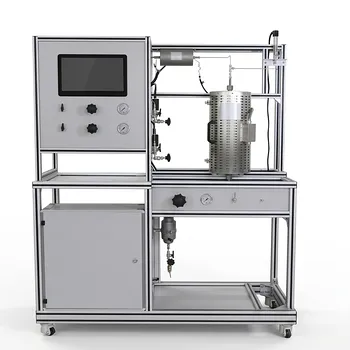
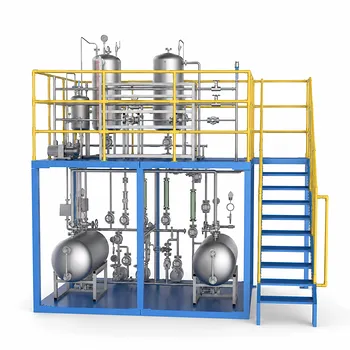
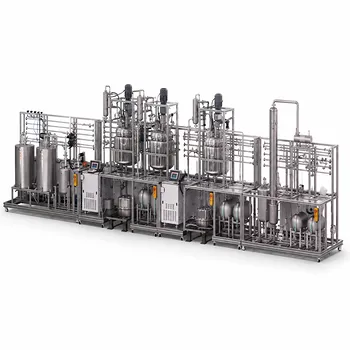
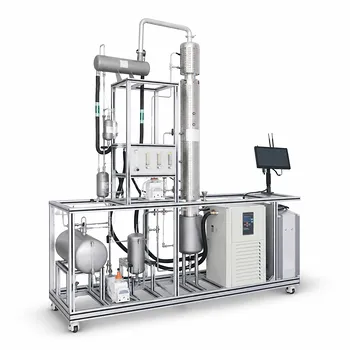
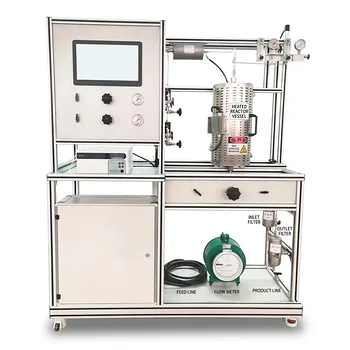
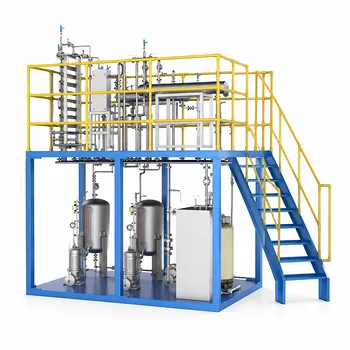
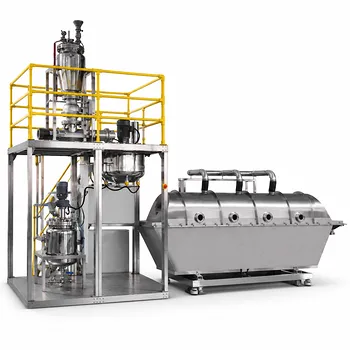
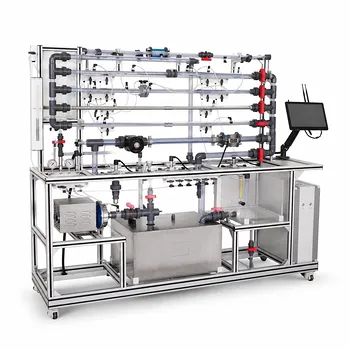
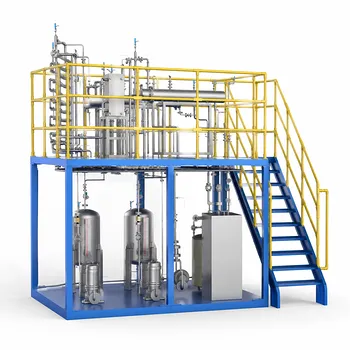
The core separation processes that can be simulated and analyzed on chemical engineering unit operations pilot plants include absorption, extractive distillation, azeotropic distillation, fractionation, rectification, stripping, and liquid-liquid extraction. Enhancing these physical experiments, Multicomponent Multistage Separation Processes (MMSP) simulation software models both conventional and complex column configurations, enabling a direct comparison between pilot-scale runs and theoretical thermodynamic predictions.
The true power of a unit operations pilot plant doesn’t come from simply watching fluids separate. It comes from the ability to overlay physical data with rigorous simulation models—a loop that turns an abstract equation into a tangible, tunable, and safe-to-explore industrial reality. This combination teaches not just what a valve does, but why the entire system behaves the way it does.
The Core Separation Processes Simulated on Pilot Plants
Separation is the soul of the chemical industry, and pilot plants compress these vast operations into a teachable scale. The primary processes fall into a few distinct families, all of which can be paired with simulation software for deeper insight.
Distillation-Based Processes
Distillation, in its many forms, is the workhorse of separation.
Fractionation and rectification are the classical distillation operations for separating mixtures based on boiling point differences. Pilot-scale columns let you physically observe tray hydraulics and product splits. Stripping is the inverse—removing a volatile component from a liquid stream using a vapor.
Extractive distillation and azeotropic distillation tackle the hard problem: close-boiling or azeotrope-forming mixtures. By adding a third component (a solvent or entrainer), these processes alter relative volatilities. Running such columns at a pilot scale, and then simulating the multicomponent vapor-liquid equilibrium, makes the abstract "separation factor" concrete.
Absorption and Stripping as a Counterpart
Absorption uses a liquid solvent to pull a specific gas component from a vapor stream. This is not a simple flash; it is a mass-transfer-rate-driven process.
Pilot-scale absorption towers let you measure concentration profiles. Simulation software then closes the loop by solving the material and energy balances stage by stage, so you can test how different solvent flow rates or packing heights affect recovery—without wasting a liter of solvent.
Liquid-Liquid Extraction
When distillation fails due to heat sensitivity or azeotropes, liquid-liquid extraction takes over. You physically bring two immiscible liquids into contact, allowing a solute to transfer based on chemical affinity.
A pilot-scale extraction column (often a rotating disc or packed column) displays the dispersion, coalescence, and concentration gradients. Simulation models can then predict the number of theoretical stages required for a given purity, teaching the critical link between phase behavior and equipment design.
Expanding the Scope with Other Physical and Chemical Separations
While the core list is dominated by distillation and extraction, pilot plants can also host membrane filtration, crystallization, and ion exchange units.
These teach a different lesson: physical separation exploits differences in molecular size or melting point, while chemical separation (like ion exchange or reactive absorption) relies on a specific reaction or affinity. Simulating these processes shifts the model from simple equilibrium stages to rate-based or kinetic models, exposing the true complexity of industrial purification.
How Simulation Software Brings These Operations to Life
The pilot plant provides the sensor data. The simulation software provides the "why" behind the numbers. Here’s how that partnership actually works in an educational setting.
Modeling Steady-State and Complex Column Configurations
MMSP simulations aren't limited to a single feed and two products. They handle complex columns with multiple feeds, side draws, and interstage heaters or coolers—exactly the configurations you find in energy-integrated plants.
This lets a student ask, "What if I add a side reboiler?" and see the impact on the temperature profile and energy duty in simulation, then validate that shift during a subsequent physical run. The software manages the impossible-to-hand-calculate matrix of equations, making advanced design accessible.
Comparing Theory to Reality: A Critical Learning Loop
The single most valuable act in a pilot plant lab is placing a simulated plot of stage temperature directly on top of the actual sensor readings.
The mismatch is the lesson. If the simulation—driven by an equation-of-state model—shows a sharper temperature gradient, you’ve just discovered the concept of stage efficiency. The software becomes a hypothesis-testing tool. You tweak the tray efficiency in the model until it mirrors the physical plant, thereby quantifying a real-world imperfection that no textbook can teach alone.
Dynamic Simulation: Beyond the Steady-State
Steady-state models tell you where you’ll end up. Dynamic simulation tells you how you’ll get there, and what happens when things go wrong.
Paired with a pilot distillation column, dynamic software models time-dependent behavior: the liquid holdup that slows a response, the pressure surge during a reflux failure, or the concentration wave that travels down the column. Students can simulate an emergency shutdown in software, analyze the safe limits, and then—with confidence and a clear mental model—execute a controlled disturbance test on the physical plant.
Optimizing Performance and Understanding Trade-offs
Every separation is an energy negotiation. Simulation lets you pull on multiple levers simultaneously.
You can explore how raising the reflux ratio increases purity but drives up cooling water and steam consumption. Or how switching from a tray column to a packed column model alters the pressure drop. By comparing these simulated trade-offs to your physical plant’s measured utility usage, you internalize the true cost of a high-purity product. This is where chemical engineering becomes business reality.
Understanding the Trade-offs and Limitations
This powerful combination is not magic. To build deep, critical thinking, you must also understand where it breaks.
The Simplifying Assumptions of Models
Every simulation rests on assumptions. Equilibrium-stage models assume each tray reaches perfect vapor-liquid equilibrium. Real trays have mixing, weeping, and channeling.
If you treat the simulator’s output as absolute truth, you will misdiagnose fouling or poor distribution as a "model error." The insight comes from respecting the model as an idealized benchmark, not a perfect mirror. The gap between that benchmark and the plant data is where the real learning happens.
Data Quality and Validation
A simulation is only as good as the binary interaction parameters in its thermodynamic package. For an unfamiliar mixture, a flawed azeotropic prediction can lead a student to an unachievable separation target.
This teaches a non-negotiable engineering discipline: always validate the chosen fluid package against experimental data before relying on it for a critical design. The pilot plant provides that experimental data, closing the circular dependency.
Physical Pilot Plant Constraints
A miniature column is not a scaled-down industrial tower. Its surface-area-to-volume ratio distorts heat loss. Its smaller pipes exaggerate frictional pressure drop.
Students must learn to separate what the simulation predicts (adiabatic, ideal hydraulics) from what the physical platform can demonstrate. The software's value isn't in replicating the pilot plant perfectly; it’s in revealing the physical plant’s inherent limitations and the principles of non-ideal scale-up.
Making the Right Choice for Your Educational Goal
The pairing of pilot plant and simulation is not a single tool but a spectrum. How you use it depends entirely on what you need your students to learn.
- If your primary focus is fundamental process understanding: Start with simple binary batch distillation in a glass column. Use a basic process simulator to generate a Rayleigh equation plot and compare it to collected samples. Let the focus stay on thermodynamics, not equipment complexity.
- If your primary focus is advanced process design and optimization: Deploy a multi-feed, side-draw continuous column with an on-line composition analyzer. Run MMSP simulations to test different feed tray locations and side-stream rates, then physically implement the best case to prove the energy savings.
- If your primary focus is operational safety and control: Integrate dynamic simulation software with the physical plant’s control system. Simulate and then safely execute a controlled upset—like a steam failure—so students can compare predicted recovery times with actual process behavior and sharpen their crisis-response intuition.
- If your primary focus is industrial-scale economics: Choose an integrated reaction-separation pilot plant, such as cracking and distillation. Use the simulation to compare the capital and energy costs of a purely physical separation against a hybrid approach using a selective hydrogenation reactor, then validate the final product purity on the plant.
The goal is never to run the perfect experiment. It’s to use the software to understand why the experiment was imperfect in the first place, and then decide, quantitatively, if that imperfection matters.
Summary Table:
| Separation Process | Physical Pilot Plant Focus | Simulation Software Role |
|---|---|---|
| Distillation (Fractionation, Extractive, Azeotropic) | Observe tray hydraulics, reflux behavior, and product purity. | Model vapor-liquid equilibrium (VLE), stage efficiency, and energy duty. |
| Absorption & Stripping | Measure mass transfer, concentration profiles, and solvent flow effects. | Solve stage-by-stage material and energy balances to optimize recovery. |
| Liquid-Liquid Extraction | Monitor dispersion, coalescence, and phase separation. | Predict theoretical stages and analyze solute affinity dynamics. |
| Membranes, Crystallization & Ion Exchange | Test physical and chemical separation limits at a pilot scale. | Apply rate-based and kinetic models to simulate non-equilibrium runs. |
Bridge the Gap Between Chemical Theory and Industrial Practice
Equip your students and researchers with the tools they need to master complex process engineering. LABPARK designs and manufactures high-performance Educational and Vocational Unit Operations Pilot Plants tailored for universities, research institutes, and enterprises. Covering chemical engineering, bioprocess & biotech, and environmental & water treatment, our pilot systems seamlessly integrate with advanced simulation software to deliver a hands-on, industry-ready learning experience.
Ready to elevate your lab's training capabilities? Contact LABPARK today to discuss your custom pilot plant requirements!
Related Products
- Multi-Reactor Educational Pilot Plant for Reaction Engineering Unit Operations
- Carbon Dioxide Hydrogen Methanol Synthesis Educational Unit Operations Pilot Plant
- Ethyl Acetate Synthesis Unit Operations Pilot Plant for Practical Training
- Multi Pump Fluid Transport Process Piping Unit Operations Training Pilot Plant
- Multi-Modal Distillation Unit Operations Training Pilot Plant
People Also Ask
- How do educational unit operations pilot plants address safety and waste management when scaling up?
- How do educational unit operations pilot plants bridge theory and design? Bridge the Engineering Gap
- Why Compare Predicted and Experimental Excess Enthalpy? Key to Accurate Pilot Plant Scale-up
- Why Use PTFE & Hastelloy in Chemical Pilot Plants? Prevent Corrosion & Ensure Safety
- How to study gasification in pilot plants? Compare exit gas composition & efficiency