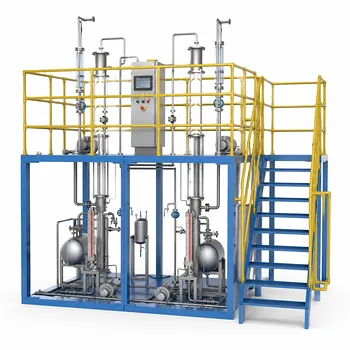
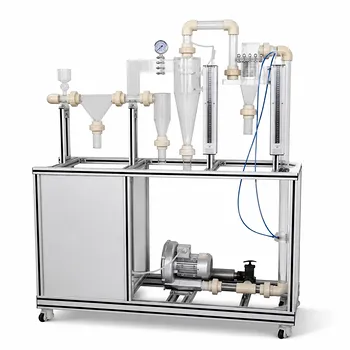
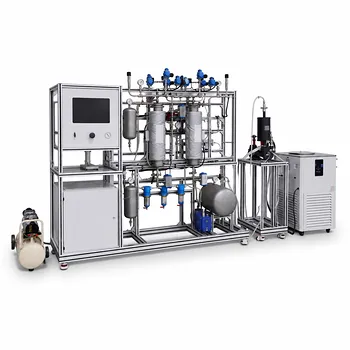
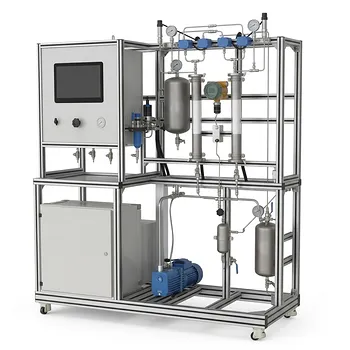
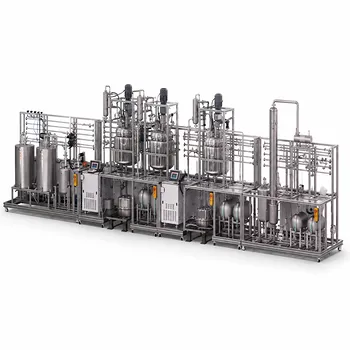
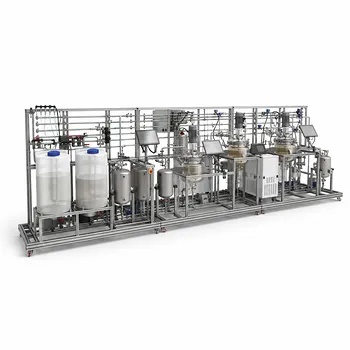
The core of any methane conversion investigation is a dedicated chemical reactor pilot plant built around a catalytic reactor system. To convert methane into syngas—a mixture of CO and H₂—you need a setup that combines precise gas delivery, extreme thermal control, and real-time chemical analysis. This typically means a catalytic fixed-bed or fluidized-bed reactor integrated with mass flow controllers, a high-temperature furnace, and an online gas chromatograph.
The foundational equipment for methane-to-syngas research isn’t a single instrument but an integrated pilot plant that allows you to run reactions under tightly controlled conditions while instantly reading the results. Without that loop, catalyst evaluation and kinetic studies remain guesswork.
Why a Packed-Bed Reactor Pilot Plant Is Essential
Methane activation requires temperatures that can exceed 800 °C and catalysts that demand uniform gas contact. A bench- or pilot-scale reactor unit lets you test those extremes safely and repeatably.
The Two Reactor Configurations That Matter
Most pilot plants for this work employ either a fixed-bed (packed-bed) reactor or a fluidized-bed reactor. Fixed-bed systems are the standard for steady-state kinetic measurements because the catalyst stays static, making flow and temperature profiles predictable. Fluidized beds become relevant when you need to study process intensification or manage rapid coking, though they add complexity in heat transfer and solids handling.
Precise Gas Flow Control Defines Your Experimental Edge
At the heart of the pilot plant are mass flow controllers (MFCs) for methane, oxidants (like O₂, CO₂, or steam), and any inert diluents. MFCs let you dial in exact gas hourly space velocities and reproduce feed compositions with minimal drift. This precision is non-negotiable because even a 1% shift in the CH₄/O₂ ratio can alter syngas selectivity and catalyst lifetime conclusions.
High-Temperature Furnace Controls Dictate Realism
The reactor tube sits inside a high-temperature furnace capable of maintaining isothermal zones across the catalyst bed. Closed-loop control with multiple thermocouples ensures that you’re measuring true kinetic activity, not temperature gradients that obscure data. This setup lets you mimic industrial steam reformer or autothermal reformer conditions at pilot scale.
The Analytical Backbone: Online Gas Chromatography
A reactor alone is blind. You need online gas chromatography (GC) that pulls product gas directly from the reactor outlet and analyzes it in near real-time. This closes the loop between process conditions and chemical output, enabling you to calculate conversion, selectivity, and carbon balances on every run.
How On-Line GC Transforms Data Quality
A multi-column GC with thermal conductivity and flame ionization detectors can quantify H₂, CO, CO₂, CH₄, and even trace hydrocarbons in a single sample loop. By automating injections every few minutes, you capture transient catalyst behavior—activation, deactivation, or coking onset—that manual sampling would miss entirely. This online interface is what turns a simple flow rig into a kinetic investigation tool.
Understanding the Trade-offs and Common Pitfalls
Even with the right equipment, certain compromises and design traps can undermine your results. Acknowledging them up front builds a more robust research platform.
Fixed-Bed vs. Fluidized-Bed: A Stability vs. Mixing Trade-off
Fixed-bed reactors provide excellent plug-flow behavior and are easier to model, but they can develop hot spots and pressure drop issues if catalysts sinter or coke. Fluidized beds offer superior heat distribution and solids mixing, yet they introduce catalyst attrition and backmixing that complicate kinetic interpretation. Choosing the wrong configuration for your end goal can make scale-up data misleading.
The Trap of Inadequate Preheating and Heat Management
Methane reforming is highly endothermic or exothermic depending on the reaction pathway. If your furnace doesn’t preheat the feed gas uniformly to reaction temperature before it hits the catalyst, you’ll measure an “apparent” rate that’s actually a heat-transfer limitation. Similarly, ignoring the need for post-reactor quenching can cause shift reactions in the sampling line, distorting the syngas ratio you think you produced.
Analytical Bottlenecks That Skew Catalyst Rankings
Online GC is powerful, but it’s only as good as its calibration and sample handling. Condensation of water or heavy byproducts in transfer lines, fluctuations in carrier gas pressure, or a single-point calibration can all produce biased syngas ratios. Investing in heated lines and frequent multi-point calibrations is mandatory, not optional, if you intend to publish or patent catalyst performance data.
How to Match Your Equipment to Your Research Goal
A successful methane-to-syngas pilot plant is not a one-size-fits-all package—it’s an assembly you tailor to your core objective. Here’s how to align your choices.
- If your primary focus is catalyst screening and longevity studies: Prioritize a fixed-bed reactor with rapid online GC and automated MFC blending to run high-throughput, reproducible cycles under exactly the same feed conditions.
- If your primary focus is kinetic modeling and mechanism elucidation: Add a second furnace zone for preheating and ensure differential reactor operation (low conversion) to decouple transport effects from intrinsic kinetics, supported by high-frequency GC sampling.
- If your primary focus is scale-up and process intensification: Move toward a fluidized-bed pilot unit equipped with differential pressure monitoring, solids feeding ports, and heat flux sensors to capture the engineering data that an isothermal lab rig cannot provide.
- If your primary focus is studying alternative oxidants like CO₂ or steam: Integrate a controlled evaporator mixer or steam generator directly into the gas delivery skid, and ensure your GC columns can separate CO₂ and H₂O without interference.
The equipment you select ultimately shapes the questions you can answer. When you combine a catalytic reactor with airtight flow control, precise thermal management, and instant analytical feedback, you transform methane conversion from a bench-top curiosity into a scalable, chemical utilization strategy.
Summary Table:
| Equipment Type | Key Function | Critical Considerations |
|---|---|---|
| Catalytic Reactor | Facilitates CH₄ conversion (Fixed-bed or Fluidized-bed) | Manage hot spots, coking, and catalyst deactivation |
| Mass Flow Controllers (MFCs) | Delivers precise gas ratios (CH₄, O₂, CO₂, Steam) | Accuracy is vital; minor drift alters selectivity |
| High-Temp Furnace | Maintains isothermal reaction zones (> 800 °C) | Requires preheating zones to avoid heat-transfer limits |
| Online Gas Chromatograph (GC) | Measures H₂, CO, CO₂, and CH₄ in real time | Needs heated sample lines to prevent condensation |
Accelerate Your Research with LABPARK Pilot Plants
Are you looking to design or upgrade your catalytic reaction systems? LABPARK provides premium Educational and Vocational Unit Operations Pilot Plants in chemical engineering, bioprocess & biotech, and environmental & water treatment.
We help universities, research institutes, and enterprises achieve precise process control, accurate flow delivery, and reliable analytical integration. Let us help you eliminate the guesswork in catalyst evaluation and scale-up studies.
Contact LABPARK today to request a quote or discuss your project specifications!
Related Products
- Natural Product Extraction Unit Operations Training Pilot Plant
- Continuous Batch Extractive Distillation Educational Pilot Plant
- Fluidized Bed Gas Solid Catalytic Reaction Educational Pilot Plant
- Ethyl Acetate Synthesis Unit Operations Pilot Plant for Practical Training
- Micro-Scale Gas-Solid Catalytic Reaction Educational Pilot Plant
People Also Ask
- How to Demo Solubility Sensitivity in SFE Pilot Plants? Practical Thermodynamics
- How do pilot plants differentiate physical vs chemical extraction? Enhance Chemical Engineering Training
- How are HTU and NTU applied to determine extraction column height? Guide to Pilot Plant Scaling
- How can Hotelling's T² & Q statistics detect pilot plant abnormalities? Optimize Safety
- Why use split-plot designs in pilot plants instead of CRD? Optimize process parameters effectively.