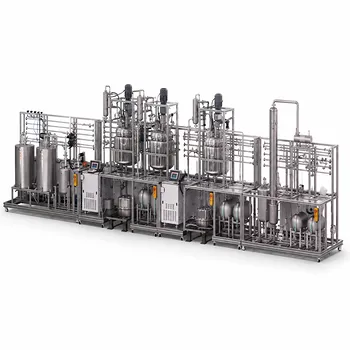
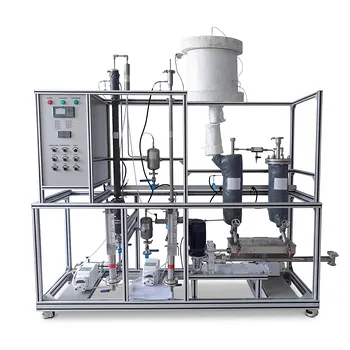
The gap between theory and reality becomes a chasm at high temperatures and pressures. Designing separation processes under these extreme conditions exposes fundamental thermodynamic weaknesses: equations of state lose predictive accuracy near critical points, multicomponent phase behavior defies simple modeling, and the boundaries between stable and unstable phase regions become razor-thin. Chemical engineering pilot plants fill this gap by generating the empirical data needed to anchor theoretical models, observe unexpected phase splits, and safely validate designs before full-scale investment.
The central challenge is that standard thermodynamic models—from cubic equations of state to activity coefficient correlations—were never built to handle the discontinuities and strong non-idealities that emerge in high-temperature, high-pressure multicomponent systems. A pilot plant becomes the only reliable bridge between a simulator’s guess and a process that works.
The Limits of Theory at Extreme Conditions
The very mathematics that define phase stability falter under the conditions where separation wants to be most efficient.
The Instability No Equation Captures Fully
Thermodynamic stability requires that the system’s Gibbs energy surface remain convex. At high temperature and pressure, however, that surface flattens dangerously near the spinodal limit.
The spinodal curve marks the thermodynamic condition where the stability determinant $A_{n+1} = 0$—the point at which a single phase must split. Near this boundary, tiny fluctuations in temperature or composition can trigger an unexpected phase separation. Cubic equations like Peng-Robinson may predict a stable mixture when reality has already crossed into a two-phase region. Pilot plants let you see that split.
Where Interaction Parameters Are Missing
Multicomponent mixtures at extreme conditions often contain light gases, supercritical solvents, and heavy solutes. The binary interaction parameters (kij) stored in process simulators are frequently regressed from data far outside your operating envelope.
Extrapolating these numbers into the critical region is guesswork. In a pilot skid, you can measure actual vapor-liquid compositions and fit your own interaction coefficients, locking the model to data instead of assumption.
The Hidden Complexity of Multi-Phase Equilibria
Theory simplifies the world to two phases. A real high-pressure separator may deliver three or more.
When a Second Liquid Phase Appears Unexpectedly
Extractions with supercritical CO₂ or high-pressure condensate strippers often enter a Type III or Type IV phase behavior zone where multiple liquid phases coexist with vapor. No standard equation of state can predict the appearance of a third phase without extensive calibration.
In a pilot plant, sight glasses and sampling ports reveal a second organic layer immediately. You capture the composition of all coexisting phases and learn how to control the separation, while a simulation might have shown just one.
The Deep Coupling of Phase Equilibria and Enthalpy
For any separation, energy balances determine reflux ratios and column diameter. Enthalpy predictions depend directly on accurate phase equilibria.
If your VLE calculation drifts by a few mole percent at high pressure, the column’s condenser duty can be off by 15–20%. Pilot plant data corrects both the phase envelope and the heat effects simultaneously, preventing the costly overdesign of heat exchangers.
Why Equations of State Fail without Empirical Correction
Even the most advanced equations of state break down when pushed too close to a pure component’s critical point.
The Critical Region’s Mathematical Singularity
At the critical point, properties like isothermal compressibility go to infinity. All analytic equations of state exhibit a fundamental flaw here—they impose a mean-field curvature that real fluids do not follow.
Cross-over models exist, but they require fluid-specific calibration against experimental PVT and vapor-liquid equilibrium data from the exact mixture of interest. A pilot plant becomes the apparatus to generate that calibration set, transforming a flawed theoretical curve into a trustworthy design tool.
Strongly Associating Systems Trap the Solver
When molecules hydrogen-bond (amines, acids, water), Gibbs energy is no longer a simple function of overall composition. You must minimize the energy with respect to “associated species” concentrations.
As simulations iterate, they can easily land outside physical bounds and crash. The remedy—an initial guess that maximizes associated species concentration followed by Newton-Raphson convergence—works only when you have experimental tie-line data to confirm the solution is real. A pilot run supplies those tie lines.
Common Pitfalls When Skipping Pilot Plant Validation
Relying only on desktop simulation introduces risks that compound at high temperature and pressure.
The Simulation Says Converged—the Process Says Column Flooded
A simulator’s convergence algorithm may find a mathematically valid solution that violates physical limits, such as negative tray efficiencies or impossible internal flows. Without experimental hydraulic and mass transfer data, you may sign off on a design that never operates.
Thermal Degradation Alters the Thermodynamic Landscape
Heating organic mixtures accelerates side reactions—polymerization, autoxidation, thermal cracking. These reactions change the composition and generate new, often highly associating species not in your initial component list.
Your original VLE model becomes obsolete. A pilot plant reveals the true steady-state composition, including the degradation products, so you can update your thermodynamics accordingly.
Making the Right Choice for Your Project
Pilot plant testing is not a one-size-fits-all mandate. The decision should scale with the thermodynamic risk inherent in your separation.
- If your primary focus is safety and regulatory compliance under high pressure: Use a pilot plant to generate vapor-liquid equilibrium data at the design envelope, validating that the model won’t miss a phase split that could lead to overpressure. Complement with material stress testing at temperature, as allowed by ASME code guidelines.
- If your primary focus is minimizing solvent consumption or energy cost: Tune binary interaction parameters and enthalpy calculations against pilot plant measurements to shave 5–10% off utility estimates, avoiding oversized reboilers and condensers.
- If your primary focus is rapid technology scale-up with limited time: Run a minimal set of pilot runs at the most non-ideal conditions—typically near the highest temperature and pressure—and use the data to fit a predictive model. The upfront time saves you from restarting a failed commercial unit later.
- If your primary focus is understanding a novel, complex feed mixture: Pair a pilot plant with an advanced analytical suite. Map the full phase envelope experimentally and use the results to select the appropriate equation of state framework, rather than forcing the mixture into a standard model.
A pilot plant does not replace good thermodynamics—it gives the thermodynamics its eyes.
Summary Table:
| Thermodynamic Challenge | Theoretical Model Failure | Pilot Plant Solution |
|---|---|---|
| Near-Critical Instability | Equations of state miss spinodal phase splits | Sight glasses & empirical data capture real phase behavior |
| Missing Binary Parameters | Extrapolation of supercritical/heavy mixtures fails | Direct measurement of actual vapor-liquid compositions |
| Multi-phase Equilibria | Models fail to predict third phase (Type III/IV) | Physical sampling ports confirm and map multi-phase layers |
| Enthalpy & VLE Coupling | VLE drift causes 15-20% errors in heat duty | Simultaneous correction of phase envelope & heat effects |
Bridge the Gap Between Thermodynamic Theory and Real-World Scaling
Don't risk column flooding, thermal degradation, or costly overdesigns due to simulator assumptions. LABPARK provides premium Educational and Vocational Unit Operations Pilot Plants in chemical engineering, bioprocess & biotech, and environmental & water treatment.
We help universities, research institutes, and enterprises obtain the precise empirical data needed to anchor thermodynamic models and safely scale up processes.
Contact LABPARK today to find the perfect pilot plant configuration for your research or industrial application!
Related Products
- Fixed Bed Gas Solid Catalytic Reaction Educational Pilot Plant
- Multi Pump Fluid Transport Process Piping Unit Operations Training Pilot Plant
- Carbon Dioxide Hydrogen Methanol Synthesis Educational Unit Operations Pilot Plant
- Ethyl Acetate Synthesis Unit Operations Pilot Plant for Practical Training
- Natural Product Extraction Unit Operations Training Pilot Plant
People Also Ask
- How do reactor pilot plants safely study gas-solid reactions? Master kinetics with thermal & flow control.
- How does the Mears criterion evaluate transport resistance? Key Guide to Intrinsic Kinetics
- Fluidized vs. Fixed Bed Reactors: Comparing Heat & Complexity in Pilot Plants
- Why is a multibed configuration necessary for exothermic reactions? Optimize your pilot plant trajectory.
- How is the friction factor determined for fixed-bed pilot plants? Select the best pressure drop correlation.