IgG’s size, shape, charge, disulfide architecture, and Fc glycosylation determine how it must be captured, concentrated, polished, and protected during downstream processing. Its approximately 150 kDa Y-shaped monomer is large enough for membrane retention during ultrafiltration, while its Fc region enables selective capture with Protein A. Surface charge, molecular heterogeneity, and sensitivity to pH and interfaces then determine the operating conditions for ion-exchange chromatography, diafiltration, and other polishing steps.
The key point is that IgG is not separated by molecular weight alone. Its Fc-mediated affinity enables highly selective capture, its size and hydrodynamic behavior govern membrane and size-based separations, and its charge and structural stability determine buffer conditions, chromatography selectivity, and allowable process stress.
How IgG Structure Determines the Downstream Process
Its quaternary structure creates a large, asymmetric molecule
IgG is composed of two heavy chains and two light chains connected by disulfide bonds. The resulting Y-shaped structure has a molecular mass of approximately 150 kDa, although the exact mass varies with subclass, glycosylation, and molecular heterogeneity.
This size and shape influence membrane retention, diffusion, chromatographic transport, and the effective pore size required in filtration equipment. IgG also behaves differently from a compact spherical protein because its Y-shaped architecture produces a characteristic hydrodynamic size and exposes multiple functional surfaces.
The Fc region enables selective affinity capture
The constant region of the heavy chains, particularly the Fc region, interacts with Protein A. This interaction is the basis of Protein A affinity chromatography, which is commonly used to capture IgG from cell-culture fluid.
The variable regions provide antigen specificity, but they are generally not the feature exploited by Protein A capture. Their primary process relevance is that sequence differences can alter charge, aggregation tendency, stability, and impurity separation behavior between antibody products.
Disulfide bonds maintain the antibody’s functional architecture
Interchain disulfide bonds hold the heavy and light chains together and help maintain the native antibody structure. Intrachain disulfide bonds also stabilize the individual immunoglobulin domains.
These bonds make redox conditions, pH exposure, temperature, and residence time important process variables. Conditions that promote reduction, scrambling, or other structural damage can generate fragments, half-antibodies, or other product variants that complicate purification and reduce activity.
Fc glycosylation adds controlled heterogeneity
IgG contains a covalently attached oligosaccharide, typically in the Fc region. Glycosylation affects molecular mass, charge distribution, Fc conformation, and interactions with some chromatographic ligands.
The glycan profile can therefore influence the behavior of IgG during characterization and polishing. It is also a critical quality attribute because changes in glycosylation can affect Fc-mediated biological functions, even when the antibody remains intact.
How These Features Map to Unit Operations
Affinity chromatography uses Fc recognition
Protein A chromatography exploits the Fc region to bind IgG selectively while allowing many host-cell proteins, media components, and other process impurities to pass through.
The equipment must provide controlled loading, residence time, washing, elution, and cleaning conditions. Because elution commonly involves a significant pH change, the column cycle must be designed to recover IgG efficiently while limiting exposure that could cause aggregation, fragmentation, or loss of activity.
Ultrafiltration uses size and hydrodynamic behavior
In ultrafiltration, the membrane retains IgG while smaller molecules, salts, and some process impurities pass through. The approximately 150 kDa molecular size is therefore central to selecting an appropriate membrane and defining the concentration strategy.
The Y-shaped structure matters because nominal molecular weight is not identical to effective membrane behavior. Membrane material, pore characteristics, protein concentration, viscosity, concentration polarization, and aggregation can all influence IgG transmission and flux.
Diafiltration changes the chemical environment
Diafiltration uses membrane retention to exchange the IgG solution into a new buffer. This step may prepare the product for ion-exchange chromatography, formulation, viral filtration, or final storage.
The antibody’s conformational stability determines which pH, ionic strength, excipients, and processing duration are acceptable. Buffer exchange must remove unwanted salts or small molecules without creating conditions that promote precipitation, aggregation, or chemical modification.
Ion-exchange chromatography uses surface charge
IgG has a surface charge that depends on its amino-acid composition and the process pH. The relevant relationship is between the solution pH and the antibody’s effective isoelectric behavior, which can vary among molecules and product variants.
This makes buffer pH and conductivity central equipment and process parameters. Ion-exchange steps can separate IgG from host-cell proteins, DNA, aggregates, fragments, and charge variants when the product and impurities have sufficiently different interactions with the resin.
Size-based polishing responds to aggregates and fragments
Native IgG, aggregates, and fragments differ in hydrodynamic size. Size-exclusion methods can exploit these differences, although their scalability and capacity may limit their role in large manufacturing processes.
Other polishing operations may also distinguish these species through charge, hydrophobicity, or membrane behavior. The structural integrity of the antibody must be preserved because process-generated aggregates and fragments are both product-quality concerns and separation targets.
Viral filtration depends on size, shape, and aggregation state
Virus-retentive filtration separates particles based largely on size and transport through a membrane. IgG must pass through with acceptable recovery while larger viral particles are retained.
The antibody’s hydrodynamic dimensions and aggregation state are important. Aggregates can foul or block the membrane, reduce throughput, and increase product loss, so upstream clarification and prior polishing affect viral-filter performance.
Which Structural Properties Set the Main Parameters?
Molecular size sets retention and throughput constraints
The large molecular size of IgG influences:
- Membrane retention and molecular-weight-cutoff selection
- Passage through viral-retentive membranes
- Diffusion and mass transfer in chromatography
- The concentration range at which viscosity and fouling become limiting
- The separation of intact IgG from fragments and smaller impurities
Equipment design must account for both the antibody’s nominal mass and its actual solution behavior.
Surface charge sets chromatographic selectivity
Charge is controlled by the antibody sequence, glycosylation, buffer pH, and ionic strength. Small differences between IgG charge variants can be useful for polishing, but they also make the process sensitive to buffer preparation and conductivity control.
Ion-exchange columns therefore require consistent pH and salt conditions. Variations in these parameters can change binding strength, alter impurity clearance, and shift product recovery.
Conformation sets the acceptable process stress
IgG depends on noncovalent interactions and disulfide bonds to maintain its active conformation. Excessive temperature, unfavorable pH, air-liquid interfaces, high local concentration, or prolonged residence time can increase aggregation or other degradation pathways.
Unit operations should consequently minimize unnecessary hold times, control temperature, and avoid operating conditions that expose the antibody to avoidable chemical or mechanical stress.
Fc accessibility determines affinity performance
Protein A binding requires the Fc region to be sufficiently accessible and structurally intact. Changes in conformation, aggregation, or chemical modification can affect ligand interaction and alter binding capacity or elution behavior.
This links product structure directly to column loading strategy, resin selection, wash conditions, and elution control.
Molecular heterogeneity affects process consistency
IgG is not always a single perfectly uniform molecular species. Charge variants, glycoforms, aggregates, fragments, and other modifications can differ in their behavior during chromatography and filtration.
A purification process must therefore be designed around the expected product distribution, not only the theoretical structure of the intended monomer.
Understanding the Trade-offs
High selectivity can increase product stress
Protein A provides strong selectivity, but the required elution conditions can expose IgG to low pH. Longer low-pH residence times may increase the risk of aggregation or structural damage.
The process must balance impurity clearance against rapid neutralization or transfer into a stabilizing buffer.
Higher concentration can reduce membrane performance
Ultrafiltration increases product concentration, but rising concentration also increases viscosity and can intensify concentration polarization. These effects can reduce flux and make filtration less predictable.
Operating targets must balance final concentration, processing time, membrane area, and product recovery.
Stronger binding is not always better
Increasing chromatographic binding can improve capture efficiency, but excessive binding may make elution more difficult or increase the severity of elution conditions. Resin capacity, residence time, and recovery must be evaluated together.
The correct target is controlled capture with acceptable recovery and product quality, not maximum binding strength in isolation.
Charge-based separation is condition-sensitive
Ion-exchange performance can change significantly with pH and conductivity. A small buffer-preparation error can alter the binding of both IgG and impurities.
This makes inline or well-controlled monitoring of pH and conductivity important for reproducible operation.
Removing aggregates can reduce recovery
Aggregates are undesirable, but separation methods that remove them may also lose some native IgG. The degree of clearance must therefore be considered alongside yield, especially when aggregates overlap with the monomer in a given separation mode.
Scale-up changes the effective operating environment
A laboratory separation may not reproduce the same mass transfer, residence-time distribution, membrane flux, or mixing behavior at pilot or manufacturing scale. Equipment sizing and control strategy must preserve the relevant structural interactions while accounting for scale-dependent hydraulic behavior.
Making the Right Choice for Your Goal
The structural analysis should be translated into operating controls for each unit operation.
- If your primary focus is selective capture: Use the intact Fc region and Protein A interaction as the foundation for affinity chromatography, with controlled loading, washing, and elution conditions.
- If your primary focus is concentration and buffer exchange: Use IgG’s size and retention behavior to select the membrane and control transmembrane pressure, flux, concentration polarization, and hold time.
- If your primary focus is impurity and charge-variant removal: Establish pH and conductivity conditions that exploit differences in surface charge without destabilizing the antibody.
- If your primary focus is structural integrity: Limit exposure to damaging pH, temperature, redox conditions, interfaces, and extended residence times.
- If your primary focus is consistent scale-up: Treat molecular size, shape, charge, glycosylation, and aggregation state as linked design inputs for chromatography, filtration, mixing, and process monitoring.
The most reliable IgG purification process is one that treats antibody structure as the basis for every separation condition, rather than selecting equipment parameters independently of molecular behavior.
Summary Table:
| IgG structural feature | Main process impact | Key unit operation parameters |
|---|---|---|
| Approximately 150 kDa size and Y-shaped structure | Determines retention, transport, and fouling behavior | Membrane cutoff, flux, pressure, concentration, and residence time |
| Fc region | Enables selective Protein A capture | Resin selection, loading, wash, elution pH, and contact time |
| Disulfide bonds and protein conformation | Limits exposure to damaging conditions | pH, temperature, redox environment, interfaces, and hold time |
| Surface charge and isoelectric behavior | Controls binding to ion-exchange media | Buffer pH, conductivity, salt concentration, and gradient design |
| Fc glycosylation | Influences mass, charge, conformation, and biological activity | Polishing conditions and glycan-related quality monitoring |
| Aggregates, fragments, and charge variants | Creates product heterogeneity and separation targets | Chromatography selectivity, viral filtration, and recovery controls |
Design Your IgG Purification Process with LABPARK
Need reliable equipment for antibody capture, concentration, buffer exchange, polishing, or scale-up? Contact LABPARK to discuss your process requirements.
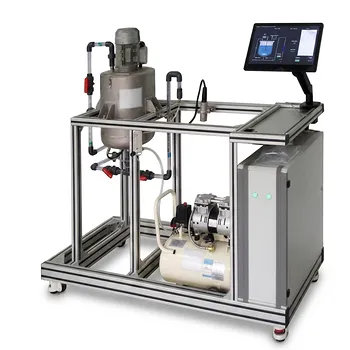
LABPARK provides Educational and Vocational Unit Operations Pilot Plants for chemical engineering, bioprocess and biotech, and environmental and water treatment applications. Our systems help universities, research institutes, and enterprises evaluate Protein A chromatography, ion-exchange purification, ultrafiltration, diafiltration, viral filtration, mixing, and process-control strategies with practical pilot-scale equipment.
Work with LABPARK to connect IgG structure with the right membrane, resin, operating conditions, monitoring tools, and scale-up approach. We can help you improve product recovery, impurity clearance, process consistency, and operator training.
Related Products
- Multi-Functional Membrane Separation Educational Pilot Plant for Unit Operations Lab
- Bio-fermentation Ethanol Production Practical Training Unit Operations Pilot Plant
- Agitation and Mixing Educational Unit Operations Pilot Plant
- Two-Dimensional Fluidization Hydrodynamics Educational Pilot Plant for Unit Operations Training
- Multi-Modal Distillation Unit Operations Training Pilot Plant
People Also Ask
- What are the key differences in membrane configurations? Choose the Right Unit Operations Pilot Plant
- How Do Pervaporation, Vapor, and Gas Permeation Differ in Pilot Plants? Key Comparison
- How do membrane separation pilot plants teach RO limits? Master osmotic pressure dynamics.
- How do temperature and pH affect membrane conductivity? Pilot Plant Guide
- How do polymer membranes restrict gas separation? Key pilot plant limits.