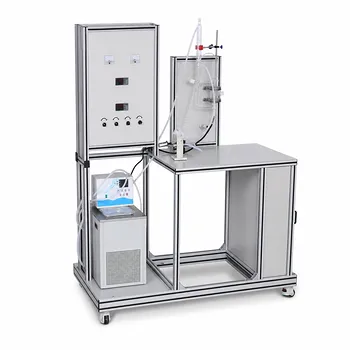
The standard binary distillation model assumes away several real physical effects to make the column mathematically manageable. The usual assumptions are negligible vapor holdup, equimolar vapor and liquid flow, negligible heat loss, constant relative volatility, and 100% tray efficiency. Together, they reduce the column to a nonlinear differential-algebraic model that can represent changing liquid holdups and compositions across the trays, reflux drum, feed stage, and reboiler with modest computational effort.
These assumptions preserve the central relationship between material holdup, vapor-liquid equilibrium, and separation dynamics, but they also make the model faster and less representative of real pilot-plant behavior. Their validity should therefore be evaluated against the time scale, mixture properties, operating conditions, and purpose of the simulation.
Why Simplifying Assumptions Are Used
The full column is a coupled dynamic system
A rigorous dynamic model must account for component balances, energy balances, vapor and liquid holdups, phase equilibrium, tray hydraulics, heat transfer, pressure variation, and stage efficiency.
These effects are strongly coupled. A change in reboiler duty can alter vapor flow, tray compositions, temperatures, pressure, condensation, and reflux, creating a large nonlinear system that is more difficult to initialize and solve.
Educational and pilot-plant models need tractable equations
For an N-tray binary column, the assumptions in the reference formulation produce approximately 2N + 4 nonlinear differential equations and 2N + 1 algebraic equations.
The exact equation count depends on the selected state variables, condenser and reboiler configuration, and whether energy balances or hydraulic states are included. The important point is that the simplified model remains detailed enough to simulate distributed column behavior without the computational burden of a fully rigorous formulation.
The Five Core Assumptions
Negligible vapor holdup
The vapor mass and energy stored on each tray are assumed negligible compared with the liquid holdup.
As a result, tray accumulation is represented primarily through liquid composition and liquid amount. Vapor compositions respond algebraically to the current liquid state rather than evolving as independent dynamic states.
Equimolar vapor and liquid flow
The model assumes that the components have equal or sufficiently similar molar heats of vaporization. Condensing one mole of vapor therefore supplies approximately the energy needed to vaporize one mole of liquid.
This leads to equimolar overflow, in which internal liquid and vapor flow rates can be treated as approximately constant between feed, product, and operating-condition changes. The assumption substantially simplifies tray material balances and removes much of the energy coupling associated with unequal component vaporization loads.
Negligible heat loss
The column is treated as adiabatic, with no meaningful heat transfer from the column wall to the surroundings.
The supplied reboiler duty is then used to generate vapor and support internal vaporization and condensation. Ambient conditions do not independently drive the column temperature profile, which makes the energy balance simpler but can reduce accuracy in an exposed pilot column.
Constant relative volatility
The relative volatility, α, is assumed constant throughout the column.
For a binary mixture, vapor-liquid equilibrium can then be represented by a compact relation such as:
[ y = \frac{\alpha x}{1+(\alpha-1)x} ]
where (x) is the more volatile component fraction in the liquid and (y) is its fraction in the vapor.
This replaces repeated vapor-pressure and temperature calculations with a direct equilibrium mapping. It is especially convenient for studying composition dynamics, but it becomes less reliable when temperature, pressure, or composition changes substantially.
100% tray efficiency
Every tray is treated as a theoretical stage. The vapor and liquid leaving the tray are assumed to have reached thermodynamic equilibrium.
This means the model predicts the maximum separation achievable for the specified number of stages and operating conditions. Actual pilot trays generally perform below this ideal because of incomplete contacting, entrainment, weeping, mixing limitations, and finite mass-transfer rates.
How the Assumptions Shape the Dynamic Model
Liquid holdup becomes the main dynamic memory
Because vapor holdup is neglected, liquid inventories store most of the transient information in the trays, reflux drum, and reboiler.
A disturbance therefore appears as changes in liquid holdup and composition that propagate through the column. The model can still capture delayed responses and composition waves, but it will generally underestimate vapor-phase storage effects.
Equilibrium relations become algebraic constraints
Constant relative volatility and perfect tray efficiency allow vapor composition to be calculated directly from liquid composition.
This creates a differential-algebraic structure: liquid states evolve through differential balances, while vapor compositions and related variables satisfy instantaneous equilibrium equations. Numerical solvers must maintain consistency between these two parts of the model.
Internal flow calculations become simpler
Equimolar overflow allows vapor and liquid flow rates to be treated as nearly uniform within a section of the column.
The resulting tray balances are easier to formulate and solve. However, the model may miss flow changes caused by unequal latent heats, significant feed thermal effects, or large temperature gradients.
The model remains useful for transient studies
The simplified formulation can track dynamic state variables such as tray liquid compositions, tray holdups, reflux-drum composition, and reboiler composition.
It is therefore useful for analyzing startup, feed changes, reflux changes, product withdrawal, and batch composition evolution when the main objective is understanding process behavior rather than reproducing every equipment detail.
Impact on Pilot-Plant Simulation
Faster simulation and easier initialization
A reduced model requires fewer dynamic states and avoids many detailed thermodynamic and hydraulic calculations.
This improves computational speed and makes consistent initialization more practical. In pilot-plant studies, initial liquid compositions are often assigned from the charged feed, after which the differential-algebraic equations are solved to establish compatible algebraic variables.
Better visibility into fundamental behavior
Simplification isolates the effects of material balance, vapor-liquid equilibrium, reflux, and holdup.
That makes the model valuable for teaching and for early-stage research because users can relate an observed response to a small number of physical mechanisms rather than to a large collection of equipment-specific correlations.
Reduced fidelity near real operating limits
A pilot plant may exhibit heat loss, pressure drop, changing tray efficiency, vapor holdup, and nonuniform flow. These effects can influence response time, temperature, product composition, and the stability of the column.
A simplified simulation can therefore predict the correct qualitative trend while giving inaccurate quantitative predictions for settling times, peak compositions, energy use, or achievable purity.
Greater importance of validation
The model should be compared with measured pilot-plant data before being used for optimization, control design, or scale-up.
Differences between predicted and measured behavior can reveal which assumption is limiting the model. For example, a systematically slow or fast response may indicate neglected holdup, while persistent composition errors may indicate unsuitable volatility or efficiency assumptions.
Understanding the Trade-offs
Constant volatility may be too restrictive
Relative volatility often changes with temperature, pressure, and composition. Treating it as constant is most defensible over a limited operating range where the mixture behaves close to the assumed equilibrium relationship.
For broader operating ranges, temperature-dependent vapor pressures or a more rigorous thermodynamic model may be necessary.
Perfect efficiency overstates separation
A column with 100% efficient trays reaches equilibrium at every stage by definition. Real equipment requires more actual trays than theoretical stages to achieve the same separation.
Using ideal stages without correction can cause the simulation to overpredict product purity or underpredict the required column height and residence time.
Adiabatic operation may not match a pilot plant
Small pilot columns often have a relatively high surface-area-to-volume ratio. Heat loss through insulation, walls, piping, and fittings can therefore be important even when it is modest in a large industrial column.
Ignoring these losses can distort the temperature profile and the vapor generation rate, particularly during startup or low-throughput operation.
Neglecting vapor holdup removes fast dynamics
Vapor holdup may be small compared with liquid holdup, but it is not always dynamically irrelevant.
It can affect rapid pressure, flow, and composition responses. A liquid-only dynamic model may be adequate for slower composition changes while being unsuitable for high-speed control or strongly transient operating events.
Equimolar overflow can fail for strongly nonideal systems
Unequal latent heats, large temperature variations, and significant thermal effects from the feed can cause vapor and liquid flow rates to vary along the column.
In those cases, assuming constant molar flows may introduce material-balance and energy-balance errors that accumulate over multiple stages.
Short-cut batch models have a separate limitation
A short-cut batch model can treat a batch operation as a sequence of short quasi-steady continuous-distillation steps.
This is computationally efficient for estimating transient composition profiles and distillate accumulation, but it does not resolve the complete tray-by-tray dynamics during each time interval. Its accuracy depends on choosing time steps short enough that the quasi-steady approximation remains reasonable.
Making the Right Choice for Your Goal
The appropriate model is determined by what the pilot plant simulation must predict.
- If your primary focus is teaching fundamental distillation behavior: Use negligible vapor holdup, equimolar overflow, adiabatic operation, constant relative volatility, and ideal stages to expose the relationships among reflux, equilibrium, holdup, and composition.
- If your primary focus is transient composition prediction: Retain the liquid holdup dynamics and validate the simplified differential-algebraic model against measured tray, reflux-drum, and reboiler responses.
- If your primary focus is rapid batch-distillation optimization: Use a short-cut model with quasi-steady intervals, but test the result against a tray-by-tray model or pilot-plant data.
- If your primary focus is control-system design: Include the vapor holdup, pressure, actuator, and hydraulic dynamics that determine fast responses, even if that increases model complexity.
- If your primary focus is scale-up or quantitative equipment design: Replace ideal-stage, constant-volatility, and zero-heat-loss assumptions with measured efficiencies, validated thermodynamics, heat-transfer estimates, and pressure-drop correlations.
Simplifying assumptions are most effective when they are treated as explicit modeling choices and tested against the pilot plant rather than mistaken for universal physical truths.
Summary Table:
| Assumption | Simplifies the model by | Main impact on pilot-plant simulation |
|---|---|---|
| Negligible vapor holdup | Removing vapor-phase dynamic states | Faster simulation, but less accurate rapid responses |
| Equimolar vapor and liquid flow | Treating internal flows as nearly constant | Easier balances, but reduced accuracy with strong thermal effects |
| Negligible heat loss | Assuming adiabatic operation | Simpler energy calculations, but possible temperature and duty errors |
| Constant relative volatility | Using a direct vapor-liquid equilibrium equation | Efficient composition modeling, but limited across wide operating ranges |
| 100% tray efficiency | Treating every tray as an equilibrium stage | Predicts ideal separation and may overstate product purity |
| Overall trade-off | Reducing thermodynamic and equipment complexity | Enables faster teaching and transient studies, but requires pilot-data validation for control and scale-up |
Choose the Right Distillation Pilot Plant Model
Need to evaluate binary distillation behavior with confidence? Contact LABPARK to discuss an Educational or Vocational Unit Operations Pilot Plant tailored to your application.
LABPARK supports universities, research institutes, and enterprises with pilot plants for chemical engineering, bioprocess and biotech, and environmental and water treatment. Our distillation systems help you:
- Demonstrate reflux, vapor-liquid equilibrium, tray holdup, and composition dynamics.
- Compare simplified differential-algebraic models with measured pilot-plant data.
- Investigate startup, feed changes, reflux adjustments, batch operation, and control strategies.
- Build practical experience before moving to more rigorous thermodynamic, hydraulic, and scale-up models.
Tell us your mixture, column configuration, teaching or research objectives, and required measurements. LABPARK can help identify the appropriate instrumentation, operating range, and model fidelity for your pilot-plant project.
Related Products
- Continuous Sieve-Plate Distillation Pilot Plant for Unit Operations Laboratory Education
- Multi-Modal Distillation Unit Operations Training Pilot Plant
- Continuous Batch Extractive Distillation Educational Pilot Plant
- Multi-Functional Special Distillation Educational Pilot Plant
- Dual-Mode Rectification Pilot Plant for Practical Training Unit Operations
People Also Ask
- How do distillation pilot plants validate VLE data? Achieve reliable solvent separation scale-up.
- How does catalyst water concentration affect distillation pilot plant design? Key separation train choices.
- What are the primary reflux ratio control strategies? Master Distillation Unit Operations
- How can real-time carbon number prediction improve distillation pilot plants? Optimize control.
- Why is the column performance diagram critical? Optimize distillation pilot plant safety & efficiency.