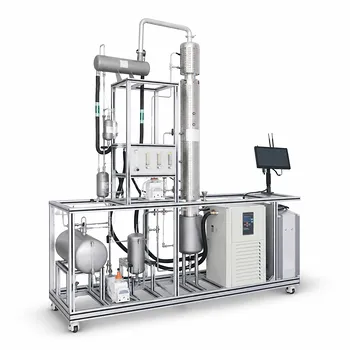
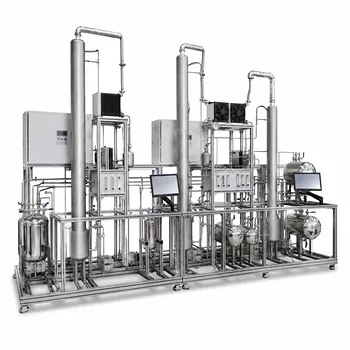
In an atmospheric and vacuum distillation pilot plant, you observe two core separation principles: fractional distillation at ambient pressure for light-to-medium boiling fractions, and vacuum-assisted distillation for heavy, heat-sensitive residues. The unit precisely demonstrates how boiling-point differences drive component separation, with a carefully controlled temperature profile that spans from 95°C at the top of the atmospheric column to over 400°C in the reheated residue feed before the vacuum tower. The vacuum step is the critical enabler—by lowering the system pressure, it drastically reduces the boiling points of heavy hydrocarbons, preventing thermal cracking while allowing students and researchers to isolate vacuum gas oil and vacuum residue.
The pilot plant models industrial crude fractionation by showing that light fractions are separated by a descending temperature gradient at atmospheric pressure, while the heavy bottom is thermally staged into a sub-atmospheric column where reduced pressure, rather than excessive heat, drives the split. This teaches the fundamental pressure–temperature–phase equilibrium relationship that governs all distillation processes.
Fractional Distillation at Atmospheric Pressure
The atmospheric column is the first separation stage, demonstrating how a multi-component mixture splits into distinct product cuts based solely on boiling ranges.
The Preheat and Feed Stage
Crude oil is preheated to 200–240°C before entering the atmospheric column. This initial temperature is high enough to partially vaporize the feed the moment it flashes at the column’s feed tray, yet low enough to avoid thermally cracking the lighter molecules.
This preheat step underscores a vital principle: you must supply enough thermal energy to initiate vapor–liquid equilibrium without degrading the feed. The pilot plant’s feed heater and insulated piping demonstrate how industrial units manage this thermal window.
The Column Temperature Profile and Fraction Boiling Points
Inside the column, a steep temperature gradient forms. The top of the column is the coolest (around 95–100°C), while the bottom operates near 350°C. Each draw-off tray corresponds to a specific boiling-point cut:
- Gasoline fraction: draws at 95–100°C.
- Kerosene: draws at 145–150°C.
- Light diesel: draws at 267–270°C.
- Heavy diesel: draws at 330–335°C.
These fixed draw temperatures are not arbitrary; they mirror the true boiling point ranges of each product. By monitoring the column’s temperature sensors, you directly visualize how vapor–liquid equilibrium creates sharp separations as the vapor rises and cools.
The Principle of Reflux and Tray Efficiency
The pilot plant also demonstrates that a temperature gradient alone is not enough. External reflux (cooled liquid returned to the top of the column) provides the necessary liquid traffic to enhance mass transfer on each tray.
As vapor rises, it encounters colder liquid, partially condensing heavier components and re-vaporizing lighter ones. This counter-current cascade is the engine of fractional distillation, and the pilot plant’s glass viewing sections make this phase interaction observable.
Vacuum Distillation: Processing the Heavy Residue
The atmospheric column’s bottom residue—material that would decompose at higher temperatures—must be separated in a fundamentally different way. This is where the vacuum column becomes the focal point.
Thermal Cracking Prevention Through Pressure Reduction
The residue leaves the atmospheric column at around 350°C and is then heated further to 380–400°C in a fired heater before entering the vacuum column. If this stream were processed at atmospheric pressure, these temperatures would trigger thermal cracking (pyrolysis), breaking large hydrocarbon molecules into unwanted lighter gases and coke.
The vacuum column operates at a significantly reduced pressure, which lowers the effective boiling point of every component. For a heavy hydrocarbon, the boiling point can drop by tens of degrees, allowing separation at temperatures well below its atmospheric decomposition threshold. The pilot plant directly demonstrates this pressure–temperature relationship: by adjusting the vacuum level, the same cut can be vaporized at a much lower temperature.
Separation of Vacuum Gas Oil and Vacuum Residue
Under vacuum, the heavy feed flashes into vapor and liquid. Vacuum gas oil (VGO) is drawn as a distillate side-stream, typically used as a feedstock for catalytic crackers. The heaviest, non-vaporizable fraction becomes vacuum residue, often destined for further visbreaking or coking.
The pilot plant teaches that without vacuum, this cut would be impossible to obtain in a pure, undegraded state. The system’s pressure sensors and sight glasses allow direct observation of flash vaporization and the effect of pressure on phase equilibrium.
The Role of Vacuum Hardware in Pilot-Scale Learning
To achieve sub-atmospheric conditions, the pilot plant integrates vacuum pumps, vacuum-rated seals, and absolute pressure transmitters. This setup shows that seal integrity and pressure control are just as critical as temperature control.
Even a minor air leak into the column will raise the pressure, shifting the boiling points and ruining the separation. This hands-on lesson in system integrity is invaluable for understanding industrial-scale vacuum operations.
Understanding the Trade-offs
No separation principle comes without compromises. The pilot plant explicitly highlights where the advantages of vacuum operation meet practical limits.
Energy consumption. Reheating the residue to 380–400°C and running vacuum pumps adds significant energy cost. The plant demonstrates that while vacuum saves product, it demands a high utility input—a reality students must balance in design.
Coking risk in the heater. Even though the vacuum column prevents cracking during separation, the pre-vacuum heater operates at temperatures where thermal degradation can begin. The pilot plant shows that short residence time and careful tube design are crucial to minimize coke formation before the flash zone.
Equipment complexity and cost. Vacuum-rated columns, condensers, and receivers are more expensive than atmospheric units. The modular design of the pilot plant often showcases how the same column can be reconfigured for atmospheric or vacuum service, making the trade-off visible in terms of additional sealing, instrumentation, and pump requirements.
Limited cut sharpness at lower pressures. Lower pressure reduces relative volatility differences in some systems, potentially requiring more theoretical stages to achieve the same separation quality. The pilot plant’s data logging allows comparison of efficiency metrics between atmospheric and vacuum runs.
How to Apply This to Your Pilot-Scale Study
Use these observations to tailor your experimental objectives or training curriculum.
- If your primary focus is understanding basic fractional distillation: Run the atmospheric column with the standard crude preheat. Map the temperature profile against the drawn fractions, and change the reflux ratio to see how cut purity changes.
- If your primary focus is heavy-fraction separation and thermal sensitivity: Operate the vacuum column and systematically vary the suction pressure. Document how the distillate yield shifts without raising the heater outlet temperature.
- If your primary focus is energy optimization: Measure the fired heater duty and vacuum pump power at different residue preheat temperatures. Find the minimum practical temperature that still yields acceptable VGO recovery while minimizing cracking.
- If your primary focus is process safety and design: Purposely introduce a controlled air leak to illustrate pressure instability, and use the glass sections to observe how even a small tar droplet signals an approaching coking condition in the heater.
The atmospheric and vacuum distillation pilot plant is more than a demonstration of boiling points—it is a living laboratory where pressure–temperature equilibrium, energy management, and thermal stability converge into a single teachable process.
Summary Table:
| Distillation Column | Operating Pressure | Temperature Profile | Primary Fractions | Core Separation Principle |
|---|---|---|---|---|
| Atmospheric Column | Ambient Pressure | 95°C (Top) to 350°C (Bottom) | Gasoline, Kerosene, Light/Heavy Diesel | Fractional distillation based on boiling-point differences |
| Vacuum Column | Sub-atmospheric | 380°C to 400°C (Feed) | Vacuum Gas Oil (VGO), Vacuum Residue | Boiling point reduction to prevent thermal cracking of heavy residue |
Bring Industrial Distillation Processes into Your Lab
To truly master complex chemical engineering concepts like phase equilibrium and vacuum fractioning, students and researchers need hands-on, high-fidelity equipment.
LABPARK provides premium Educational and Vocational Unit Operations Pilot Plants in chemical engineering, bioprocess & biotech, and environmental & water treatment. Designed specifically for universities, research institutes, and enterprises, our pilot plants deliver the safety, reliability, and precision instrumentation required for advanced training and research.
Ready to upgrade your laboratory capabilities? Contact the LABPARK team today to find the ideal pilot plant solution for your institution.
Related Products
- Continuous Sieve-Plate Distillation Pilot Plant for Unit Operations Laboratory Education
- Multi-Functional Special Distillation Educational Pilot Plant
- Multi-Modal Distillation Unit Operations Training Pilot Plant
- Dual-Mode Rectification Pilot Plant for Practical Training Unit Operations
- Multi Functional Membrane Crystallization Educational Unit Operations Pilot Plant
People Also Ask
- How can real-time carbon number prediction improve distillation pilot plants? Optimize control.
- How to select the right activity coefficient model (Wilson, NRTL, UNIQUAC) for distillation pilot plants?
- What are the primary reflux ratio control strategies? Master Distillation Unit Operations
- How does catalyst water concentration affect distillation pilot plant design? Key separation train choices.
- Why is vacuum operation capability an essential feature for a distillation unit operations pilot plant? Unlock Efficiency