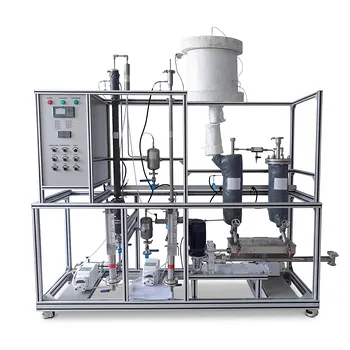
Ensuring safety in a pilot plant handling flammable and explosive materials is fundamentally about designing multiple, independent layers of protection. The most critical systems include explosion-proof structural design, continuous inert gas blanketing to prevent flammable atmospheres, flame arrestors to stop flame propagation, fixed gas detection with automatic alarms, and safety interlocks that trigger emergency shutdowns. These hardware safeguards must be supported by rigorous operating procedures and comprehensive training to create a truly resilient safety architecture.
A safe pilot plant doesn't rely on a single barrier. It uses an integrated defense-in-depth strategy—combining inherent safety in design, engineered controls, monitoring systems, and administrative protocols—to prevent, detect, and mitigate hazards before they can escalate.
The Foundation: Inherently Safe Design
This level stops hazards at the source, before they require active intervention.
Minimizing Leak Points Through Mechanical Integrity
Every joint is a potential leak source. For flammable solvents like ethanol, acetone, or toluene, welded connections are preferred over flanges wherever possible. This drastically reduces the chance of vapor release into the lab environment. The goal is reliable containment as the first line of defense.
Eliminating Ignition Sources at the Equipment Level
The most dangerous ignition source around flammable vapors is often the equipment itself. Explosion-proof enclosures and electrical fittings are mandatory in any area where a flammable atmosphere might occur. For mixing applications, consider replacing traditional agitated vessels with liquid jet mixers. These have no rotating shaft or mechanical seal, eliminating a primary leak and spark source, making them an intrinsically safer choice for educational settings.
Explosion Venting and Structural Integrity
Even with strong prevention, the risk of an internal explosion cannot be zero. The pilot plant structure and vessels must be designed to safely vent an explosion. Standards like NFPA 68 (deflagration venting) guide the integration of relief vents and explosion disks that direct the blast and flame to a safe location, preventing catastrophic equipment rupture.
Creating a Non-Flammable Atmosphere
The core strategy for explosion prevention is to ensure the fuel-air mixture never reaches its flammability limit.
Inert Gas Blanketing and Purging
A nitrogen purging system is essential for feed and product tanks, reactors, and any vessel headspace. By maintaining a continuous low-flow nitrogen blanket, oxygen concentration is kept well below the Limiting Oxygen Concentration (LOC), making ignition impossible. This is the most direct application of NFPA 69 principles.
Strategic Ventilation
Open-frame structural designs and dedicated laboratory exhaust hoods are critical secondary controls. They actively dilute any vapors that escape containment, preventing accumulation near the pilot plant. The ventilation rate must be calculated to keep concentrations safely below the substance's Lower Flammability Limit (LFL).
Continuous Gas Detection
No prevention system is perfect. Therefore, fixed gas detectors placed strategically around the pilot plant provide real-time monitoring. These detectors are tied to automatic alarms that activate long before vapor reaches dangerous levels, giving operators time to intervene or triggering an automatic system response.
Layered Control and Automatic Intervention
When manual operation and basic design aren't enough, active safety systems take over.
The Role of Safety Instrumented Systems (SIS)
Modern pilot plants separate the basic control system from the safety system. A Safety Instrumented System (SIS) is a dedicated layer designed to take the plant to a safe state on demand. It operates independently of the Basic Process Control System (BPCS), meaning a control system failure won't disable the safety function.
Voting Logic for Reliability and Availability
Pure safety often conflicts with operational continuity. A sensor might fail and cause a false emergency trip. To balance this, SIS can use redundant voting logic:
- 1oo2 (1 out of 2) : Very safe, but a single sensor failure causes a false shutdown, which is frustrating in a training environment.
- 2oo3 (2 out of 3) : This system shuts down only when two of three sensors detect a hazard. It achieves high safety integrity while dramatically reducing spurious trips, making it ideal for educational pilot plants demonstrating industry practices like IEC 61511 and the ALARP principle.
Automatic Interlocks and Emergency Shutdown
A safety interlocking system is the direct action arm. It can automatically shut off fuel supply, stop pumps, close valves, and initiate maximum inert gas flow if a critical parameter—like high reactor pressure, high temperature, or a gas leak—is breached. This system must include a single, clearly marked emergency shutdown (ESD) button that immediately brings all equipment to its fail-safe position.
Human and Procedural Safeguards
The best engineered systems can be defeated by human error or a lack of preparedness.
Rigorous Training and Personal Protective Equipment (PPE)
All personnel must undergo documented safety training and sign safety commitments. The minimum PPE is non-negotiable: lab coats, protective goggles, and task-specific gloves (chemical-resistant, heat-resistant). Training should include the location and use of emergency showers, eyewash stations, and first aid kits.
Structured Emergency Protocols
Procedures must be written, rehearsed, and accessible. This includes:
- Emergency Shutdown: A step-by-step guide for safely stopping the pilot plant during a loss of control.
- Utility Outages: Clear plans for how the system will fail safely during power, water, air, steam, or inert gas loss.
- Major Releases: Instructions for containing a spill of combustible chemicals.
- Waste Disposal: Standard steps for hazardous waste handling and equipment cleanup to prevent cross-contamination.
Laboratory Infrastructure Controls
The lab itself is a safety system. Master shut-off valves for water, electricity, and gas must be immediately accessible. Any process generating toxic or irritating vapors must be entirely enclosed within a fume hood. Pre-operational and post-shutdown utility line checks become a critical routine.
Understanding the Trade-offs
Objective safety design requires acknowledging real-world limitations.
- Inerting vs. Complexity: Continuous nitrogen blanketing adds operational cost and complexity, requiring inert gas supply management and strict oxygen monitoring. For very small-scale, open-frame equipment in a fume hood with low solvent inventory, this may be a trade-off against dilution ventilation alone, but for any enclosed vessel, it's mandatory.
- Liquid Jet Mixers vs. Process Needs: A liquid jet mixer removes a spark and leak source but cannot provide the high-shear mixing an agitator can. If the educational goal is to study agitator dynamics, you must accept the added risk and implement rigorous seal monitoring and maintenance.
- 2oo3 Voting vs. Simplicity: A 2oo3 system increases the sensor count, wiring, and programming logic, which can confuse novice students. A simpler 1oo1 (single sensor) interlock is easier to understand but offers no fault tolerance. The balance depends on whether the plant's primary goal is teaching advanced automation or basic process principles.
- Special Hazards Deserve Special Systems: Alkali metals (sodium, potassium) react violently with water. Standard sprinkler systems are a disaster here. Pilot plants simulating these reactions must have sand-based or dry powder extinguishers, excess-flow valves, and rigorously moisture-free feed systems under nitrogen, demonstrating that safety systems are not one-size-fits-all.
Making the Right Choice for Your Goal
Select and layer these safety systems based on your primary objective:
- If your primary focus is educating students on basic unit operations: Prioritize robust simple interlocks (1oo1), highly visible gas detection alarms, and exhaustive, rehearsed manual emergency procedures. Keep the automated safety logic as transparent as possible to teach the "why."
- If your primary focus is research with novel or energetic chemistry: The foundation must be a thorough process hazard analysis (PHA). Then, over-engineer the containment, nitrogen inerting, and explosion venting. Use flexible SIS configurations where you can adjust trip setpoints as the process is better understood.
- If your primary focus is demonstrating industry-standard best practices (as in an advanced vocational lab): Implement the full IEC 61511 layer-of-protection analysis framework. Deploy a 2oo3 voting SIS on a DCS/PLC platform, fully separate from the BPCS, and integrate NFPA 68/69 compliant venting and suppression.
Every safety system you choose must work together as a single, integrated defense that protects not only the equipment, but crucially, the people whose training and discovery will define the future of the field.
Summary Table:
| Safety Category | Key Controls | Primary Safety Function |
|---|---|---|
| Inherently Safe Design | Welded connections, Ex-proof equipment, Relief vents | Minimizes leak points and eliminates potential ignition sources. |
| Atmosphere Control | Nitrogen purging/blanketing, Ventilation, Gas detectors | Prevents flammable vapor accumulation & maintains low oxygen levels. |
| Active Controls (SIS) | Safety interlocks, 2oo3 voting logic, Emergency Shutdown (ESD) | Automatically drives the system to a fail-safe state during anomalies. |
| Procedural Safety | Structured emergency protocols, PPE, Rigorous operator training | Ensures human preparedness and correct manual intervention. |
Build a Safer Future for Chemical Engineering Education
At LABPARK, we supply state-of-the-art Educational and Vocational Unit Operations Pilot Plants in chemical engineering, bioprocess & biotech, and environmental & water treatment for universities, research institutes, and enterprises. We prioritize safety by integrating industrial-grade safeguards—such as automated safety interlocks, inert gas blanketing, and explosion-proof designs—into all our pilot scale systems.
Equip your facility with reliable, industry-compliant training plants. Contact our expert team today to discuss your project!
Related Products
- Fixed Bed Gas Solid Catalytic Reaction Educational Pilot Plant
- Multi Pump Fluid Transport Process Piping Unit Operations Training Pilot Plant
- Carbon Dioxide Hydrogen Methanol Synthesis Educational Unit Operations Pilot Plant
- Ethyl Acetate Synthesis Unit Operations Pilot Plant for Practical Training
- Natural Product Extraction Unit Operations Training Pilot Plant
People Also Ask
- How do reactor pilot plants safely study gas-solid reactions? Master kinetics with thermal & flow control.
- How does the Mears criterion evaluate transport resistance? Key Guide to Intrinsic Kinetics
- Fluidized vs. Fixed Bed Reactors: Comparing Heat & Complexity in Pilot Plants
- Why is a multibed configuration necessary for exothermic reactions? Optimize your pilot plant trajectory.
- What are the differences between pseudohomogeneous and heterogeneous models in pilot plants?