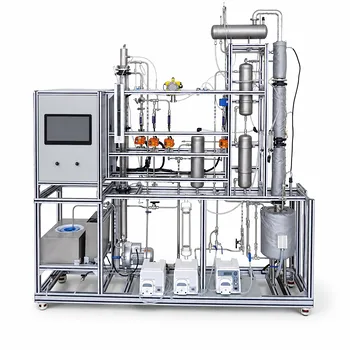
Your priority is airflow—before, during, and after an experiment. The core ventilation and fume hood rules for educational pilot plants are unambiguous. Start the exhaust system before any work begins inside the hood, keep the glass sash at the manufacturer’s designated operating height, never place heating devices directly on the hood surface (always use insulation pads), and run the exhaust for an additional 3 to 5 minutes after operations cease to purge residual vapors. Furthermore, keep the ventilation paths and the small sinks inside the hood completely free of flammable materials, waste, and debris.
Proper fume hood use in a pilot plant is not a single-step task. It is a sequential, three-phase protocol—startup, containment, and purging—designed to eliminate the invisible hazards of volatile solvents and toxic gases before they ever reach a person’s breathing zone. The “why” behind each step is as critical as the step itself.
The Non-Negotiable Rules of Fume Hood Operation
These directives exist because pilot plants frequently handle volatile solvents, generate toxic off-gases, or cultivate biological agents that demand a negative-pressure barrier. The rules form a closed loop. Miss one link, and you compromise the entire safety chain.
Starting the Exhaust Before You Start the Work
Never walk up to a hood and begin manipulating glassware or charging a reactor without verifying airflow. Starting the exhaust system first establishes a steady, inward velocity of air. This creates the aerodynamic curtain that prevents fumes from escaping into the lab.
In an educational setting, where multiple operators may share a pilot plant bay, the assumption that “someone else turned it on” is a leading cause of exposure. Make it a personal, tactile check: confirm the exhaust flow indicator, listen for the fan, or check the pressure differential display before your hands carry any substance over the sill.
The Sash as Your Primary Barrier
The glass sash is not a convenience item to be pushed fully open for easier access. Its purpose is to maintain the correct face velocity. When the sash is raised above the operating height—often marked by a manufacturer’s arrow or a physical stop—the hood’s containment ability drops exponentially.
For pilot-scale glass reactors or fermenters that are deeper than standard bench equipment, the temptation to lift the sash to maneuver components is high. Resist it. If the apparatus truly does not fit with the sash at the proper height, then the unit is not appropriately matched to that hood. The correct fix is either resizing the setup or using a walk-in hood with a rigid, certified containment envelope—never overriding the sash stop.
Heat, Hoods, and the Insulation Pad Rule
Pilot plant reactions often require heating mantles, hot plates, or oil baths. The primary reference’s instruction to place an insulation pad underneath these devices is often overlooked, yet critical. Many fume hood liners, especially those made of fiberglass-reinforced polyester or other composite materials, can degrade or even ignite when exposed to sustained high temperatures.
An insulation pad does double duty. It protects the hood’s structural integrity and prevents a thermal runaway scenario where heat transfers to residual chemicals that may have dripped onto the work surface. This is particularly relevant after a pilot run, when trace solvents or cleaning agents could be present.
The 3-to-5-Minute Post-Run Purge
Stopping the exhaust the moment you kill the power to the reactor is a classic mistake. The space inside the hood is still saturated with whatever vapors were generated during the reaction, and the pilot plant’s piping and open vessels continue to off-gas.
Running the exhaust for an additional 3 to 5 minutes scrubs the interior volume with multiple air changes. It eliminates the silent risk of the next student or technician opening the sash and receiving a cloud of residual hydrogen chloride, solvent fumes, or aerosolized biological material directly to the face.
Clear the Pathways and the Sinks
Blocking the ventilation slots at the back of the hood—with reagent bottles, waste beakers, or rags—disrupts the designed airflow pattern. Air no longer sweeps the full work area; instead, it creates dead zones and turbulent eddies that can trap contaminants.
The small cup sink inside many pilot plant hoods is equally critical. Dumping waste solvents down that sink without proper traps, or leaving solid debris to clog it, can create a direct pathway for flammable vapors to travel backward from a waste container into the hood. Keep the sink clear and use it only with the correct waste capture canisters downstream.
Why These Rules Matter in a Pilot Plant Lab
A pilot plant is not a benchtop flask. You are working with scaled-up volumes, higher energy inputs, and often a continuous flow of material. That magnification turns a minor ventilation lapse into a significant event.
Pilot-Scale Volumes Increase Hazard Magnitude
A small fume cupboard spill of 100 milliliters of acetone is an annoyance. A pilot plant leak of 10 liters inside the same hood is a fire-and-explosion risk that can overwhelm the exhaust capacity. The sash height and exhaust flow become exponentially more important when the inventory of volatile material inside the enclosure is substantial. The 3-to-5-minute purge, which might feel overly cautious for a single beaker, becomes an absolute necessity for a distillation column or a fermenter off-gassing CO₂ and ethanol vapor.
Gases Are Only the Obvious Hazard
While the primary rule states that operations generating toxic, volatile, or irritating gases must be conducted in fume hoods, educational labs often underestimate non-obvious sources. Opening a sealed reactor after a bioprocess run can release aerosols loaded with active biological agents. Pouring warm solvent from a receiver generates vapor even if no visible “gas” is seen. The fume hood’s containment handles particulates, mists, and biological aerosols just as surely as visible fumes—but only if the airflow is established and the sash is positioned correctly.
Integration with the Broader Safety System
Ventilation alone is insufficient. It must integrate with the pilot plant’s emergency shutdown, gas detection, and utility fail-safe procedures. If a power outage stops the exhaust fan, the immediate action plan—detailed in the supplementary references—must kick in. Trained operators need to know: close the sash fully to create a passive barrier, shut off the process heating and material feeds, and evacuate according to the spill and release protocols. The fume hood is one component of a layered defense that includes PPE, training, and storage inspection. But it remains the frontline engineering control that captures hazards at their source.
Understanding the Trade-Offs and Blind Spots
Every safety rule involves a practical trade-off. Acknowledging these openly is essential for trust and for creating protocols that people will actually follow.
Containment vs. Accessibility
A sash held at 18 inches provides optimal face velocity but severely restricts arm movement when assembling tall columns or glass bioreactors. Operators may be tempted to lift the sash “just for a moment.” The only safe response is to plan the work in stages: assemble what you can outside the hood, pre-configure the reactor components so that the final connections require minimal dexterity, and use remote-operation tools or long-handled valve actuators. If the task truly cannot be performed at the correct sash height, then the hood itself is the wrong containment solution for that pilot rig.
The Illusion of “Clean” Air
Odor is not a reliable indicator of containment failure. Many highly toxic or hazardous vapors—like carbon monoxide or methylene chloride—have poor or misleading warning properties. A pilot plant operator may feel safe because they “can’t smell anything,” while in reality the hood’s face velocity has dropped below 80 linear feet per minute and vapors are spilling out at waist level. This is why objective airflow checks, sash position alarms, and fixed gas monitors are non-negotiable supplements to the basic rule set.
Purging vs. Operational Efficiency
The 3-to-5-minute post-run exhaust requirement can feel wasteful in a teaching lab with tight scheduling. Students may want to immediately open the hood to dismantle their setup for the next group. Cutting this purge short, even once, normalizes a high-risk behavior. The better trade-off is to design the experimental schedule with built-in ventilation time and to train students that the purge is part of the run, not an optional appendage.
The Sink Trap Paradox
Using the in-hood sink as a temporary waste catch seems convenient, but it creates a hidden vapor return path. The water trap in a sink evaporates over time, especially when hot equipment is nearby. Once that trap is dry, the hood is directly connected to the drain piping, which may harbor flammable or reactive vapors. The sink must always be capped when not in active use for a purpose that includes a liquid-seal waste container, or it must be inspected for water fill before each run.
Making Ventilation Safety a Reflex, Not a Checklist
Adherence to fume hood guidelines fails when they are treated as a memorized list of disconnected rules. A pilot plant is a dynamic space. Safety must become a conditioned habit, supported by facility design.
Designing the Training Around the “Why”
Every pre-lab session for a pilot plant experiment should include a 5-minute segment that not only states the rules but shows the consequences of ignoring them. Demonstrate, with a smoke tube or a velocity meter, what happens to the containment cloud when the sash is raised 4 inches too high. Show the thermal image of a hood liner with and without an insulation pad under a heating mantle. When operators understand the physical mechanism, they internalize the behavior far more deeply than when they merely sign a safety commitment form.
Environmental Cues That Enforce Protocol
The lab itself can act as a coach. Install permanent, clearly marked arrows on every hood showing the maximum safe sash height (in both centimeters and inches). Place a small, durable sign directly on the sash handle: “Exhaust ON first. Purge 5 min after.” Locate a thermometer strip on the work surface in the zone where hot equipment is most likely to be placed. These are passive, constant reinforcements that reach an operator even on the most stressful pilot run day, when mental bandwidth is consumed by an unexpected process fluctuation.
Integrating Ventilation with Emergency Response
Fume hood protocols are incomplete without linking them to the lab’s master shutdown systems. Every ventilation training module must be cross-referenced with the location and activation method for the master gas, water, and electricity cut-offs, as well as the eyewash stations and emergency showers. In a pilot plant release event, the operator’s first action might be to close the hood sash fully while a colleague initiates an emergency alarm and ventilation purge boost. This seamless integration of control, containment, and egress is what turns a near miss into a non-event.
Applying These Guidelines to Your Specific Goals
Your pilot plant may be teaching unit operations, running a bioreactor for enzyme production, or conducting electrolysis experiments. The fundamentals remain identical, but the emphasis shifts.
- If your primary focus is high-temperature distillation or catalysis studies: Pay obsessive attention to the insulation pad rule and confirm your hood lining is rated for the sustained temperatures your heating mantles or oil baths will reach. Never substitute a makeshift ceramic tile for a pad without verifying vapor barriers.
- If your primary focus is bioprocessing with live cultures or volatile metabolites: Treat the post-run purge as an absolute biological safety step, not just chemical hygiene. Combine it with a strict wipe-down protocol before the sash is raised, and pre-validate that the exhaust system is sufficient for the oxygen consumption and CO₂ output of your fermenter.
- If your primary focus is handling flammable solvents or hydrogen-rich off-gas streams: Go beyond the basic ventilation rules. Integrate continuous LEL (Lower Explosive Limit) monitoring inside the hood, ensure all electrical equipment is rated for the classified area, and physically eliminate any ignition source from the airflow path.
- If your primary focus is training a rotating cohort of students in a shared pilot plant: Engineer the scheduling around the purge times. Make it physically impossible to turn in a post-lab report without documenting the start-exhaust, sash-height-check, and post-purge timestamps. The goal is to build a lifelong safety reflex.
Your fume hood is the one piece of equipment standing between a pilot plant operator and a life-altering inhalation injury. Treat it as a dynamic, active barrier that requires deliberate, informed engagement at every phase—startup, run, and shutdown.
Summary Table:
| Fume Hood Phase / Area | Core Safety Rule | Primary Safety Purpose |
|---|---|---|
| 1. Startup | Turn exhaust system ON before starting work | Establishes inward airflow velocity to prevent fume escape |
| 2. Containment | Keep sash at designated operating height | Maintains face velocity and acts as a physical barrier |
| 3. Heating | Place insulation pads under heating devices | Prevents thermal degradation and ignition of the hood liner |
| 4. Purging | Run exhaust for 3 to 5 minutes post-operation | Flushes out residual hazardous vapors and aerosols |
| 5. Housekeeping | Keep vents, pathways, and cup sinks clear | Avoids airflow turbulence and hazardous vapor backflow |
Elevate Lab Safety and Hands-On Learning with LABPARK
Ensuring absolute safety in educational laboratories requires both rigorous protocols and reliable engineering controls. LABPARK designs and provides state-of-the-art Educational and Vocational Unit Operations Pilot Plants in chemical engineering, bioprocess & biotech, and environmental & water treatment. Built to meet the highest safety standards, our systems help universities, research institutes, and enterprises train the next generation of engineers safely and effectively.
Ready to upgrade your laboratory with compliant, high-performance pilot plants? Contact LABPARK today to discuss your custom project requirements!
Related Products
- Fixed-Bed Chemical Reaction and Gas Dust Tar Removal Unit Operations Pilot Plant
- Multi-Functional Special Distillation Educational Pilot Plant
- Multi-Reactor Educational Pilot Plant for Reaction Engineering Unit Operations
- Absorption and Desorption Educational Unit Operations Pilot Plant
- Rising and Falling Film Evaporation Educational Unit Operations Pilot Plant
People Also Ask
- When to transition from PID to adaptive control in pilot plants? Key process indicators.
- How do deviations in estimating latent heat impact pilot plant thermal systems? Avoid hardware mis-sizing.
- Why Compare Predicted and Experimental Excess Enthalpy? Key to Accurate Pilot Plant Scale-up
- How to study gasification in pilot plants? Compare exit gas composition & efficiency
- Why Use PTFE & Hastelloy in Chemical Pilot Plants? Prevent Corrosion & Ensure Safety