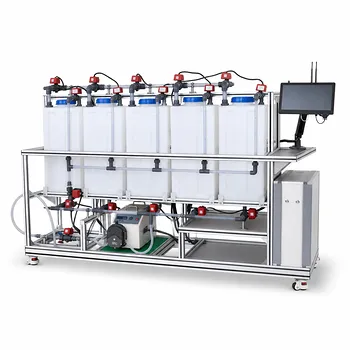
Microalgae remove nutrients through photosynthetic growth, while protozoa improve clarification by consuming suspended microorganisms and organic particles. In wastewater treatment pilot plants, these organisms support nutrient recovery, effluent polishing, and biological process evaluation. Their growth and population dynamics also provide information about how stable and effective the treatment system is.
Microalgae primarily assimilate dissolved inorganic nutrients, while protozoa regulate suspended microbial populations. Together, they help pilot plants test nutrient removal, biomass production, clarification, sludge behavior, and biological stability before full-scale implementation.
How Microalgae Support Wastewater Treatment
Assimilating Dissolved Nutrients
Microalgae such as Chlorella and Scenedesmus use dissolved inorganic nutrients, particularly nitrogen and phosphorus, for photosynthetic growth. This converts pollutants in the wastewater into algal biomass that can potentially be harvested.
Their role is therefore both remediation and nutrient recovery: nutrients are removed from the liquid phase while becoming part of a usable biological product.
Supporting Photosynthetic Treatment
Through photosynthesis, microalgae contribute oxygen to the treatment environment. This can support aerobic microbial activity and help biological reactors degrade organic matter, although the amount of oxygen produced depends on light, algal concentration, loading, and reactor conditions.
Pilot plants allow engineers to evaluate these relationships under controlled hydraulic and operating conditions.
Producing Single-Cell Protein
The resulting algal biomass can have value as single-cell protein or as a feedstock for further processing. This does not make every wastewater-grown algal culture suitable for direct use, however; contaminants and regulatory requirements must be assessed before any recovery application.
Testing Nutrient-Recovery Strategies
Microalgal pilot systems help researchers determine how effectively a particular wastewater supports algal growth and nutrient removal. They can also reveal whether harvesting the biomass is practical and whether residual nutrients remain in the treated water.
How Protozoa Improve Biological Treatment
Consuming Suspended Bacteria
Protozoa, including ciliates, flagellates, and amoebae, feed on free-swimming bacteria and other suspended microbial material. This grazing reduces dispersed biological solids in the liquid phase.
The result is often improved effluent clarity, because fewer suspended microorganisms remain in the treated water.
Regulating the Microbial Community
Protozoa interact dynamically with bacteria and other microorganisms by consuming biomass and competing for available nutrients. This creates a biological balance that influences organic degradation and the structure of the activated-sludge community.
Their activity is part of the food web within the reactor, rather than a separate polishing step operating independently from bacterial treatment.
Supporting Solids Separation
By reducing dispersed bacteria, protozoa can contribute indirectly to better floc structure and sludge settling characteristics. Pilot plants can examine these effects while varying aeration, organic loading, solids retention time, and hydraulic conditions.
Improved settling helps separate biological solids from the final effluent.
Indicating Process Health
Protozoan populations are useful biological indicators of reactor condition. Their abundance and community composition can provide clues about treatment performance, organic loading, aeration conditions, and system stability.
Monitoring protozoa does not replace chemical and physical measurements, but it adds information that conventional tests may not capture quickly.
Why Pilot Plants Matter
Reproducing Realistic Conditions
Pilot plants provide a controlled physical system in which researchers can expose microbial communities to realistic wastewater flows and changing waste-stream conditions. This makes it possible to study microbial performance without the cost or risk of immediately modifying a full-scale facility.
Evaluating Microbial Interactions
Wastewater treatment depends on complex interactions among bacteria, microalgae, protozoa, and other microorganisms. Pilot-scale operation helps reveal how these populations respond to nutrient availability, organic matter, hydraulic changes, and solids separation.
Optimizing Treatment Parameters
Engineers can use pilot plants to adjust biological oxidation, nutrient removal, sludge settling, and harvesting conditions. The resulting data supports process design and reduces uncertainty before scale-up.
Investigating Specialized Contaminants
Pilot plants can also model more difficult waste streams, including those containing nanoparticles or other industrial contaminants. In such cases, biological treatment may be combined with processes such as membrane filtration, sedimentation, or advanced oxidation.
Microalgae and protozoa remain relevant to the biological component, while specialized separation and destruction methods address contaminants that organisms cannot reliably remove.
Understanding the Trade-offs
Algal Biomass Must Be Harvested
Nutrient assimilation is only a complete treatment benefit if the resulting algal biomass is separated from the water. Otherwise, nutrients may return to the liquid phase when the biomass decays.
Biological Performance Is Sensitive to Conditions
Light availability, temperature, nutrient ratios, dissolved oxygen, organic loading, and hydraulic conditions can all affect microalgal and protozoan populations. Results from a pilot plant must therefore be interpreted in relation to its operating conditions.
Protozoa Are Indicators, Not Single-Variable Controls
A change in protozoan abundance can signal a process disturbance, but it does not identify the cause by itself. Operators should interpret biological observations alongside measurements such as dissolved oxygen, suspended solids, nutrient concentrations, settling behavior, and organic removal.
Recovery Claims Require Contaminant Assessment
Biomass produced from wastewater may contain accumulated contaminants. Before using it for protein, feed, fertilizer, or other purposes, the material requires appropriate characterization and regulatory evaluation.
Making the Right Choice for Your Goal
Pilot plants are most effective when biological observations are connected to measurable treatment objectives.
- If your primary focus is nutrient removal: Use microalgal growth and biomass harvesting studies to evaluate nitrogen and phosphorus assimilation and recovery.
- If your primary focus is effluent clarity: Monitor protozoan grazing and suspended-solids behavior alongside settling and turbidity measurements.
- If your primary focus is process stability: Track protozoan communities as biological indicators, while confirming their interpretation with chemical and operating data.
- If your primary focus is scale-up: Use pilot-scale microbial performance data to optimize loading, hydraulic, oxidation, separation, and harvesting conditions before full-scale design.
Understanding these microorganisms as both treatment agents and process indicators enables more reliable wastewater treatment design and scale-up.
Summary Table:
| Organism or focus | Primary role | Key benefits | Important considerations |
|---|---|---|---|
| Microalgae | Assimilate nitrogen and phosphorus through photosynthetic growth | Nutrient removal, biomass production, oxygen generation, and nutrient recovery | Requires suitable light, temperature, nutrient balance, and effective biomass harvesting |
| Protozoa | Consume suspended bacteria and organic particles | Improved effluent clarity, solids separation, and biological process monitoring | Interpret population changes with dissolved oxygen, solids, nutrient, and settling data |
| Pilot plant evaluation | Test microbial interactions under controlled, realistic conditions | Supports process optimization, performance validation, and lower-risk scale-up | Results depend on hydraulic loading, organic loading, aeration, and operating conditions |
| Specialized wastewater treatment | Combine biological treatment with filtration, sedimentation, or advanced oxidation | Addresses difficult contaminants, including nanoparticles and industrial pollutants | Biological treatment may require additional separation or destruction processes |
Planning a more reliable wastewater treatment process? Contact LABPARK to discuss an Educational or Vocational Unit Operations Pilot Plant tailored to your objectives. LABPARK supports universities, research institutes, and enterprises with pilot-scale systems for environmental and water treatment, as well as chemical engineering and bioprocess and biotech applications. Evaluate microalgal nutrient removal, protozoan-driven clarification, biomass harvesting, sludge behavior, process stability, and scale-up conditions with practical equipment designed for meaningful testing and training.
Related Products
- Solid Waste Pyrolysis and Refining Educational Pilot Plant for Unit Operations
- Dual-Mode Rectification Pilot Plant for Practical Training Unit Operations
- Thermal Desorption Exhaust Gas and Tail Water Treatment Educational Pilot Plant
- Electrochemical Water Treatment Educational Unit Operations Pilot Plant
- Natural Product Extraction Unit Operations Training Pilot Plant
People Also Ask
- How do educational unit operations pilot plants bridge theory and design? Bridge the Engineering Gap
- How do unit operation requirements differ between traditional chemical processes and bioprocesses? Build Better Pilot Plant Curricula
- How do educational unit operations pilot plants address safety and waste management when scaling up?
- How do educational unit operations pilot plants bridge theory and industrial process development? Hands-On Learning
- How can unit operations pilot plants demonstrate simultaneous removal of light and heavy impurities? Configure a modular setup