Pilot plants are the critical bridge between theory and commercial reality.
Unit operations pilot plants for solid dosage forms provide a controlled but realistic environment where students and engineers physically encounter the messy, non-linear behavior of powders and process equipment. By operating mills, blenders, and tablet presses at a meaningful scale, trainees learn exactly how scale-dependent forces—impeller speed, dwell time, bed depth—can cause blend segregation, tablet capping, or inconsistent potency. This experiential training transforms abstract scale-up principles into practiced risk-mitigation skills.
The skill of managing scale-up is built on direct, sensory understanding: feeling how a powder mass flows differently, seeing segregation patterns, and reacting to process deviations in real time. Unit operations pilot plants condense years of industrial experience into a safe, educational laboratory, giving future engineers the confidence to diagnose and prevent the failures that emerge only when you leave the bench.
The Scale-Up Puzzle: Why Laboratory Success Can Fail at Production
The leap from a 0.5 kg R&D blend to a 100 kg engineering batch is not just a matter of multiplying quantities. The physical environment changes dramatically, and with it, the behavior of every particle.
The Hidden Instability of Changing Surface-to-Volume Ratios
When you scale a V-shell blender from 3 feet to a multi-story commercial unit, the surface-area-to-volume ratio collapses. Heat transfer, moisture evaporation, and shear distribution all shift, creating hot spots or dead zones that never appeared at the bench.
Segregation and Flow: Adversaries That Amplify with Scale
A perfectly uniform laboratory blend can desegregate horrifically as it flows through a large hopper. Fine API particles percolate downward, while coarser excipients roll to the edges. Without feeling that separation happening in a pilot-scale handling system, an engineer may never predict the potency drift that shows up in finished tablets.
Mechanical Stress and Tablet Capping
Compaction forces that worked beautifully on a single-station eccentric press often fail on a rotary press producing thousands of tablets per minute. Dwell time, turret speed, and pre-compression all become critical. Pilot plant tablet presses teach how these parameters interact to cause capping or lamination long before a commercial batch is lost.
How Pilot Plants Build Competence Through Immersive Learning
Unit operations pilot plants recreate the physical reality of manufacturing, forcing trainees to apply engineering first principles to a live process.
Simulating an Industrial Process, Not a Demonstration
These plants handle granules, binders, and lubricants in dynamic conditions—continuous blenders, fluid bed dryers, high-shear granulators. Students learn that powder flowability can change mid-batch, that drying endpoint determination is an art tied to fluidization velocity and inlet air temperature, and that granule over-wetting leads to downstream milling problems.
Turning Dimensional Analysis into Muscle Memory
Abstract concepts like Reynolds number, Froude number, or power number come to life. By varying impeller speed in a granulator, the trainee sees how shear regime directly determines granule density. By changing feed rate in a continuous blender, they observe how residence time distribution affects blend uniformity. This physical cause-and-effect cements the scaling correlations that textbooks can only hint at.
Embedding Design of Experiments into Routine Practice
Instead of one-factor-at-a-time tinkering, pilot plants are ideal for running structured DoE. Trainees can study how feed rate, screw speed, and screen size in a milling step simultaneously influence particle size distribution. Because the experiments happen on a system that mirrors real equipment, the resulting models carry far more predictive weight and teach the discipline of statistically grounded process development.
From Empirical Art to Predictive Science: Training for the Future
Modern industrial strategy is moving away from expensive, iterative scale-up runs. Pilot plants are the platform where this shift becomes a working skill.
Validating Simulation Models with Physical Truth
Digital scheduling and process simulation tools are only as accurate as their assumptions. A fluidized bed drying model that looks perfect in software can fail because it ignores wall friction or inlet humidity fluctuations. In a pilot plant, students collect real temperature profiles, moisture curves, and pressure drops, then feed that data back into the simulation. They learn to calibrate models against physical reality—the single most powerful skill for de-risking a scale-up.
Demystifying Continuous Manufacturing
Continuous processing collapses the scale-up challenge because the development-scale equipment and the production line run at the same flow rate; only the run time changes. Pilot plants with continuous blenders or continuous direct compression lines let students study steady-state dynamics, residence time distribution, and real-time process analytical technology (PAT) control. They experience firsthand how a disturbance at the feeder is measured and corrected without stopping the line, building the mindset needed for fully continuous solid dosage production.
Building the Scientific Foundation for a “Right-First-Time” Scale-Up
By operating pilot-scale equipment, students learn to recognize when a step is intrinsically risky—difficult solids handling, high-pressure granulation, or unfamiliar continuous technology. They practice gathering reaction enthalpies, monitoring material corrosion, and developing failure scenarios like backup unit operations or safety interlocks. This rigorous hazard-by-design approach eliminates the trial-and-error mentality that once plagued pharmaceutical scale-up.
Understanding the Limitations: What Pilot Plants Cannot Do
An honest assessment must acknowledge that even the best pilot plant has boundaries, and conflating pilot-scale success with commercial-readiness can be dangerous.
Not Every Nuance of Mega-Scale Equipment Translates
A pilot-scale fluid bed dryer may not replicate the exact air distribution malformations of a 1000 kg unit. Wall effects, feed frame design, and excipient sourcing can still introduce surprises. The pilot plant teaches the core physics, but it does not guarantee that a 1/10th-scale batch will be identical to a full commercial lot.
Cost and Time Can Constrain Exploration
Setting up and cleaning a pilot-scale granulation suite takes resources. Curricula must balance the depth of hands-on experimentation with the breadth of theoretical design, ensuring that students also learn the modeling and statistical tools to extrapolate beyond what they physically observe.
The Real World is Messier
While pilot plants introduce variability, they still operate in a controlled academic setting. Students need supplementary training in GMP documentation, change control, and the vendor-specific idiosyncrasies that appear only on a real production floor. The pilot plant builds judgment; it does not replace industrial experience.
Making the Right Investment in Training for Solid Dosage Scale-Up
The design of an educational program—or of your own professional development—should map directly to the scale-up challenges you most need to conquer.
- If your primary focus is building deep, tactile mastery of powder behavior and segregation risks: Prioritize a pilot plant that includes a full powder handling train—bin blenders, hoppers, and gravity-fed tablet presses—so you can see how blend uniformity is preserved or destroyed through the sequence.
- If your primary focus is preparing the workforce for continuous manufacturing: Invest in a continuous blending and direct compression platform with integrated NIR or Raman probes, and build exercises around Residence Time Distribution (RTD) modeling and real-time control loop tuning.
- If your primary focus is bridging the gap between simulation and physical scale-up: Use pilot-scale equipment as a data factory: force students to predict a drying curve or granule size distribution using a first-principles model, then run the experiment, diagnose the mismatch, and iteratively refine the model until it is trustworthy.
- If your primary focus is reducing scale-up risk for a specific difficult compound: Design a campaign that mirrors a commercial process—starting with a cohesive API prone to sticking—and use the pilot plant to systematically evaluate mill speed, lubricant blending time, and compression force, generating the design space that will guide the engineering batch.
Hands-on confrontation with real material behavior at a plausible scale is what turns a knowledgeable theoretician into a scale-up professional. The pilot plant is the gym where that transformation occurs.
Summary Table:
| Scale-Up Challenge | Physical Impact | Pilot Plant Training Solution |
|---|---|---|
| Surface-to-Volume Ratio | Heat transfer & shear distribution shifts | Dynamic processing in fluid beds & granulators |
| Segregation & Flow | API potency drift in large hoppers | Hands-on powder flow & handling management |
| Mechanical Stress | Tablet capping & lamination on rotary presses | Parameter optimization (dwell time, turret speed) |
| Model Validation | Simulation mismatch with physical reality | Real-time data collection & model calibration |
Elevate Your Engineering & Process Training with LABPARK
Bridging the gap between classroom theory and industrial reality requires hands-on experience. LABPARK provides state-of-the-art Educational and Vocational Unit Operations Pilot Plants designed for universities, research institutes, and enterprises.
Our advanced pilot plants span key disciplines to prepare your students and engineers for real-world scale-up challenges:
- Chemical Engineering & Solid Dosage
- Bioprocess & Biotechnology
- Environmental & Water Treatment
Equip your facility with the tools to build practical troubleshooting, model validation, and process control skills. Contact LABPARK today to discuss your customized training solutions!
Related Products
- Solid Waste Pyrolysis and Refining Educational Pilot Plant for Unit Operations
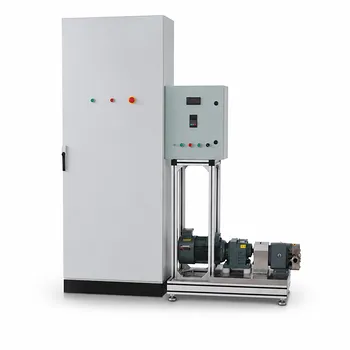
- Quantitative Dosing and Liquid Flow Control Educational Unit Operations Pilot Plant
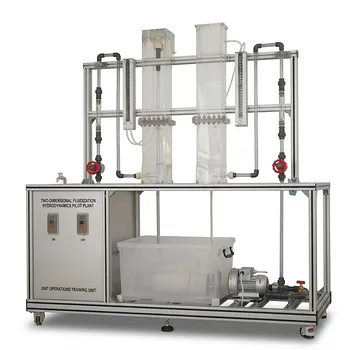
- Two-Dimensional Fluidization Hydrodynamics Educational Pilot Plant for Unit Operations Training
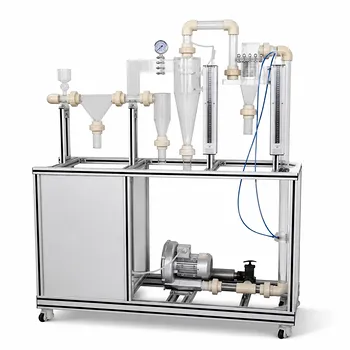
- Gas-Solid Heterogeneous Separation Demonstration Educational Unit Operations Pilot Plant
- Multi Pump Fluid Transport Process Piping Unit Operations Training Pilot Plant
People Also Ask
- How do educational unit operations pilot plants bridge theory and design? Bridge the Engineering Gap
- How do educational unit operations pilot plants address safety and waste management when scaling up?
- When to transition from PID to adaptive control in pilot plants? Key process indicators.
- Why is the chemical plant startup schedule crucial? De-risk scale-up with pilot plants.
- How to study gasification in pilot plants? Compare exit gas composition & efficiency