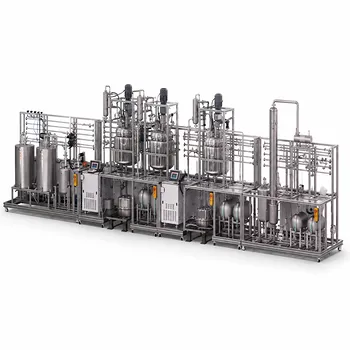
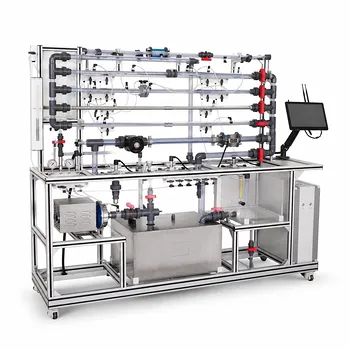
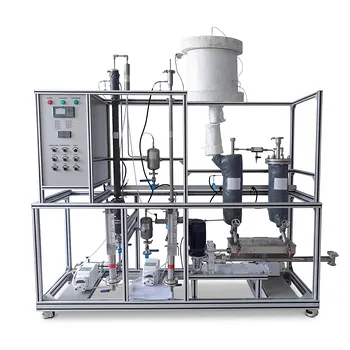
The jump from a beaker-based reaction to a multi-million-dollar production line is where countless promising chemistries go to die. Pilot plants are the primary risk-mitigation tool that stands between a laboratory discovery and a commercial-scale plant. They systematically validate design assumptions, generate reliable mass and energy balances under real flow conditions, and uncover safety or materials issues long before major capital is committed.
A pilot plant is not a miniature factory—it’s a strategic risk-filtration system. It converts uncertain, small-scale observations into bankable process data, giving you the confidence to either build the right commercial plant or kill an uncostable project early, before the numbers become catastrophic.
Why the Lab Bench Gives a False Sense of Security
Reactions that behave predictably in a gram-scale flask often derail at scale due to non-linear changes in heat and mass transfer. Agitation patterns, mixing times, and heat removal that feel trivial in the lab can become dominant, process-killing forces when volumes increase by orders of magnitude.
Ignoring these scale-dependent phenomena is a direct path to commercial failure. A process that shows near-perfect yield and purity in the lab can produce runaway exotherms, fouling, or unusable product in a full-sized reactor, simply because the physics of transport stopped being forgiving.
The Disconnect Between Lab Kinetics and Plant Reality
In the laboratory, heat dissipates almost instantaneously, and concentration gradients disappear with a quick swirl. This masks the true sensitivity of a reaction to temperature and mixing. In a large vessel, poor heat removal can lead to hot spots that generate impurities at levels never seen in the lab.
This is more than a technical nuisance—it’s a commercial risk. If a product can’t meet purity targets at scale, the entire market entry collapses into rework, delays, or outright cancellation.
Scale-Up Is Not About Making Things Bigger—It’s About Making Things Survive Different Physics
Every dimension you scale up changes the ratio of surface area to volume, altering residence times and temperature profiles. Unit operations pilot plants bridge this gap by operating at an intermediate scale where these phenomena first become measurable and controllable.
They force engineers to confront what the lab data never revealed—whether a catalyst truly lasts a thousand hours, whether a recycle stream will accumulate trace toxins, or whether a distillation column will flood under the required throughput. Without this physical proving ground, a commercial plant design is just a wish.
The Pilot Plant as a Risk-Filtration Engine
Pilot plants systematically defuse the three uncertainties that most commonly destroy commercial ventures: unsafe behavior, uneconomic yields, and incompatible materials. By running integrated unit operations under continuous flow, they expose the hidden cost drivers and hazards that lab notebooks ignore.
Verifying Mass and Energy Balances Under Real Flow Conditions
Lab calculations often assume idealized mixing and steady states that never materialize in practice. A pilot plant collects real-world data on material flows, heat inputs, and pressure drops across actual components. This transforms theoretical mass and energy balances into operational certainties, allowing you to size equipment without dangerous guesswork.
Without this data, commercial-scale pumps might be undersized, heat exchangers might be hopelessly under-specced, and your energy costs could render a product non-competitive—all mistakes that only surface after the capital is spent.
Preliminary Hazard Assessment That Prevents Catastrophe
Exothermic reactions that look benign in small glassware can turn into runaway scenarios when scaled. Pilot plants enable controlled introduction of process upsets—stirrer failures, coolant loss, dosing errors—to map out safe operating boundaries.
This is not a regulatory box-ticking exercise; it’s insurance against plant-wide explosions, production shutdowns, and corporate liability. A rigorous pilot-plant hazard analysis often pays for itself by preventing a single thermal runaway event that could destroy both assets and reputation.
Exposing Material Incompatibility Long Before Ordering Tonnage Equipment
Corrosion, embrittlement, seal swelling—these silent killers often remain invisible until a process runs continuously for weeks. A pilot plant puts construction materials, gaskets, and sensors into prolonged contact with the real process stream, revealing incompatibilities that would otherwise trigger emergency shutdowns and expensive metallurgy retrofits in a commercial facility.
Catching these issues at the pilot scale is astronomically cheaper than replacing a failed reactor or column in a full-scale plant months after start-up.
Modern Strategies That Compress Validation Time
The historical approach of building a series of ever-larger pilot plants (each 10–100x bigger than the last) is too slow and capital-hungry for today’s markets. Modern methods fuse pilot-scale experiments with computational modeling to leapfrog intermediate stages while actually increasing confidence.
Hyperbrid Modeling: Pairing Physical Pilots with Simulation
By validating first-principles models against a small number of pilot-plant data points, engineers can simulate scales far beyond what they physically tested. This hybrid approach allows you to bypass one or even two orders of magnitude of intermediate piloting, transitioning from a miniplant directly to a demonstration unit.
Critically, this still requires the physical pilot plant to provide the ground truth that prevents the model from drifting into fantasy. The pilot plant becomes a model-calibration engine, not just a scale-testing tool.
Miniplants and Integrated System Trialing
A scaled-down version of the projected commercial plant—often called a miniplant or integrated pilot unit—is designed specifically to test continuous operation of the entire flow sheet. It studies recycle stream composition, catalyst deactivation rates, and separation effectiveness over hundreds of hours.
Investors and boards want to see data from a system that actually ran, not just from its individual components. A miniplant run demonstrates that your startup’s elegant laboratory chemistry can survive the recycle loops and impurity build-up that kill real processes, dramatically lowering the commercial risk perceived by funders.
The Hidden Trade-offs: When a Pilot Plant Becomes a Bottleneck
Pilot plants are not free, and running them indefinitely can become its own form of commercial risk. They consume time, raw materials, and engineering attention that could otherwise be deployed elsewhere. If the piloting scope is too broad, it delays market entry and burns capital without delivering proportionate risk reduction.
The skill lies in piloting enough to de-risk the truly unknowable variables—mass transfer limitations, fouling rates, runaway scenarios—while trusting proven modeling for predictable scaling factors. An over-engineered pilot campaign on a robust, well-understood unit operation wastes resources; skipping piloting entirely on a novel reaction architecture invites disaster.
The Cost of Piloting vs. the Cost of Failure
Operating a pilot plant for several months may cost a few hundred thousand dollars. A failed commercial start-up due to an unscalable design can write off tens of millions in capital and lost opportunity. The cost of risk is not the pilot plant bill—it’s the probability-weighted loss from skipping it.
The industry’s six-tenths rule (where cost scales as capacity raised to ~0.6) gives a statistical baseline, but it collapses without actual pilot performance data to feed it. Without pilot-tuned inputs, a capital estimate is meaningless, and securing project funding becomes nearly impossible.
Making the Right Choice for Your Innovation Stage
Pilot plants are not one-size-fits-all; their role must be tailored to your specific commercial risk profile. The following guide aligns pilot-plant strategy with common business objectives.
- If your primary focus is attracting investment or securing a Stage Gate approval: Run an integrated miniplant that demonstrates continuous operation of the complete flow sheet, including recycle streams and separation loops. Bankable data from a functional miniplant is the single most persuasive tool for converting skeptical financial decision-makers.
- If your primary focus is compressing time-to-market while controlling risk: Invest in a lean physical pilot that generates high-quality data exclusively for validating your process simulation model. Use the tuned model to leapfrog to a demonstration scale, bypassing multiple intermediate-sized pilots.
- If your primary focus is identifying hidden safety or environmental liabilities: Design a pilot campaign that deliberately introduces process upsets and runs materials-of-construction tests under worst-case conditions. A safety-focused pilot is not about proving the process works—it’s about finding how it fails before it can hurt someone.
- If your primary focus is avoiding cost overruns on a fixed-price EPC contract: Use a pilot plant to lock down mass and energy balances, equipment sizing, and cycle times with empirical certainty. The more pilot-validated your basis of design, the less you expose your project to the crippling contingency add-ons that come with uncertain scale-up data.
Pilot plants do not eliminate commercial risk, but they transform it from a blind gamble into a calculated, manageable decision. That degree of control is what separates a scalable breakthrough from an expensive lesson in chemistry’s hidden scale-dependence.
Summary Table:
| Scale-Up Challenge | Pilot Plant Mitigation Strategy | Commercial Value |
|---|---|---|
| Unpredictable Kinetics | Evaluates heat & mass transfer in real flow | Prevents low yields & impurities |
| Process Hazards | Simulates upsets & maps operating limits | Prevents thermal runaways & accidents |
| Material Degradation | Tests metallurgy & gaskets under continuous run | Avoids emergency shutdown costs |
| Inaccurate Scale-up Models | Validates simulation data (hybrid modeling) | Accelerates time-to-market safely |
Accelerate Your Scale-Up & Mitigate Process Risks with LABPARK
Transitioning from lab bench to commercial production requires reliable, real-world data. LABPARK helps universities, research institutes, and enterprises bridge this gap. We provide high-quality Educational and Vocational Unit Operations Pilot Plants across chemical engineering, bioprocess & biotech, and environmental & water treatment.
Don't let scale-up uncertainties derail your projects. Ensure safety, optimize mass balances, and secure your process design today.
Contact LABPARK experts now to discuss your pilot plant needs!
Related Products
- Fixed Bed Gas Solid Catalytic Reaction Educational Pilot Plant
- Carbon Dioxide Hydrogen Methanol Synthesis Educational Unit Operations Pilot Plant
- Ethyl Acetate Synthesis Unit Operations Pilot Plant for Practical Training
- Natural Product Extraction Unit Operations Training Pilot Plant
- Green Anhydrous Ethanol Refining Practical Training Pilot Plant
People Also Ask
- How do reactor pilot plants safely study gas-solid reactions? Master kinetics with thermal & flow control.
- How does the Mears criterion evaluate transport resistance? Key Guide to Intrinsic Kinetics
- Fluidized vs. Fixed Bed Reactors: Comparing Heat & Complexity in Pilot Plants
- Why is a multibed configuration necessary for exothermic reactions? Optimize your pilot plant trajectory.
- What are the differences between pseudohomogeneous and heterogeneous models in pilot plants?