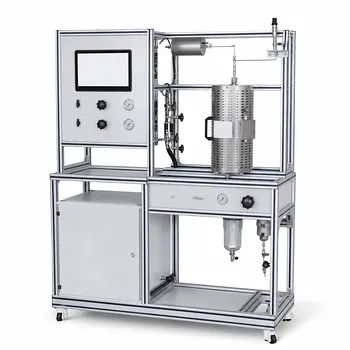
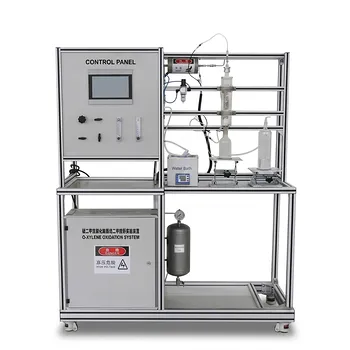
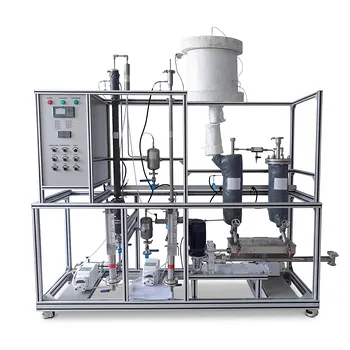
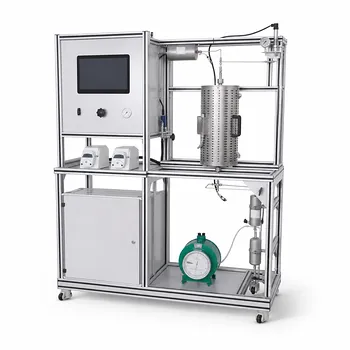
A syngas-to-chemical synthesis pilot plant is a living classroom for core reaction engineering principles. It directly teaches the water-gas shift reaction, methanation, and Fischer-Tropsch synthesis, while forcing students to grapple with catalytic reactor operation, temperature and pressure management, gas separation, and recycle stream optimization. Each of these unit operations becomes a hands-on lesson in how thermodynamics, kinetics, and transport phenomena converge.
Beyond simply running reactions, the pilot plant bridges the gap between textbook theory and industrial reality. Students learn to see how kinetics, thermodynamics, transport phenomena, and process control intertwine to govern yield, selectivity, and safety—all within a single, integrated system.
The Core Reaction Suite: A Playground for Fundamental Concepts
These three catalytic pathways form the backbone of the plant and unlock a wealth of teaching moments.
Water-Gas Shift: Equilibrium and Le Chatelier in Action
The water-gas shift reaction (CO + H₂O → CO₂ + H₂) is a mildly exothermic equilibrium-limited process. Students directly observe how temperature shifts equilibrium—lowering it favours hydrogen production but slows kinetics, while raising it speeds the reaction at the cost of conversion. This tension teaches the thermodynamic vs. kinetic trade-off that defines real reactor design.
Methanation: Heat Management and Catalyst Dynamics
Methanation (CO + 3H₂ → CH₄ + H₂O) is highly exothermic. Operating the pilot plant forces students to manage hotspot formation in a fixed-bed reactor, monitor axial temperature profiles, and understand the risk of catalyst deactivation by sintering. They also learn to correlate gas chromatography data with catalyst activity over time.
Fischer-Tropsch: Selectivity and Product Distribution
The Fischer-Tropsch synthesis produces a wide spectrum of hydrocarbons and alcohols. By varying temperature, pressure, and H₂/CO ratio, students see how Anderson-Schulz-Flory distributions shift. This introduces the concept of selectivity control—a direct application of reaction engineering to maximize desired fuel or chemical cuts.
Mastering Heat and Mass Transport Regimes
The pilot plant transforms abstract transport theory into a tangible, manipulative experiment.
Identifying the Rate-Determining Step
Gas-solid catalytic reactions can be controlled by surface kinetics, pore diffusion, or gas-film mass transfer. By systematically raising the reaction temperature or increasing gas flow velocity, students observe a shift in the controlling regime. A linear increase in rate with temperature signals kinetic control; a plateau indicates diffusion limitation. This simple experiment cements the Thiele modulus and effectiveness factor concepts.
Dynamic Temperature Control and Autothermal Operation
The plant’s heating and cooling systems demonstrate how exothermic reactions can be thermally managed. Students learn to simulate autothermal operation—using the heat of reaction to sustain the process without external energy. They witness why proper preheating, cooling, and inert gas purges are not just procedural steps but essential reactor safety and stability controls.
Reactor Design and Operational Reality
Scaling down an industrial reactor reveals the engineering decisions that shape every real process.
Pressure, Space Velocity, and Residence Time
Students manipulate pressure to shift equilibrium in methanation or Fischer-Tropsch, directly testing the van’t Hoff equation in practice. Changing space velocity (GHSV) alters conversion and selectivity, teaching the fundamental trade-off between throughput and conversion. Real-time data show how these variables affect the mean residence time distribution in the catalytic bed.
Gas Separation and Recycle Loops
The pilot plant’s gas separation unit (membranes, PSA, or cryogenic mock-ups) and H₂/CO recycle streams illustrate how to boost overall yield. Students calculate recycle ratios, observe the buildup of inerts, and learn why purging is necessary to prevent catalyst poisoning—connecting mass balances to industrial process flow.
From Stoichiometry to Atom Economy
Running syngas reactions catalytically, rather than stoichiometrically, demonstrates green chemistry in motion. Students can compare experimental yields to the theoretical atom economy of 100% for pathways like methanation, and contrast them with traditional stoichiometric routes that generate heavy waste. This directly links reactor engineering to process sustainability.
Integrating Theory: From Data to Reactor Model
The pilot plant’s instrumentation makes it a data-rich learning environment.
Kinetic Parameter Estimation
Using gas chromatography data and temperature logs, students fit rate equations to experimental data. They estimate activation energies and pre-exponential factors for each reaction, validating published kinetic models or discovering discrepancies caused by mass transfer limitations—a vital lesson in model discrimination.
Process Intensification Visualization
Heat-integrated reactors, such as a counter-current heat exchanger sharing a reactor wall, compress multiple unit operations into one. Students measure how energy consumption drops when thermal energy is recovered, seeing firsthand how process intensification reduces equipment footprint and operational cost.
Common Pitfalls and Trade-offs in Pilot Plant Learning
Even the best teaching tool has limits that must be addressed head-on.
Scale-Down Distortion
Wall effects and bypassing are exaggerated at pilot scale, so observed conversions may not linearly extrapolate to industrial dimensions. Students must learn to distinguish between intrinsic kinetics and apparatus-specific artifacts.
The Black Box Trap
If students simply follow a standard operating procedure without analyzing the data, the plant becomes a demonstration rather than an experiment. Instructors must design open-ended investigations—for example, “maximize C5+ yield while minimizing methane”—to force genuine reaction engineering thinking.
Simplifying Complex Interactions
Real industrial plants cope with catalyst deactivation, pressure drop from fines, and trace contaminants. The clean, idealized feeds of a teaching pilot plant can mask these realities. Students must be reminded that robustness and poison resistance are as critical as fresh catalyst activity.
Making the Most of Your Pilot Plant for Reaction Engineering Education
Your educational goal determines how you should deploy the plant.
- If your primary focus is fundamental kinetics and thermodynamics: Design experiments where students systematically vary temperature and pressure to extract rate constants and equilibrium constants, then compare to literature values.
- If your primary focus is industrial reactor operation and process safety: Emphasize start-up/shut-down procedures, alarm management, hotspot detection, and how recycle streams influence stability. Let students experience the consequences of a poorly tuned temperature controller.
- If your primary focus is green and sustainable processing: Have students calculate atom economy and E-factors for each pathway, then challenge them to optimize the plant for minimum waste and maximum energy integration.
- If your primary focus is data-driven process control and modelling: Use the plant’s real-time data acquisition to teach model predictive control or simple PID tuning, linking reaction engineering with automation.
A syngas-to-chemical synthesis pilot plant does more than illustrate reactions—it builds the instinctive, systems-level thinking that defines a mature reaction engineer.
Summary Table:
| Reaction / Concept | Core Engineering Principle | Key Learning Outcome |
|---|---|---|
| Water-Gas Shift | Thermodynamics & Equilibrium | Observe temperature-dependent equilibrium limits |
| Methanation | Heat Management & Kinetics | Manage fixed-bed hotspots & catalyst deactivation |
| Fischer-Tropsch | Product Selectivity | Analyze and shift Anderson-Schulz-Flory distributions |
| Transport Regimes | Mass & Heat Transport | Identify rate-limiting steps (kinetic vs. diffusion) |
| Process Operations | Mass Balances & Recycle Loops | Optimize conversion and yield with gas separation recycle |
Bring Industrial-Scale Learning to Your Institution
LABPARK provides state-of-the-art Educational and Vocational Unit Operations Pilot Plants in chemical engineering, bioprocess & biotech, and environmental & water treatment. Tailored for universities, research institutes, and enterprises, our pilot plants bridge the gap between textbook theory and real-world industrial applications.
- Hands-on Training: Empower students to master complex kinetics, thermodynamics, and reactor design safely.
- Customized Configurations: Flexible equipment designs engineered to align with your specific curriculum and research goals.
- Industrial Standard: Prepare the next generation of engineers with industry-ready process control skills.
Ready to elevate your engineering laboratory? Contact us today to request a quote or custom design!
Related Products
- Ethyl Acetate Synthesis Unit Operations Pilot Plant for Practical Training
- Carbon Dioxide Hydrogen Methanol Synthesis Educational Unit Operations Pilot Plant
- Aspirin API Synthesis Unit Operations Training Pilot Plant
- Methanol Synthesis and Catalyst Performance Evaluation Educational Unit Operations Pilot Plant
- Carbon Dioxide Hydrogenation Methanol Synthesis Educational Unit Operations Pilot Plant
People Also Ask
- How do pilot plants demonstrate esterification? Visualizing Chemical Engineering Equilibrium
- When to transition from PID to adaptive control in pilot plants? Key process indicators.
- Why is the chemical plant startup schedule crucial? De-risk scale-up with pilot plants.
- Why Use PTFE & Hastelloy in Chemical Pilot Plants? Prevent Corrosion & Ensure Safety
- How do deviations in estimating latent heat impact pilot plant thermal systems? Avoid hardware mis-sizing.