Knowledge Chemical Engineering Education What precautions for calcination and drying? Master Thermal Unit Operations
Author avatar

Tech Team · LABPARK

Updated 1 month ago

What precautions for calcination and drying? Master Thermal Unit Operations


Heating too fast, cooling too quick, and handling samples carelessly will compromise your results before you even begin analysis. The core precautions are to enforce slow, controlled temperature ramps to prevent violent combustion or sample ejection, and to standardize cooling in a desiccator so that weighings are accurate and consistent. These steps are not just formalities—they are the difference between precise data and an irreproducible experiment.

Thermal unit operations for calcination and drying are a battle against thermal shock, airborne losses, and moisture re-absorption. The most critical precaution is managing the rate of change—both heating and cooling—to protect sample integrity and ensure that the final mass you measure is the true mass of your analyte.

Controlling the Heating Phase to Preserve the Sample

The danger is rarely the final temperature; it’s how you get there. A sudden spike in heat can physically eject light, fluffy precipitates or ignite organic matter, creating convection currents that carry the sample right out of the crucible.

The Filter Paper Problem: Why Gradual Carbonization Matters

If your sample contains filter paper, the heating must be gradual and oxygen-limited. You are aiming for carbonization (smoldering into ash) not flaming combustion.

A flame creates turbulent air currents that can blow the fine, dry precipitate out. If you see a flame, immediately cover the crucible with its lid. This starves the fire of oxygen and instantly extinguishes it, containing the sample and preventing loss.

Ramp Rates: The Universal Principle

Even without paper, a controlled ramp rate prevents mechanical spattering. Moisture or volatile components trapped inside solid particles can turn to gas explosively if heated too fast.

Think of it like popping popcorn. Apply heat slowly to let the steam escape gradually; blast it with high heat immediately, and the kernel—or in this case, your precipitate—shatters and scatters. Modern thermal operations use programmable controllers to enforce low ramp rates (often 2–10°C/min) until the main decomposition is complete.

Standardizing Cooling and Handling Procedures

Hot porcelain or platinum doesn’t just burn fingers—it seems heavier if weighed warm. Until it reaches thermal equilibrium with the balance room, your mass readings will drift, rendering the entire gravimetric analysis useless.

The 30-Minute Desiccator Rule

After high-temperature calcination in a muffle furnace, a crucible must cool in a desiccator for approximately 30 minutes. This isn’t an arbitrary number.

It’s the time needed for the crucible to drop to near ambient temperature without re-absorbing moisture from the air. The desiccant (silica gel, anhydrous calcium sulfate) maintains a dry atmosphere, preventing the hygroscopic calcined ash from gaining weight due to humidity.

Handling with a Purpose

The crucible, once cooled, should be handled only with clean tongs, never bare fingers. Skin oils and moisture add mass and can corrode the crucible at high temperatures during the next cycle.

In pilot plants or educational settings, the discipline of lid placement matters. Store the lid slightly ajar in the desiccator to prevent it from sticking due to vacuum formation, but always keep it on during the final cooling phase to shield the sample.

Understanding the Trade-offs

Safety and accuracy sometimes pull in opposite directions. Recognizing these tensions prevents procedural arrogance.

Speed vs. Safety

You might be tempted to remove a crucible from the furnace red-hot and quench it on a cold bench to save time. Never do this. Thermal shock can crack the crucible, spall off fragments into the sample, and create an invisible error. The 30-minute cooling investment is negligible compared to the cost of repeating an entire ashing procedure.

Modern Instrumentation vs. Operator Discipline

Many modern muffle furnaces have built-in timers and automatic door locks that prevent opening at unsafe temperatures. These are excellent safety containment features. However, they can breed complacency. If the furnace cools the sample but you skip the desiccator step because “the furnace is dry,” you’ll still get a wrong weight. The deep need is thermal equilibrium at the balance, not just post-furnace cooling.

Making the Right Choice for Your Goal

The exact procedure depends on whether you prioritize ultimate accuracy, speed, or cost.

  • If your primary focus is analytical accuracy: Standardize the cooling time (e.g., 30 minutes in a desiccator) without exception. Use a second desiccator to back up your workflow. The lid must be closed tightly only after the full cooling period, and you must weigh by difference immediately.
  • If your primary focus is operational throughput: Invest in a second set of crucibles. While one batch cools, the next is heating. Never compromise the cooling time—overlap it instead. This keeps the thermal cycles safe while maximizing furnace uptime.
  • If your primary focus is pilot-plant scalability: Document the precise ramp-and-soak profile that prevents spattering, not just the final setpoint. A procedure that works for a single porcelain crucible may fail for a large tray due to different heat transfer dynamics. Validate the temperature profile with a thermocouple inside a representative sample.

Embrace the thermal lag. The secret to repeatable calcination and drying is never forcing a sample to change temperature faster than it naturally can, and never rushing the final measurement before the entire system has returned to a steady, dry state.

Summary Table:

Operation Phase Critical Precaution Actionable Best Practice
Heating Phase Enforce slow, controlled ramp rates (2–10°C/min). Prevents sample spattering and explosive gas release.
Carbonization Use gradual, oxygen-limited heating. Prevents flaming combustion; cover crucible if ignition occurs.
Cooling Phase Cool in a desiccator for 30 minutes. Prevents moisture re-absorption and stabilizes mass readings.
Sample Handling Handle crucibles only with clean tongs. Prevents contamination from skin oils and moisture.

Optimize Your Thermal & Chemical Engineering Labs with LABPARK

Achieving precise and repeatable results in thermal unit operations requires both rigorous procedures and high-performance equipment. LABPARK provides state-of-the-art Educational and Vocational Unit Operations Pilot Plants in chemical engineering, bioprocess & biotech, and environmental & water treatment.

We help universities, research institutes, and enterprises bridge the gap between theory and industrial practice with safe, scalable, and robust pilot-scale systems.

Ready to elevate your training and research capabilities? Contact LABPARK today to discuss your laboratory requirements with our technical specialists.

Related Products

People Also Ask

Related Products

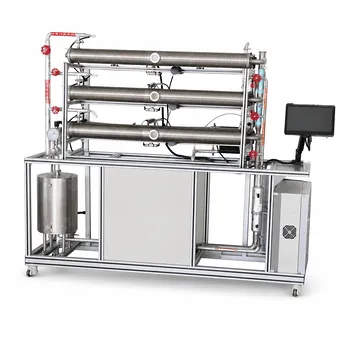
Comprehensive Multi-Modal Heat Transfer Unit Operations Pilot Plant for Engineering Training

Comprehensive Multi-Modal Heat Transfer Unit Operations Pilot Plant for Engineering Training

Comprehensive multi-modal heat transfer unit operations pilot plant for engineering training. Features four heat exchanger types, multi-media switching, and three operating modes. Hands-on experience in safety, optimization, and process control. Industrial-grade design with real-time data acquisition for chemical engineering labs.

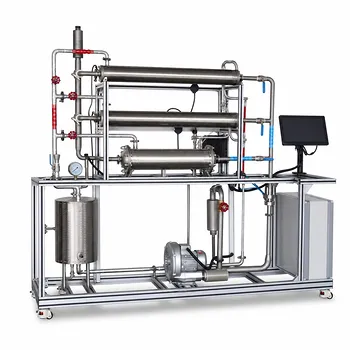
Dual Mode Heat Transfer Pilot Plant for Unit Operations Training

Dual Mode Heat Transfer Pilot Plant for Unit Operations Training

Engineering-scale dual-mode heat transfer pilot plant for hands-on unit operations training in chemical engineering. Features real and simulated modes, multiple heat exchanger types, comprehensive coefficient determination, and advanced process control with data acquisition for engineering students and researchers.

Potassium Salt Thermal Dissolution and Crystallization Separation Educational Unit Operations Pilot Plant

Potassium Salt Thermal Dissolution and Crystallization Separation Educational Unit Operations Pilot Plant

This educational pilot plant allows chemical engineering students to perform potassium salt thermal dissolution and cooling crystallization experiments, integrating solubility studies, supersaturation control, and solid-liquid separation in a safe, compact, and customizable laboratory system for hands-on unit operations learning.

Hot Filtration Educational Unit Operations Pilot Plant Laboratory System

Hot Filtration Educational Unit Operations Pilot Plant Laboratory System

This integrated laboratory bench-scale hot filtration pilot plant enables students to study solid-liquid separation under thermal conditions, featuring a stainless steel vessel, removable heating jacket, and multi-layer filter plates for unit operations education, ideal for chemical engineering laboratory curriculum.

Three-Tube Heat Transfer Educational Pilot Plant for Unit Operations Training

Three-Tube Heat Transfer Educational Pilot Plant for Unit Operations Training

Three-tube heat transfer pilot plant for studying convective heat transfer enhancement and condensation. Allows comparison of smooth, corrugated, turbulent tubes, verifying empirical correlations. Ideal for chemical engineering education with safety and closed-loop steam recovery.

Comprehensive Heat Transfer Coefficient Determination Educational Unit Operations Pilot Plant

Comprehensive Heat Transfer Coefficient Determination Educational Unit Operations Pilot Plant

Advanced industrial-grade educational pilot plant for comprehensive heat transfer coefficient determination. Enables quantitative convective heat transfer analysis, evaluates double-pipe and shell-and-tube exchanger configurations, and includes digital data acquisition. Customizable for engineering curriculum. Ideal for engineering unit operations labs.

Shell and Tube Heat Exchanger Heat Transfer Coefficient Determination Educational Pilot Plant

Shell and Tube Heat Exchanger Heat Transfer Coefficient Determination Educational Pilot Plant

LABPARK's shell and tube heat exchanger pilot plant enables students to investigate heat transfer coefficients, LMTD, co-current vs counter-current flow, bridging theory and industrial practice. Customizable for chemical, mechanical, environmental engineering curricula. Ideal for unit operations and process engineering labs.

Throttling Effect Determination Educational Unit Operations Pilot Plant

Throttling Effect Determination Educational Unit Operations Pilot Plant

Investigate the Joule-Thomson throttling effect with this educational unit operations pilot plant. Designed for engineering students, it enables hands-on comparative analysis of adiabatic gas expansion using precise process control, interactive digital interface, and eco-friendly operation, ensuring safe repeatable thermodynamic experiments.

Multi-Reactor Educational Pilot Plant for Reaction Engineering Unit Operations

Multi-Reactor Educational Pilot Plant for Reaction Engineering Unit Operations

Integrated bench-scale educational pilot plant for chemical engineering teaching featuring fixed bed fluidized bed and stirred tank reactors with web-based digital twin controls and safety interlocks for hands-on unit operations and reaction engineering comparative studies in one compact system.

Supercritical High-Gravity Flash Evaporation Educational Unit Operations Pilot Plant

Supercritical High-Gravity Flash Evaporation Educational Unit Operations Pilot Plant

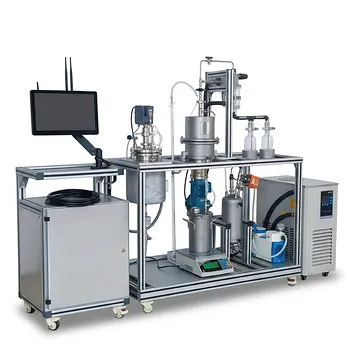
Bench-scale integrated teaching system for advanced separation and mass transfer, combining supercritical high-gravity flash evaporation with heating, chemical reaction, and material collection, featuring modular design, Stainless Steel 316L construction, transparent visualization, touchscreen control, and safety systems for chemical engineering education.

Multi-Functional Drying Educational Unit Operations Pilot Plant

Multi-Functional Drying Educational Unit Operations Pilot Plant

Versatile multi-functional drying educational unit operations pilot plant integrating tunnel, fluidized bed, and spray drying. Enables hands-on study of drying curves, psychrometry, and gas-solid separation for chemical engineering curriculum in higher education labs.

Two-Dimensional Fluidization Hydrodynamics Educational Pilot Plant for Unit Operations Training

Two-Dimensional Fluidization Hydrodynamics Educational Pilot Plant for Unit Operations Training

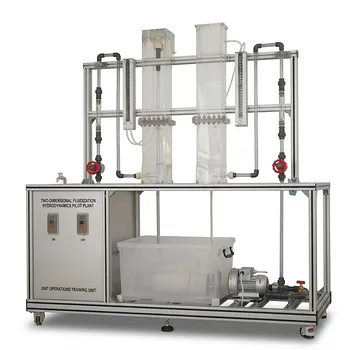
Explore gas-solid and liquid-solid fluidization hydrodynamics with our transparent 2D educational pilot plant. Ideal for chemical engineering unit operations labs, it demonstrates fixed to fluidized bed regimes, measures pressure drop, and integrates QR-code digital learning for enhanced student training.

Carbon Material Thermal Pretreatment Multiphase Separation Educational Pilot Plant

Carbon Material Thermal Pretreatment Multiphase Separation Educational Pilot Plant

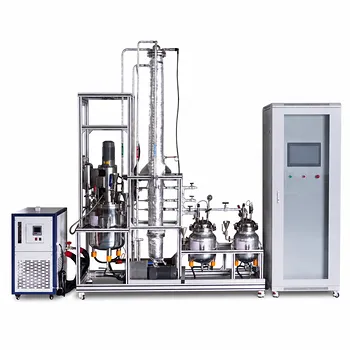
Educational pilot plant for carbon material thermal pretreatment and multiphase separation. Features jacketed agitated reactor, separation column, and modern controls for hands-on unit operations training in heat transfer, fluid flow, and process safety with industrial-grade materials and wireless data acquisition.

Multi-Modal Distillation Unit Operations Training Pilot Plant

Multi-Modal Distillation Unit Operations Training Pilot Plant

Multi-modal distillation pilot plant for practical unit operations training in chemical engineering education. Features real, analog, and semi-physical simulation modes, industrial construction, customizable for university labs. Hands-on fractionation columns, SCADA control, safety systems. Includes sight glasses, sampling ports, closed-loop recycling.

Rising and Falling Film Evaporation Educational Unit Operations Pilot Plant

Rising and Falling Film Evaporation Educational Unit Operations Pilot Plant

Hands-on educational pilot plant for studying rising and falling film evaporation, flow regimes, and heat transfer. Customizable for university labs with industrial instrumentation and data acquisition. Enables comparative evaluation of evaporation modes and energy efficiency.

Thermal Desorption Exhaust Gas and Tail Water Treatment Educational Pilot Plant

Thermal Desorption Exhaust Gas and Tail Water Treatment Educational Pilot Plant

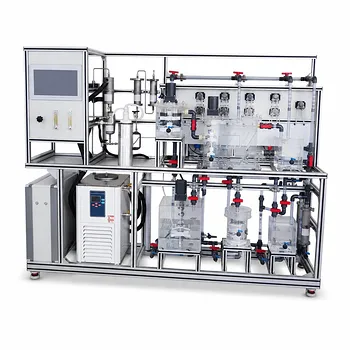
Bench-scale educational pilot plant for treating thermal desorption exhaust gas and tail water integrates condensation, Fenton oxidation, precipitation, filtration, and carbon adsorption. Ideal for chemical engineering and environmental labs, teaching unit operations, process control, and real-time data analysis.

Multi Functional Catalytic Reaction and Reactor Evaluation Educational Unit Operations Pilot Plant

Multi Functional Catalytic Reaction and Reactor Evaluation Educational Unit Operations Pilot Plant

Bench-scale educational pilot plant for catalytic reaction and reactor evaluation, integrating fixed bed, fluidized bed, and stirred tank reactors. Students compare reactor designs, evaluate catalysts, and study reaction kinetics and hydrodynamics. Perfect for unit operations labs in chemical engineering curricula.

Educational Compression Refrigeration Performance Determination Unit Operations Pilot Plant

Educational Compression Refrigeration Performance Determination Unit Operations Pilot Plant

This educational pilot plant for compression refrigeration performance determination offers dual COP evaluation, regenerative cycle comparison, and calorimeter calibration. Customizable for curriculum integration, it features environmentally conscious design. Supports thermodynamic mapping on pressure-enthalpy diagrams and synchronous monitoring with centralized instrumentation.

Educational Unit Operations Pilot Plant for Intraparticle Diffusion Effective Factor Measurement

Educational Unit Operations Pilot Plant for Intraparticle Diffusion Effective Factor Measurement

Designed for chemical engineering university labs, this pilot plant allows hands-on determination of catalyst particle intraparticle diffusion effective factors and gas-solid reaction kinetics using a fixed-bed tubular reactor with industrial touchscreen control, bridging theory and practical reactor design.

Dual-Mode Gas Absorption and Desorption Unit Operations Training Pilot Plant

Dual-Mode Gas Absorption and Desorption Unit Operations Training Pilot Plant

Industrial-scale pilot plant for gas absorption and desorption training in chemical engineering. Features dual-mode operation with real and simulated materials, transparent columns for flow visualization, and customizable design. Supports independent or combined loops for hands-on unit operations experiments.


Leave Your Message