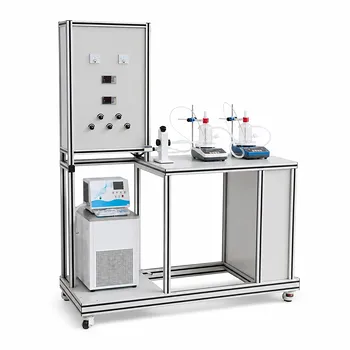
Methods to intensify mass transfer in extraction pilot plants boil down to engineering the three terms of the fundamental rate equation: driving force, mass transfer coefficient, and interfacial area. By applying counter-current flow, chemical reaction, pulsation, agitation, pulsed electric fields, and droplet-breakup mechanisms, a pilot unit can dramatically accelerate the extraction kinetics and approach equilibrium in fewer stages.
Every intensification method directly manipulates at least one of the three core variables in the rate expression ( dG = K \cdot dA \cdot dY ). The smartest pilot-plant strategy selects the lever that best fits the system’s physical properties, chemistry, and safety constraints—and often combines them for a synergistic effect.
Increasing the Driving Force (( \Delta Y ))
Counter‑Current Flow as a Default Design
The most fundamental way to boost the driving force is to run the two phases in counter-current contact.
Fresh solvent meets the most depleted raffinate, and fresh feed meets the most loaded solvent, creating a persistently steep concentration gradient across the entire column.
This maximizes ( dY ) without adding any extra energy—it is a pure flow‑geometry play.
Chemical Reaction to “Consume” the Solute
When simple physical partitioning is too slow, introducing a chemical reaction at the interface can maintain a zero or very low solute concentration in the receiving phase.
The reaction continuously removes the transferred species from the interfacial film, effectively making ( c^*_A ) negligible and preventing the gradient from decaying.
This is why extractants like D2EHPA or amines are used in metal‑ion pilots—the fast acid‑base or complexation chemistry keeps the driving force pinned at a high level.
Enhancing the Mass Transfer Coefficient (( K ))
Pulsation and Mechanical Agitation
The mass transfer coefficient is limited by boundary layer resistance—the thin stagnant films of liquid that molecules must diffuse through.
Pulsation (in pulsed columns) or mechanical agitation (in mixer‑settlers, rotating disc contactors) introduces turbulence that continuously disrupts and thins these films, slashing the diffusion path length.
At the same time, the energy input promotes internal circulation inside droplets, turning the droplet itself into a well‑mixed micro‑reactor and further increasing the overall coefficient.
Pulsed Electric Fields
Applying a pulsed electric field to a droplet can induce droplet oscillation and internal electrohydrodynamic circulation.
This physical effect reduces the effective boundary layer resistance without adding significant shear, making it particularly useful for biological extractions where cells or sensitive molecules might be damaged by mechanical agitation.
The principle is the same—fluid motion at the interfacial scale—but the driver is electrostatic stress instead of pressure waves or impeller blades.
Maximizing the Interfacial Area (( A ))
Droplet Break‑Up by Agitation, Packing, or Shearing
The single most powerful lever in the pilot‑plant toolbox is specific interfacial area, ( a = 6\phi_D / d_{32} ).
Agitators, static mixers, or the packing material itself break the dispersed phase into micro‑droplets, drastically reducing the Sauter mean diameter ( d_{32} ) and pushing ( a ) above 500 m²/m³.
The physical principle is this: the same volume of dispersed liquid, when shattered into a thousand droplets, exposes orders of magnitude more contact surface—and since mass transferred is directly proportional to area, the rate jumps accordingly.
Packing Geometry and Phase Wetting
In packed columns, the solid surfaces immobilize and guide the continuous phase, while the dispersed phase trickles through as droplets or rivulets.
The packing does not just break droplets; it also creates a tortuous path that renews the interfacial surface continuously, keeping the area fresh.
Critical rule: The packing must be fully wetted by the continuous phase—but not by the dispersed phase—otherwise droplets coalesce into slugs, area collapses, and the column performs like a simple spray tower.
Controlling Holdup Through Flow Rates
The dispersed‑phase holdup ( \phi_D ) appears directly in the area equation.
By deliberately setting the volumetric flow ratio of the two phases, operators can increase ( \phi_D ) (more drops per unit volume) and thus boost the specific area—right up to the flooding point.
This is a purely hydrodynamic adjustment: too high a holdup, and droplets crowd together, coalesce, and flood the column; the art is to operate just below that limit.
Understanding the Trade‑offs
Every intensification method comes with a cost that must be assessed at pilot scale.
Emulsification and Phase Separation
Excessively high agitation or pulsation energy can reduce droplet size to the point where coalescence becomes painfully slow.
The pilot plant then experiences rag layers, slow settler throughput, or entrainment—counteracting the very productivity gains the intensification was supposed to deliver.
Axial Dispersion and Back‑Mixing
In a packed column, aggressive pulsation or ill‑placed redistributors can promote axial mixing, which smears the concentration gradient and makes the column behave as if it had fewer theoretical stages.
Intensifying ( K ) and ( a ) while ignoring axial dispersion is a classic mistake that leads to optimistic lab extrapolations and disappointing scale‑up.
Material Compatibility and Energy Cost
Pulsed electric fields or high‑shear mixers add capital and operating expense.
Chemical reaction intensification frequently demands corrosive extractants or extreme pH, forcing the pilot plant to use borosilicate glass, PTFE, or high‑grade stainless steel—making the rig more delicate and expensive to maintain.
Making the Right Choice for Your Goal
Your choice of intensification method should be guided by the nature of the system and the development objective.
- If your primary focus is simple physical separation with few stages: A packed column with counter-current flow and carefully selected packing material will provide a cost‑effective and easy‑to‑operate pilot unit.
- If your primary focus is high‑throughput metal extraction or slow kinetics: Agitated columns or mixer‑settlers combined with a chemical extractant (e.g., D2EHPA) will rapidly consume the solute and maintain an aggressive driving force.
- If your primary focus is sensitive biologics that cannot tolerate shear: Pulsed electric fields or gentle pulsation in a liquid‑liquid column offer boundary layer disruption without the microscale violence of an impeller.
- If your primary focus is teaching or understanding droplet phenomena: A transparent pulsed or rotary‑disc column lets you visually correlate agitation energy with droplet size, holdup, and flooding behavior—making the physics of intensification tangible.
Ultimately, the most effective pilot‑scale strategy is not to blindly maximise every variable, but to match the intensification method to the bottleneck—be it a sluggish interface, a small area, or a weak gradient—and then validate the combined effect with a simple material‑balance tracer study that confirms you truly gained the extra stages.
Summary Table:
| Target Variable | Intensification Method | Physical Principle & Mechanism |
|---|---|---|
| Driving Force (ΔY) | Counter-current flow & chemical reactions | Maintains steep concentration gradient; removes solute from interface |
| Mass Transfer Coeff. (K) | Mechanical agitation, pulsation & electric fields | Thins boundary layers; induces internal droplet circulation |
| Interfacial Area (A) | Packing geometry, shearing & flow rate control | Minimizes droplet diameter; increases dispersed-phase holdup |
Optimize Your Extraction Workflows with LABPARK
Are you looking to enhance mass transfer efficiency in your research or training facilities? LABPARK provides state-of-the-art Educational and Vocational Unit Operations Pilot Plants in chemical engineering, bioprocess & biotech, and environmental & water treatment for universities, research institutes, and enterprises.
Our pilot plants are engineered to help you model, analyze, and master advanced separation techniques with high precision and safety.
Contact us today to discuss your laboratory requirements and find the ideal system for your team!
Related Products
- Educational Rotary Disc Liquid-Liquid Extraction Pilot Plant
- Comprehensive Liquid-Liquid Extraction Pilot Plant for Engineering Education
- Gallium and Indium Selective Extraction Educational Pilot Plant
- Ternary Liquid-Liquid Equilibrium Educational Pilot Plant
- Liquid-Liquid Mass Transfer Coefficient Determination Educational Pilot Plant
People Also Ask
- How do density and IFT affect liquid-liquid extraction pilot plants? Optimize Column Performance
- How to Estimate KD for Liquid-Liquid Extraction Pilot Plants Using Henry's Law when Lab Data is Limited
- In a liquid-liquid extraction pilot plant, how is a ternary-phase diagram utilized to determine solvent feed requirements?
- How to Select a Liquid-Liquid Extraction Pilot Plant with Space Constraints: Key Factors
- Why is the plait point a critical limit in liquid-liquid extraction pilot plants? Safe LLE Operation