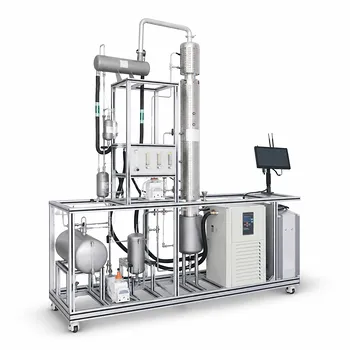
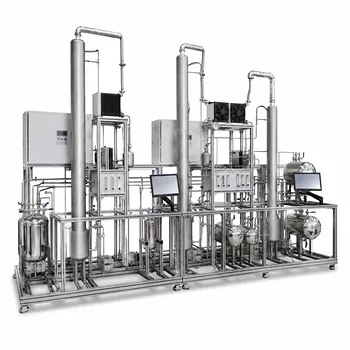
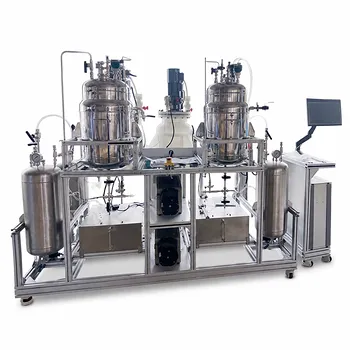
Selecting the right materials is not just a specification—it’s the single most important decision you’ll make for a distillation pilot plant processing volatile organic compounds (VOCs). The entire wetted path—the column shell, internals (trays or packing), and the reboiler—must be built from stainless steel, typically Grade 304 or 316, because only these alloys combine the chemical inertness, mechanical toughness, and thermal resilience needed to prevent leaks, fires, or catastrophic failure when handling solvents, monomers, or heat-sensitive volatiles.
The core insight: Start with 316 stainless steel for all wetted parts when the VOC stream has any risk of corrosive impurities, halides, or acidic byproducts; for well-characterized, non-aggressive mixtures, 304 is a cost-effective option. But true safety and long-term reliability extend far beyond the column metal—every gasket, seal, and sight-glass component must be matched to the chemistry and temperature of your process, or the entire system’s integrity collapses at the weakest link.
Why Material Choice Directly Dictates Safety and Uptime
Pilot plants for VOCs operate in a dangerous triangle of chemical reactivity, flammability, and thermal stress. The material must address all three simultaneously, not just survive them.
The Chemical Aggression of VOCs
Many common solvents—esters, ketones, chlorinated compounds—can swell, dissolve, or embrittle polymers and attack low-alloy steels. Even trace contaminants like organic acids or chlorides can catalyze pitting corrosion in standard stainless grades. A pilot plant that leaks because a gasket softened or a weld became porous doesn’t just ruin an experiment; it creates a fire and inhalation hazard.
Mechanical Integrity Under Rapid Thermal Cycling
Distillation columns swing from cold startup to operating temperatures (often 100–250°C) in minutes. Materials must handle the resulting expansion and contraction without warping tray decks or loosening flange bolts. Stainless steel’s high strength-to-weight ratio keeps the column structurally rigid, maintaining tight hydraulic seals across the temperature range.
Preventing Catastrophic Leaks in Enclosed Spaces
Pilot plants are frequently located in university labs or R&D bays without the open-air buffer of a full-scale plant. A single gasket failure can fill the room with flammable vapor. Every material choice—from the column shell to the valve packing—must create a sealed boundary that contains the process even if an upset occurs.
The Cornerstone: Stainless Steel Grades 304 and 316
The primary reference correctly frames stainless steel as the industrial standard for VOC pilot plants. But the choice between 304 and 316 deserves a deeper look.
When Grade 304 Suffices
Grade 304 stainless steel (18% chromium, 8% nickel) offers excellent general corrosion resistance against a wide range of organic solvents, alcohols, and hydrocarbons. It’s the go-to choice for pilot plants processing well-characterized, non-halogenated VOC streams without acidic or chloride-bearing impurities. Its lower cost and excellent availability make it attractive for educational laboratories that want to mirror industrial hardware without breaking budgets.
Why Grade 316 Adds an Extra Layer of Protection
The addition of 2–3% molybdenum in Grade 316 sharply improves resistance to pitting and crevice corrosion, especially in environments where chlorinated solvents or trace hydrochloric acid might form. If your VOC stream is at all uncertain, or if you plan to use steam injection (which can introduce dissolved oxygen and chlorides from water), the modest premium for 316 is negligible compared to the cost of a corroded reboiler or tray collapse.
Realistic Training on Industrial-Grade Materials
In vocational and university settings, using these stainless steels isn’t just about durability. It exposes students and operators to the actual materials used in industry, ingraining safety habits and maintenance routines that directly transfer to full-scale plants operating under the same regulatory frameworks.
Beyond the Column: Gaskets, Seals, and Sight Glasses
The column metal is only half the story. Volatile organics will seek out and attack any incompatible soft component, turning a well-designed rig into a leak hazard.
Gaskets and Soft Seals Are the Silent Failure Points
Flange and manway gaskets must be chemically inert and thermally stable. Standard elastomers (nitrile, neoprene) swell and degrade quickly in many solvents. The correct selection is PTFE (virgin or filled) or flexible graphite for general use, and perfluoroelastomers (e.g., Kalrez) only for the most aggressive environments. Always verify the gasket’s maximum service temperature against your reboiler’s output—not just the column’s average.
Sight Glasses and Instrumentation
For VOC service, integrated sight glasses should be borosilicate glass with a transparent polycarbonate shield and a metal frame, never a standalone glass tube. Wetted parts of pressure transmitters, thermowells, and level sensors must also be stainless steel or Hastelloy; plastic instrument bodies or unprotected electrical connections are incompatible with the explosion-proof enclosures and purging strategies demanded by volatile organic work.
Material-System Integration: Why Safety Protocols Inform Material Choices
The supplementary references highlight that pilot plants for VOCs require explosion-proof heating, closed-loop condensation, and inert gas blanketing. These safety systems, in turn, place demands on materials:
- Heating enclosures (e.g., electric mantles or steam jackets) must be housed in stainless-steel shells that resist external corrosion and contain any internal arc.
- Seals on condenser connections cannot off-gas or degrade under continuous exposure to recirculating hot vapors.
- Piping for nitrogen purging must be metal (stainless or copper) to avoid static buildup, and all junction boxes on the skid require the correct ATEX or NEC rating.
Choosing column materials without designing the surrounding hardware to the same standard is like installing a vault door on a cardboard box.
Understanding the Trade-offs
No material selection is free of compromise. Being explicit about the downsides helps you build a rational procurement plan.
- Cost vs. corrosion certainty: 316 stainless costs 20–40% more than 304. If your VOC mixture is simple and dry, that premium may not add value. But any future process change that introduces chlorides will force a costly rebuild.
- Glass vs. all-metal columns: Glass columns offer invaluable visibility for teaching, but they are fragile and create additional leak paths at joints. For volatile, flammable liquids, a fully welded 316 column with a protected sight port balances safety with observability.
- Gasket replacement burden: PTFE gaskets creep under load and require periodic re-torquing, while graphite can oxidize at very high temperatures. There is no “fit-and-forget” solution—your material choice must align with your maintenance capabilities.
- Weight and mobility: A stainless-steel pilot plant is heavy. If the unit will be moved frequently, consider modular skid designs rather than substituting lighter alloys that compromise safety.
Making the Right Choice for Your Pilot Plant
Every VOC pilot plant is a unique intersection of chemistry, budget, and intended use. Anchor your decision to your primary goal.
- If your primary focus is absolute safety with unknown or variable VOC chemistries: Specify 316 stainless steel for all wetted parts, PTFE envelope gaskets, and a fully enclosed, inert-purged skid with ATEX/IECEx-rated components. This eliminates the most common material-failure vectors.
- If your primary focus is cost-effectiveness for a dedicated, well-characterized, non-corrosive VOC stream: 304 stainless steel for the column and internals is a proven, economical choice, provided you still invest in high-quality PTFE gaskets and proper pressure-relief pathways.
- If your primary focus is educational demonstration of distillation principles: Balance the need for visibility (using borosilicate sections with protective laminates) against the imperative of safety—prefer stainless-steel column sections for the reboiler and hot-vapor zones, reserving glass only for low-temperature, pressure-relieved observation points.
The right material strategy transforms a distillation pilot plant from a potential hazard into a robust, trustworthy tool that will generate reliable data and train operators for years to come.
Summary Table:
| Material | Recommended Use | Key Benefits | Key Limitations |
|---|---|---|---|
| Grade 304 Stainless Steel | Non-halogenated VOCs, general organic solvents | Cost-effective, good general corrosion resistance | Susceptible to pitting from halides/acids |
| Grade 316 Stainless Steel | Corrosive VOCs, chlorinated solvents, steam injection | Excellent resistance to pitting and crevice corrosion | Higher cost (20-40% premium) |
| PTFE / Graphite | Flange and manway gaskets, soft seals | High chemical inertness, thermal stability | Requires periodic maintenance/re-torquing |
| Borosilicate Glass | Observation ports, light-duty educational units | High visibility for teaching and monitoring | Fragile, potential leak paths at joints |
Partner with LABPARK for Safe, Industry-Grade Pilot Plants
At LABPARK, we understand that material integrity is non-negotiable for volatile organic compound (VOC) processing. We provide state-of-the-art Educational and Vocational Unit Operations Pilot Plants in chemical engineering, bioprocess & biotech, and environmental & water treatment tailored for universities, research institutes, and enterprises.
Get custom-configured systems built with high-grade materials (316 SS, PTFE) that ensure maximum safety, process reliability, and realistic vocational training.
Contact LABPARK today to discuss your project requirements!
Related Products
- Continuous Sieve-Plate Distillation Pilot Plant for Unit Operations Laboratory Education
- Multi-Functional Special Distillation Educational Pilot Plant
- Continuous Batch Extractive Distillation Educational Pilot Plant
- Multi-Modal Distillation Unit Operations Training Pilot Plant
- Electrolyte Distillation Purification and Formulation Educational Pilot Plant
People Also Ask
- Why is vacuum operation capability an essential feature for a distillation unit operations pilot plant? Unlock Efficiency
- How does catalyst water concentration affect distillation pilot plant design? Key separation train choices.
- How to select the right activity coefficient model (Wilson, NRTL, UNIQUAC) for distillation pilot plants?
- What are the primary reflux ratio control strategies? Master Distillation Unit Operations
- How can real-time carbon number prediction improve distillation pilot plants? Optimize control.